By Ebenezer Kow Abraham
Learning Through Objects in Virtual Reality
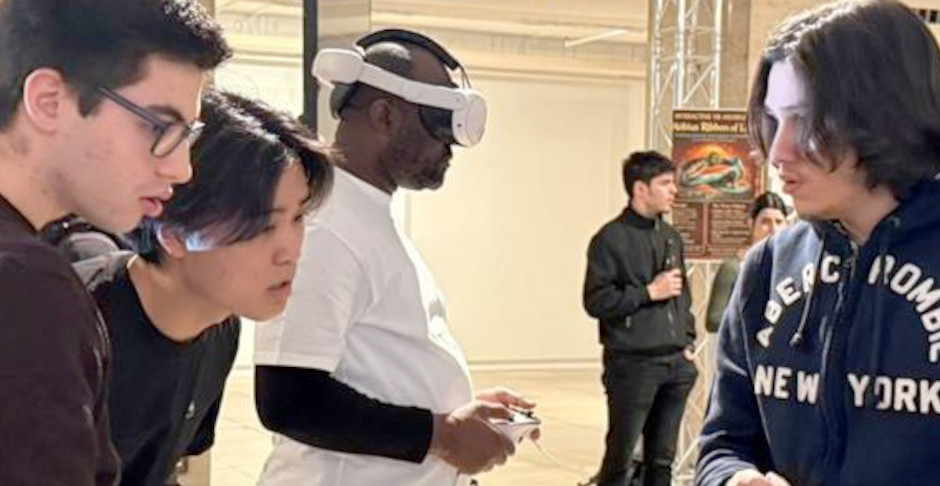
The Department of Art Education at the University of Education, Winneba (UEW), and the Technical University of Munich (TUM) have launched an innovative international collaboration that brings together cultural heritage, contemporary art, Indigenous Knowledge Systems, virtual architecture, and immersive technologies. Enabled by the Exploring Visual Cultures (EVC) Network, the project provides a platform for intercultural dialogue, collaborative learning, and innovative experimentation through Virtual Reality (VR).
The collaboration is part of Interactive Visualisation, a 6 ECTS elective seminar offered in the Winter Semester 2026/2027 at TUM. The seminar analyses the intersection of architecture, Extended Reality (XR), and digital culture, posing fundamental questions about the nature of virtual architecture and the role of architectural thinking in forming immersive digital environments. Through research and prototype development, students investigate how XR can serve as a medium for spatial experience, representation, collaboration, and learning. The course is taught by Michelle Walter. Technical and infrastructural support is provided by XR-HUB Bavaria, under the leadership of Silke Schmidt. Students enrolled in the seminar come from a range of disciplines, including Architecture, Informatics, and the Built Environment, as well as from international partner institutions, creating a multidisciplinary context for experimentation and innovation.
For the Winter Semester 2026/2027, the seminar focuses on designing and developing a digital exhibition space centred on lifelong learning. Inspired by the Akan Adinkra symbol Nea Onnim No Sua A, Ohu ("One who does not know can know through learning"), the project embraces curiosity, openness, and the search for knowledge as guiding principles. Using 3D-scanned cultural heritage objects from Ghana, students are challenged to consider how virtual architecture can curate, contextualise, and stage objects as catalysts for discovery, reflection, and understanding. The project asks: How can a virtual environment become a route to learning? How might immersive digital spaces transform the museum experience into a platform for lifelong learning?
At the University of Education, Winneba, Level 300 students created the contemporary artworks featured in the collaboration in the 2025/2026 academic year as part of the Independent Studies in Drawing course in Ebenezer Kow Abraham’s class. The Ghanaian component of the project, including the selection of cultural heritage objects, the thematic framework, and the pairing of heritage objects with contemporary artworks, is curated and academically led by Abraham.
The project brings together digitally scanned heritage objects from the National Museum of Ghana, the Nkyinkyim Museum, and other cultural heritage collections, alongside contemporary works by UEW students. Each student group at TUM is paired with a UEW student and tasked with transforming one heritage object and one contemporary artwork into an immersive VR experience. Together, these pairings explore how indigenous knowledge, memory, spirituality, identity, community, and the environment continue to shape contemporary life.
For more information about Ananse, follow the link. For more information about Beneath the Hide, follow the link.
Learning Through Stories
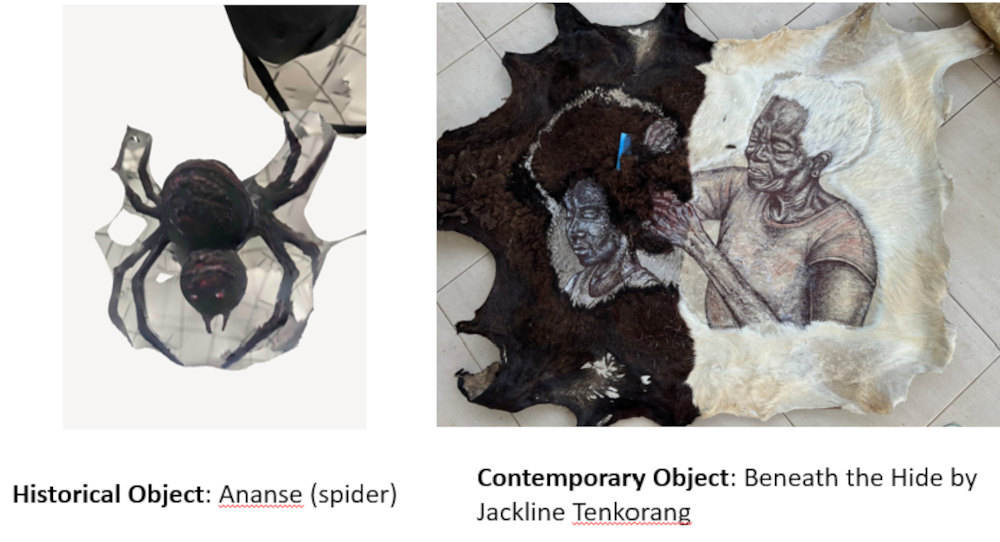
The first thematic space examines how stories, symbols, and visual narratives convey cultural knowledge across generations. A scanned image of Ananse, the iconic spider and central figure in Ghanaian folklore, is paired with Jackline Tenkorang Adjei's Beneath the Hide.
While Ananse stories have long served as vehicles for wisdom, moral instruction, and cultural memory, Beneath the Hide reflects on identity, ancestral inheritance, and self-discovery by revealing hidden surfaces within animal hide. Together, the works explore how stories shape human understanding, demonstrating that knowledge is transmitted not only through oral traditions but also through personal memory, material processes, and cultural reflection.
Learning Through Becoming
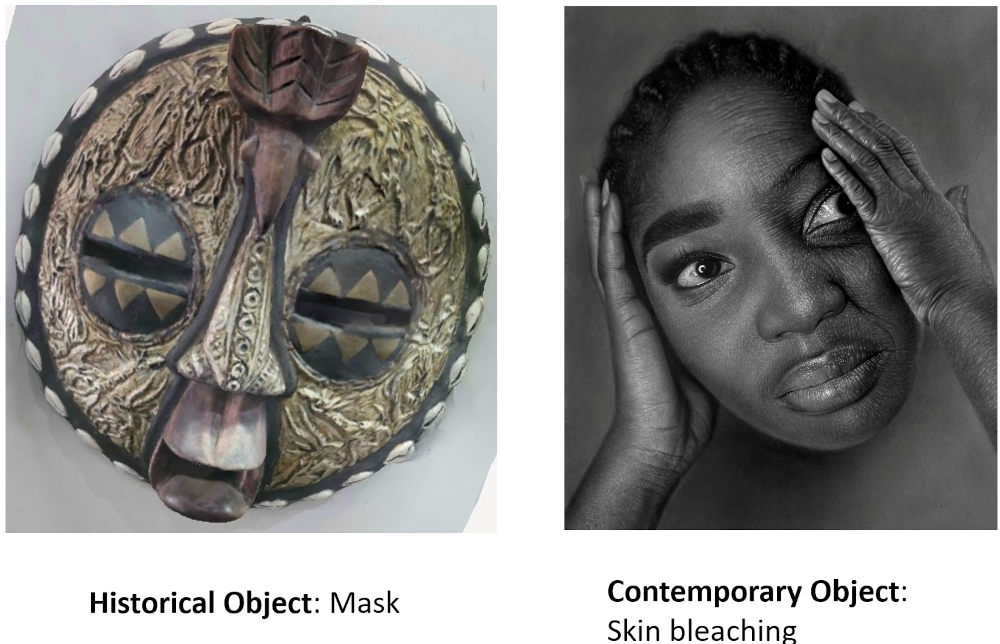
The second thematic space explores identity as a process of transformation, self-discovery, and becoming. This theme pairs a traditional Ancestral Mask with Stanley Adoma's Melanin Suppressed.
In many Ghanaian traditions, masks are not merely decorative objects. Through ritual performance, they enable transformation, allowing the wearer to assume new identities, embody spiritual presences, and participate in communal acts of meaning-making. The mask teaches that identity is not fixed but shaped through culture, belief, and social experience.
Adoma's Melanin Suppressed examines a contemporary dimension of becoming. Drawing on personal experiences and the influence of Eurocentric beauty standards, the work reflects on the pressures that encourage people to alter their natural appearance in pursuit of socially constructed ideals. Through detailed charcoal portraits, the artist advocates for self-acceptance, cultural pride, and the affirmation of African beauty.
Together, the ancestral mask and Melanin Suppressed explore how identities are performed, negotiated, concealed, and reclaimed. While the mask reveals transformation through ritual and cultural performance, Adoma's work challenges contemporary pressures that shape perceptions of self-worth and beauty. The pairing invites viewers to reflect on the forces that influence who they become and how individuals learn to embrace their identities within changing cultural and social contexts.
Learning Through Ancestors
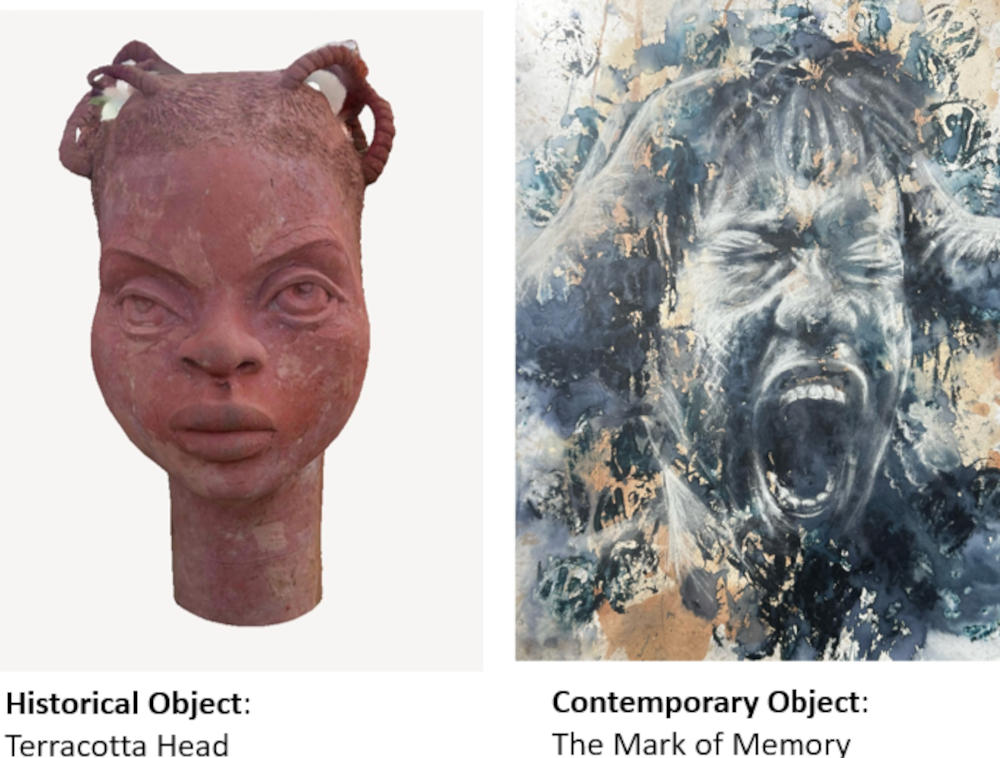
The third thematic space focuses on memory, remembrance, and ancestral knowledge. A Terracotta Funerary Head from the Nkyinkyim Museum is paired with Esther Obenewaa Ansah’s The Mark of Memory.
Historically, terracotta funerary heads served as symbolic stand-ins for the deceased during funeral ceremonies, preserving their presence within communal acts of remembrance. Ansah's work explores the enduring legacies of slavery and colonialism through stained surfaces, branding marks, and Adinkra symbols that speak to trauma, resilience, memory, and cultural survival.
Together, the two works reveal that memory operates as a form of knowledge. Whether through funerary traditions or artistic acts of remembrance, both works preserve connections between past and present, demonstrating how communities learn from those who came before them.
Learning Through Spirituality
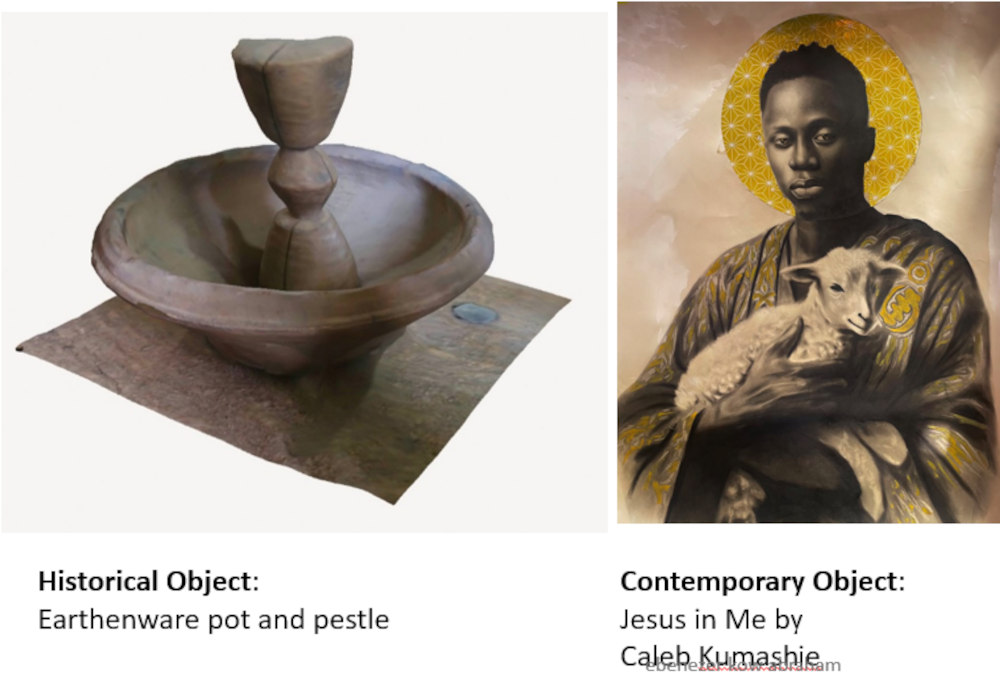
The fourth theme examines how material objects and visual images facilitate encounters with the sacred. A traditional Earthenware Pot and Pestle, historically used in everyday life and ancestral rituals, is paired with a contemporary work by Caleb Kumashie that reimagines Christian iconography through an African lens.
The earthenware vessel functions not merely as a domestic object but as a medium for maintaining relationships between the living and ancestral worlds. Kumashie's work likewise addresses spiritual understanding through visual representation, questioning inherited depictions of divinity and foregrounding African perspectives within Christian imagery.
Together, the works demonstrate how communities learn through spiritual practice and belief. They reveal how objects and images become vessels for communicating, experiencing, and renewing sacred knowledge.
Learning Through the Environment
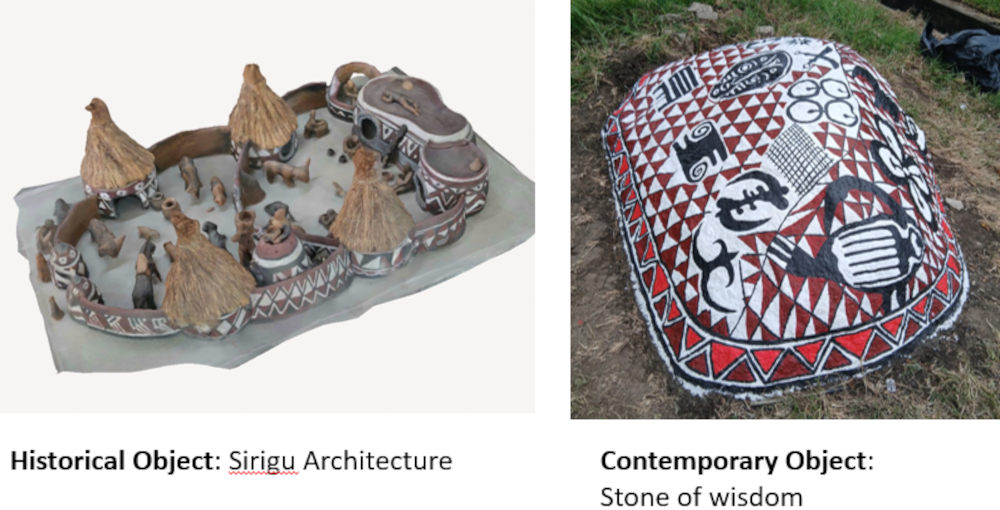
The final thematic space focuses on the environment as a source of cultural knowledge. This section pairs Sirigu Household Architecture and Wall Paintings with a contemporary environmental artwork by Victor Kolog.
Sirigu's traditional architecture is renowned for its mural traditions, geometric forms, and symbolic imagery, created primarily by women and passed down through generations. The compounds embody indigenous knowledge of community, environment, place, and cultural continuity.
Kolog's work extends this tradition into a contemporary context. Drawing on Adinkra symbols, Sirigu-inspired geometric patterns, and a carefully selected colour palette, the artwork transforms a natural rock surface into a site of cultural expression. The work celebrates Ghanaian heritage, identity, unity, and interconnectedness, and demonstrates how indigenous artistic knowledge can be preserved and reimagined in contemporary forms.
Together, the two works demonstrate that knowledge resides not only in objects but also in the environments people create and inhabit. They reveal how landscapes, architecture, and artistic interventions can serve as living repositories of cultural memory and community wisdom.
International Collaboration Through Virtual Reality
A defining feature of this project is the collaboration between students in Ghana and Germany. While UEW students contribute cultural knowledge, historical context, and artistic perspectives, TUM students explore innovative methods to translate these ideas into immersive virtual environments. Through workshops, discussions, consultation sessions, and collaborative design processes, participants engage in reciprocal learning that reflects the philosophy of Nea Onnim No Sua A, Ohu.
The project demonstrates how cultural heritage can move beyond preservation to serve as an active educational resource. By placing historical artefacts from Ghana's museums in dialogue with contemporary artworks by a new generation of Ghanaian artists, the collaboration creates opportunities to explore questions of identity, memory, spirituality, community, and the environment through digital technologies.
Supported by the Exploring Visual Cultures (EVC) Network, the initiative highlights the value of international partnerships in advancing innovative approaches to art education, heritage interpretation, virtual architecture, and intercultural understanding. As visitors move through the resulting VR environments, they encounter cultural heritage not as a collection of static artefacts but as living sources of knowledge that continue to shape contemporary artistic practice and inspire new ways of learning across cultures and generations.
25th September 2026