
EVERYDAY MATERIAL CULTURE AND THE MAKING OF MEANING
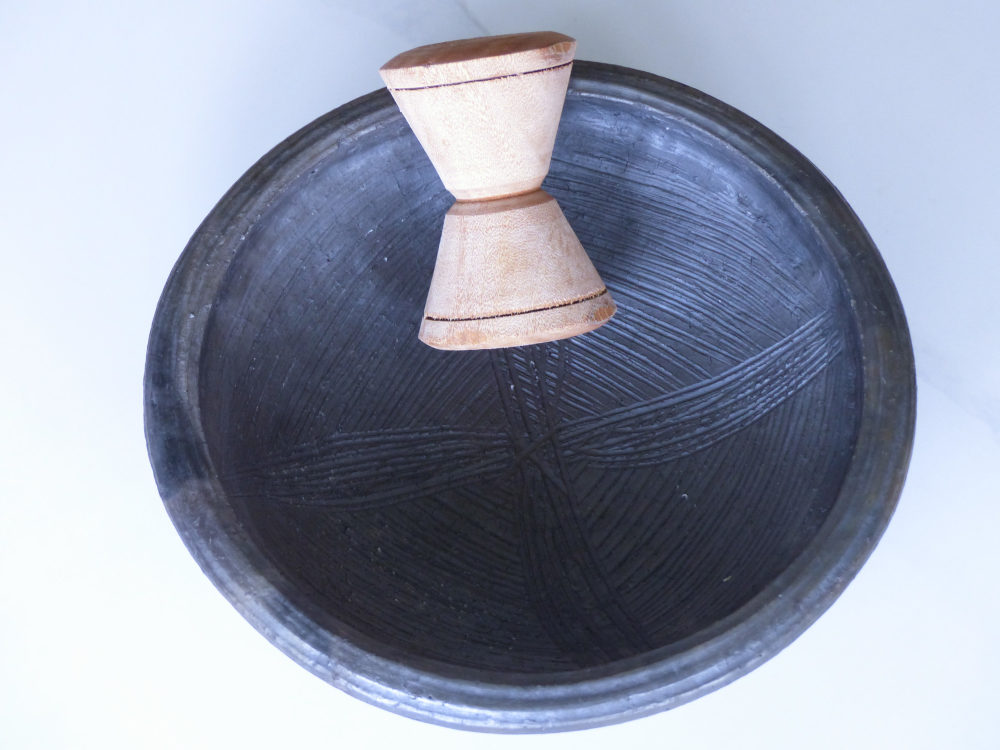
Figure 1: Unknown Artist, Asanka ne Eta. Photo: aftradvillagekitchen.co.uk
INTRODUCTION
The Ghanaian Akan Asanka ne Eta is an earthenware pot and pestle that connects everyday food preparation, rooted in practical skills and inherited knowledge, to spirituality. In this essay, I examine how the Asanka ne Eta acquires multiple meanings through everyday use, inherited knowledge, cultural memory, and, in some contexts, spiritual practice. Rather than treating these traditional objects, asanka ne eta, as inherently spiritual, this essay explores how context and use shape their meaning. Labi (2009) shows how Akan art conveys beliefs, philosophies, and history; Kusimi et al. (2020) examine how resources, skills, and cultural practices transmit knowledge through Mpraeso pottery. Both emphasise context and warn against unsupported claims about cultural meaning. This discussion examines Asanka ne Eta’s material qualities, uses, cultural meaning, and role in spiritual learning. It links these to material practice, inherited knowledge, and spiritual meaning, distinguishes observable features from documented interpretations, and avoids assumptions about sacredness.
I selected the Asanka ne Eta because it occupies a familiar place in Ghanaian domestic life while also raising questions about how ordinary objects become carriers of knowledge. As a Ghanaian Art Educator, I reckon that personal familiarity can encourage assumptions. I therefore combine lived cultural knowledge with scholarly sources and aim to contrast observation with interpretation.
DESCRIPTION AND PHILOSOPHICAL FOUNDATIONS
The Asanka and eta as a material pair
The Asanka (Earthenware pot) is a broad, shallow, grooved bowl for crushing and mashing ingredients with a wooden ‘eta’ (pestle); it can also serve food (Nunoo, 2019). Although some sources call the pestle ‘tapoli’, this article uses ‘eta’, as specified for the reference object (Cooke, 2023; Akan Dictionary, 2024). The pot holds ingredients and provides a work surface, while the ‘eta’ applies force and guides movement. The user controls pressure, pace, and texture through the interaction of design, materials, and skill. Asanka may be rough and hand-formed or smoothed by scraping, rubbing, or burnishing. Interior ridges create a textured work surface. Firing conditions and iron content produce colours from reddish-brown or orange to grey or nearly black; food, oil, and heat may darken the bowl. Unless makers or users specify otherwise, these variations reflect firing and use, not decoration or symbolism.
Shallow grooves on the interior increase friction during grinding and guide ingredients between the bowl and eta, creating distinctive wear patterns. Their depth, spacing, and direction may indicate the object’s intended use and the maker’s techniques. Repeated use smooths the grooves, polishes the rim or base, and leaves residue in recessed areas. The eta’s working end may become rounded or darkened, while its handle may conform to the user’s grip. Together, these traces reflect the interaction of hand, tool, and bowl, including posture, pressure, and rhythm. However, wear on the object indicates its handling history.
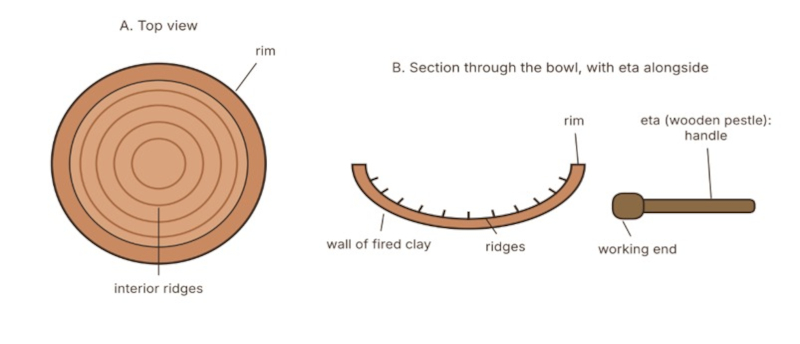
Figure 2: Schematic of an Asanka ne Eta: (A) top view and (B) section through the bowl, with the eta alongside. Author’s illustration, not to scale; the number, spacing, and pattern of ridges vary between bowls
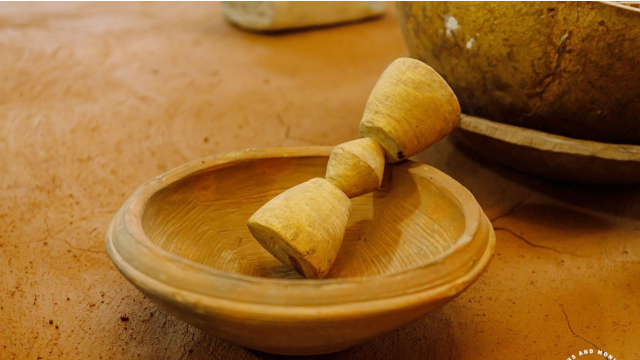
Figure 3: Unknown Artist, Asanka ne Eta. Photo: National Museum of Ghana
Materiality and the visible–intangible relationship
Labi (2009) argues that tangible Akan art can convey intangible cultural knowledge, including values, beliefs, proverbs, history, and worldviews. An Asanka’s form may carry culturally understood meanings, but utilitarian objects do not necessarily have fixed symbolism; interpretation requires evidence from their production, use, and related practices. Miller’s (2005) edited volume challenges the divide between objects and social life, while Morgan (2021) examines how material forms shape religious experience and practice. Neither, however, establishes a sacred purpose for any Asanka or eta.Turning clay into a bowl connects natural resources with human knowledge. Selecting, preparing, shaping, drying, and firing clay require practical judgment and craft expertise. Kusimi et al. (2020) document pottery materials, processes, and cultural and economic dimensions in Mpraeso, showing that production depends on skill, labour, and local knowledge, not shaping alone.
CULTURAL MEANING
‘Asanka ne eta’ are everyday cooking tools used skillfully, with users gaining ingredient knowledge through observation, demonstration, correction, and practice. The pot may represent nourishment, hospitality, and collective food practices in contexts where users and communities recognise and articulate these meanings. Its meaning varies by household and context; it is not a universal symbol of Akan life, but gains significance through use, preservation, explanation, and memory.
Pot-making likewise shapes pottery’s cultural meaning. In Mpraeso, materials, techniques, symbolism, taboos, and economics influence production (Kusimi et al., 2020). Each pot reflects makers’ knowledge and labour, users’ practices, and the social conditions forming its materials, form, and creation. Ghanaian pottery includes funerary and ritual objects, while Akan material culture connects physical forms to religious and ancestral practices (Labi, 2009). If the reference pot is linked to ancestral ritual, questions remain about its role, who interprets it, and the evidence that supports it.
Learning Through Spirituality prompts me to examine how objects connect to less visible spiritual knowledge. In Akan society, spirituality is expressed through teachings, texts, beliefs, objects, places, bodily practices, and rituals. An object’s significance may arise from relationships, experiences, and beliefs: does it possess spiritual meaning, or do people create meaning through understanding and use? Morgan's (2021) study explores lived religion through objects and practices rather than belief alone. Asanka ne Eeused in ancestral rituals gain meaning through their materials, use, and relationships. This challenges the divide between material and spiritual life: objects help people experience, remember, and communicate spirituality, linking the living with ancestors. However, physical presence itself does not establish spiritual significance. Morgan's theory highlights the importance of material objects in religious studies.
Miller's (2005) edited volume ‘Materiality’ examines how things shape social life, challenging divisions between objects and the values, ideas, and relationships through which people understand the world. It encourages me to see earthenware pots and pestles as more than tools. This perspective reshapes how I interpret spiritual traditions. Assuming traditional objects have mysterious, ancient, or universal meanings may obscure the diversity of experiences. Spiritual meanings may emerge from history, circumstances, relationships, and personal understanding. Responsible interpretation remains open to community opinions and differing explanations.
ASANKA NE ETA IN ANCESTRAL WORSHIP AND TRADITIONAL GHANAIAN RELIGION
In Akan ancestral religion, ancestors (asamanfo) watch over the living and protect their lineage (Gilbert, 1987). The living communicates with them through libations at important events and Adae festivals. Centred on the stool house, where ancestral spirits are believed to rest, these festivals involve invocation, propitiation, and veneration. Clay pots may also temporarily house deities in water. An Asanka ne Eta’s spiritual significance comes from its use, not the vessel. During ceremonies, meaning depends on who prepares the food and their knowledge; whether it is for the living, ancestors, or both; the words and gestures; whether food is eaten, offered, or poured out; and who is authorised to participate. A bowl used daily to grind pepper may connect the living with ancestors in a ceremony, then return to everyday use. Sacredness arises from action, intention, and community recognition, not the clay itself.
TRANSCULTURAL PERSPECTIVES
The Asanka ne Eta illustrates how an object’s meaning changes across cultural contexts. Although it remains a food-preparation utensil in Ghanaian households, it also carries cultural memory beyond Ghana. Cooke (2023), for example, recounts how the author's mother brought an Asanka to New York in 1988, which sustained family traditions. For diaspora communities, it may therefore signify cultural continuity, while other audiences may encounter it as material heritage or design.
Its uses have also expanded. As domestic reliance on traditional pottery declines, Nunoo (2021) explores the Asanka bowl as an artistic medium, including wall murals and fountains. These settings shift attention from practical function to artistic interpretation and heritage. They also raise questions of representation: whose knowledge shapes the object’s meaning when it moves from household use to markets, museums or digital exhibitions? A decolonial perspective calls for interpretations that respect the knowledge of originating communities rather than valuing the object only when reframed as art or heritage. The Asanka ne Eta thus demonstrates how meaning is negotiated across users, places and audiences, rather than remaining fixed.
CHANGING MEANINGS
The Asanka ne Eta traditionally served as a kitchen tool for grinding peppers, tomatoes, and spices, and for eating and sharing food (Cooke, 2023; Nunoo, 2019). Its practical and social roles reflected household food traditions. Women made these vessels for domestic, utilitarian, and sometimes ritual use (Nortey, 2022), drawing on knowledge of materials, techniques, and taboos (Kusimi et al., 2020). Colonial institutions favoured industrial and wheel-based ceramics. After independence in 1957, African traditions gained recognition as resources for national consciousness (Akoto, 2014), marked by the National Museum of Ghana’s opening on 5 March. Yet indigenous pottery received little institutional or economic support: investment favoured industrial and academic ceramics, the Saltpond factory was not sustained, and women potters remained undervalued (Nortey, 2022). This disparity persisted after independence.
Blenders and plastic bowls have displaced some traditional pottery uses (Nunoo, 2021; Nortey & Asiamoaso, 2019), while artistic adaptation, diaspora identity, commercial display, and virtual exhibitions have expanded the Asanka ne Eta’s role (Cooke, 2023; Abraham, 2026). This history is not simply one of decline and recovery: domestic use has contracted as symbolic, commercial, diasporic, and exhibition meanings have grown. Authority over value has shifted from households and colonial institutions to the nation-state, market, and museum. Evidence is strongest for domestic use and contemporary adaptations; colonial and post-independence developments require more object-specific archival and oral-history research.
CONTEMPORARY RELEVANCE
Asanka ne Eta shows inherited skills responding to new technologies. In ‘Diversifying the Usages of Asanka Bowls’, Nunoo explains that blenders and plastic bowls have replaced some pottery uses and examines new artistic applications to sustain interest (Nunoo, 2019). Continuity retains familiar use while exploring new ones without erasing an object’s history or recognisable qualities. These objects also foster learning. Studying their materials, form, production, use, and embodied cultural knowledge, beliefs, and values highlights craftsmanship and prompts questions about how knowledge is learned, interpreted, and evidenced. It also enables discussion of spirituality without claiming an unverified sacred function.
In visual culture education, the Asanka can explore indigenous technologies, material knowledge, sustainability, intangible heritage, food culture, and the relationship between objects and identity. It encourages students to question how knowledge is embedded within everyday objects and how cultural meanings are interpreted. Asanka’s relevance depends on whether it stays a utensil or becomes art. It also requires sustaining pottery production, makers' livelihoods and skills, and knowledge embedded in use. Preservation must recognise the human practices that give objects meaning, while recognising evolving traditions and varied interpretations.
In many Ghanaian homes today, even with a blender for grinding, people still use the Asanka ne Eta. Some believe the texture and ‘vibe’ it gives can never be replaced, so for certain foods, they choose the Asanka over the blender. The continued use and study of the Asanka contribute to the broader discussion of valuing indigenous knowledge systems. Within decolonial scholarship, such objects are reminders that technological knowledge, aesthetic judgement, and systems of learning existed long before colonial educational structures.
CONCLUSION: LEARNING THROUGH SPIRITUALITY
The ‘Asanka ne Eta’ shows how objects shape practical knowledge, cultural tradition, and spiritual life through the ways people make, use, remember, and interpret them. Studies of Ghanaian pottery and Akan material culture connect objects with knowledge and practice. Research in Mpraeso examines pottery-making and cultural transmission; Labi links tangible forms with intangible heritage, while Nunoo explores adaptation and continuity.
Spiritual learning asks how meanings form, are experienced and shared, and change—not simply which objects are sacred. Rigorous interpretation weighs evidence, listens to knowledge holders, and distinguishes fact from inference. The (Asanka ne Eta) raise questions about material life, cultural knowledge, and spirituality, while highlighting how much remains to learn. The Asanka ne Eta shows how visual culture operates through the interaction of material form, social practice, spirituality, cultural memory and historical change. Its continued reinterpretation across educational, domestic, shrines, artistic, and diasporic contexts illustrates how meanings are negotiated rather than fixed.
REFERENCES
- Akan Dictionary. (2024, August 15). Asanka. https://www.akandictionary.com/2024/08/
- Cooke, C. (2023, March 16). Asanka. https://yourstory.tenement.org/stories/asanka-1988
- Kusimi, B. A., Donkor, A. K., Ayivor, J. S., Kyeremeh, K., & Kusimi, J. M. (2020). The lifecycle of pottery art processes and production in Mpraeso, Ghana. De Arte, 55(3), 70–94. https://doi.org/10.1080/00043389.2020.1805849
- Labi, K. A. (2009). Reading the intangible heritage in tangible Akan art. International Journal of Intangible Heritage, 4, 41–57. https://www.ijih.org/volumes/article/46
- Miller, D. (Ed.). (2005). Materiality. Duke University Press. https://doi.org/10.1215/9780822386711
- Morgan, D. (2021). The thing about religion: An introduction to the material study of religions. University of North Carolina Press.
- Nunoo, A. (2019). Diversifying the usages of Asanka bowls [Master’s thesis, Kwame Nkrumah
- University of Science and Technology]. https://ir.knust.edu.gh/handle/123456789/