
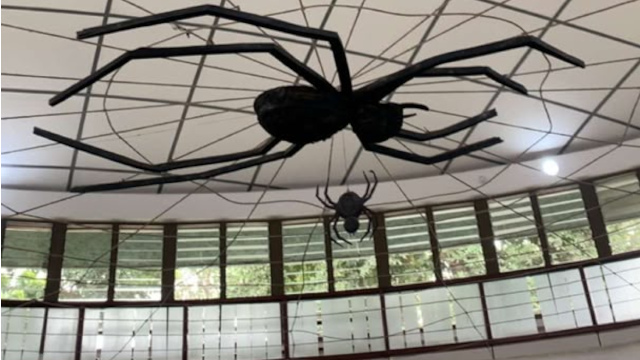
A physical form to a character that has traditionally been passed on through spoken stories
The Ananse sculpture introduces one of the best-known figures in Akan storytelling. Ananse is not simply a character used to entertain children. Through Anansesɛm, or Ananse stories, knowledge, values, beliefs, and ideas about everyday life have been shared across generations. Many Ananse stories place the character in difficult situations where he has to make a decision or find a solution. Sometimes his cleverness helps him to succeed. At other times, his greed, dishonesty, impatience, or pride causes him to fail. These different situations give listeners the opportunity to think about what happened and why it happened.
Storytelling therefore serves as a way of learning. Rather than simply giving listeners’ rules to follow, Ananse stories allow them to observe characters, consider their choices, and think about the consequences. Recent research on Akan folklore argues that stories and proverbs can contribute to education by connecting learning with Ghanaian cultural values and Indigenous ways of knowing (Amponsah, 2023).
The Ananse sculpture gives a physical form to a character that has traditionally been passed on through spoken stories and performances. It can therefore be understood alongside the stories, values, and knowledge associated with Ananse in Akan culture.
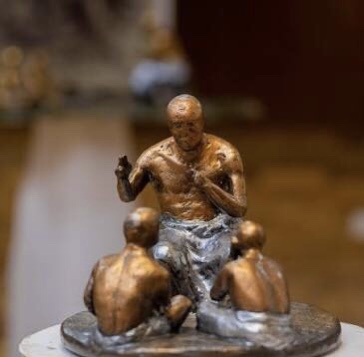
Ivan Howard & Ekow Tandoh, composition of Ananse storytelling, UEW. Photo credit: UEW media team, 2026
Describe and Philosophical Foundation
Ananse, the spider, is a central figure in Akan folklore. The term Anansesɛm is commonly translated as “Ananse stories” or “spider stories”. These stories form part of the wider oral tradition through which cultural knowledge and values have been passed from one generation to another. Ananse is usually portrayed as a clever but complicated character. He can be creative, resourceful, and quick-thinking, but he can also be greedy, selfish, dishonest, or impatient. His character is therefore not that of a perfect hero.
This makes Ananse particularly useful for teaching and reflection. Listeners can admire his intelligence while also questioning the way he uses it. They can look at both his successes and his mistakes and decide what they think about his actions. A recent study by Ben-Daniels (2024) describes Ananse as an important figure in Ghanaian folklore whose stories continue to have cultural relevance. The study highlights the connection between Ananse, cultural identity, values, and the preservation of historical knowledge.
Concrete Narrative Example: How Wisdom Was Spread Across the World
A well-known story within Anansesɛm shows the value of wisdom and the problems that can come from trying to keep knowledge to oneself. In this story, Ananse collected all the wisdom (nyansa) in the world and put it inside a hollow calabash because he wanted to keep it all for himself. To keep his treasure away from others, he decided to tie the calabash around his neck and hide it at the top of a tall palm tree. However, because the large calabash was hanging in front of him, Ananse found it difficult to climb the tree. He could not hold on to the trunk properly. His young son, Ntikuma, stood at the bottom of the tree and watched his father struggle. Eventually, Ntikuma called out:
“Father, would it not be easier to climb if you strapped the calabash to your back instead of your front?”
Ananse stopped and realised that his son had given him a simple but useful idea. He became frustrated because, despite having all the wisdom in the world, he had failed to think of something that a young child had noticed. Angry and disappointed, Ananse dropped the calabash. It broke on the ground, and the wisdom inside it scattered in all directions so that everyone could have a share of it. The story teaches that wisdom cannot belong to one person alone. No one can know everything, and people can learn from one another. Knowledge grows when it is shared, discussed, and passed from one person to another.
Cultural Significance and Social Praxis - The Mechanics of Anansegoro
Anansesɛm has traditionally been part of communal storytelling. Storytelling provided an opportunity for people to come together, listen, respond, and share knowledge. The storytelling experience was not simply about one person speaking while everyone else remained silent. The audience could participate through responses, songs, laughter, questions, and comments. This made storytelling and interactive social activity. Some features included:
- Call and response: The storyteller and listeners could respond to one another during the performance.
- Musical interludes: Songs could be used to maintain attention and strengthen the important parts of the story.
- Proverbs: Proverbs could be used to express ideas briefly and give listeners something to think about.
- Audience participation: Listeners were active participants in the storytelling process.
- Discussion and reflection: The story could lead people to discuss the behaviour of the characters and the lessons arising from the story.
Storytelling in Ghana has long been used to communicate cultural knowledge, values, language, and social expectations. Recent work by the National Commission on Culture also describes storytelling as a means of transmitting cultural knowledge, supporting moral development, and maintaining connections between generations. Amponsah (2023) similarly argues than Akan stories and proverbs can contribute to education because they carry moral values and ideas about relationships and community life.
Diaspora, Adaptability, and Cultural Survival
Ananse stories have travelled beyond West Africa. Through the force movement of Africans during the transatlantic slave trade, aspects of African oral traditions were carried to the Caribbean and the Americas. As Ananse stories travelled, the character appeared under different names and in different forms. In some Caribbean traditions, for example, the character became known as Anansi or Aunt Nancy. Although the stories changed according to their new social and cultural settings, the character continued to be associated with cleverness, survival, and the ability to overcome stronger opponents.
The spread of Ananse stories shows how oral traditions can adapt while retaining important connections to their cultural origins. It also demonstrates how storytelling can help communities maintain cultural memory across generations and geographical boundaries. The continued interest in Ananse in Ghana also shows that the character is not limited to stories from the past. In 2024, Ben-Daniels examined the continued relevance of Ananse in contemporary Ghanaian society, particularly in relation to cultural identity, values, and historical connections.
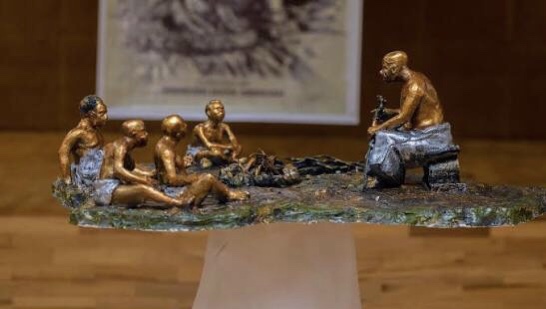
Ivan Howard & Ekow Tandoh, composition of Ananse storytelling, UEW. Photo credit: UEW media team, 2026
Epistemological Framework of Anansesɛm
Anansesɛm provides a useful way of thinking about how knowledge is acquired, understood, and shared. Within Akan thought, knowledge is not only about having information. Learning is also connected to experience, understanding, judgement, relationships, and the ability to apply what one knows.
|
CONCEPT |
PHILOSOPHICAL MEANING AND APPPLICATION |
|
Nimdeɛ (Knowledge) |
Knowledge gained through learning, experience, observation, and interaction with others. |
|
Nyansa (Wisdom) |
The ability to apply knowledge appropriately and make sensible decisions. |
|
Asɛm (Word/Statement) |
What is spoken or communicated; its meaning can depend on the situation and context. |
|
Nteaseɛ (Understanding) |
The ability to understand people, situations, and the meaning behind what is communicated. |
a. Experience over Abstract Knowledge: Nimdeɛ and Nyansa
The distinction between Nimdeɛ and Nyansa helps to explain the relationship between knowledge and wisdom. A person may know many things without always knowing how to use that knowledge well. Wisdom involves using what one knows to make good decisions and respond appropriately to situations. Ananse stories often show this difference. Ananse may be clever and knowledgeable, but his decisions are sometimes affected by greed, pride, or impatience. His mistakes therefore become part of the lesson.
This idea is important in education because learning is not only about remembering information. It also involves understanding how knowledge can be applied in real situations. Amponsah (2023) identifies stories, proverbs, moral codes, and other elements of Akan folklore as important resources for developing a more culturally grounded approach to education in Ghana.
b. Learning through the Flawed Hero
Ananse is not a perfect character. He makes mistakes, sometimes behaves selfishly, and often has to face the results of his decisions. At the same time, he is creative, observant, and able to find solutions to difficult problems. This combination makes him useful for learning because listeners can examine both his strengths and weaknesses. Instead of simply being told what is right or wrong, listeners can ask:
- What did Ananse do?
- Why did he make that choice?
- What happened because of his decision?
- Was there another way he could have handled the situation?
- What can we learn from his success or failure?
This encourages learners to think about actions, motives, consequences, and different possible choices.
Research on Ghanaian folklore also supports using culturally familiar stories as learning resources. Addo and Adu (2022), for example, found that folk resources can support culturally relevant teaching in Ghanaian creative arts education.
c. Embodied, Metaphor and Visual-Linguistic Learning
The Ananse sculpture connects a physical object with an oral tradition. A learner may first see the sculpture simply as a representation of a spider. However, knowledge of Ananse stories adds another level of meaning. The spider becomes associated with intelligence, creativity, problem-solving, mistakes, humour, and the consequences of human actions. This relationship between objects, stories, symbols, and knowledge is important in Indigenous learning. Knowledge can be communicated not only through written texts but also through spoken language, visual forms, performance, symbols, and everyday experience.
A recent study of an Akan folklore by Koga and Acheampong (2024) demonstrates the continuing importance of Ananse stories as a part of the Akan language and oral; tradition. Their study presents an Ananse folklore in Asante, together with its English translation, showing how such stories can also contribute to the documentation and study of Akan language and culture. The Akan proverb “Nea onnim no sua a, ohu” is commonly understood as expressing the idea that a person who does not know can learn. This idea connects closely with Anansesɛm. Learning can happen through listening, observing, asking questions, making mistakes, and learning from others.
Conclusion: The Contemporary Relevance of Anansesɛm
The Ananse sculpture at the National Museum of Ghana represents more than the image of a spider. It provides an opportunity to explore a wider tradition of storytelling, knowledge, values, and learning. Anansesɛm has been used across generations to explore human behaviour and relationships. The stories can address honesty, patience, responsibility, cooperation, intelligence, greed, and the consequences of one’s actions. At the same time, they allow listeners to question the characters and discuss different ways of understanding the story.
The educational value of Anansesɛm remains relevant today. Recent research argues that Ghanaian Indigenous knowledge can contribute to education when it is meaningfully connected to teaching and learning. Amponsah (2023) specifically identifies Akan folklore as a source of educational ideas, while more recent research continues to examine ways of integrating Indigenous knowledge into Ghanaian education. The Ananse tradition also shows that learning does not happen only through formal instruction. People can learn through stories, conversations, observation, experience, art, language, and community life. The story of the calabash of wisdom makes this idea clear: knowledge should not be kept by one person; it becomes more meaningful when shared.
Core Educational Outcomes of Anansesɛm
- Critical Thinking and Scepticism: Ananse’s plans often fail because of his pride or greed. His stories encourage listeners to question ideas, think carefully, and avoid trusting everything without thinking about it.
- Pedagogy of the Flawed Hero: Unlike idealised folklore heroes, Ananse is clearly flawed, he can be selfish, impatient, and arrogant. Learners can gain knowledge by examining his mistakes as well as his successes.
- Problem-Solving and Adaptability: Ananse shows how people can use what they have in creative ways to solve problems and adapt to difficult situations (bɔ mmodden).
- Social Responsibility and Ethics: Ananse stories often explain natural phenomena or social rules, such as why the spider lives in corners. These stories can teach learners to think about the balance between personal desires and responsibility to others.
REFERENCES
- Addo, A. O., & Adu, J. (2022). Examining the use of folk resources for creative arts education in Ghana’s basic schools. International Journal of Education & the Arts, 23(4). https://doi.org/10.26209/ijea23n4
- Amponsah, S. (2023). Akan folklore as a philosophical framework for education in Ghana. International Review of Education, 69(1-2), 125-142. https://doi.org/10.1007/s11159-023-09993-x
- Ben-Daniels, F. (2024). Reclaiming Ananse: Discussing the trickster’s relevance in contemporary Ghanaian society. Nairobi Journal of Humanities and Social Sciences. https://doi.org/10.58256/at 1pe365
- Koga, K., & Acheampong, D. (2024). A folklore in Akan: The reason why Ananse lives on the ceiling. Asian and African Languages and Linguistics, 18.
- Naah, A. M., & Osei-Himah, V. (2024). Perspectives of pre-service teachers on Indigenous Knowledge practices and their integration into the teaching and learning of science. European Journal of Education and Pedagogy, 5(4). https://doi.org/10.24018/ejedu.2024.5.4.834
- National Commission on Culture. (2026). Storytelling, Indigenous Knowledge Systems, and cultural transmission. National Commission on Culture.