The Collective Memory Exhibition aims to highlight the role of visual culture in recording narratives shared by social communities. Its significance resides mainly in the effort to bring together artworks from five different countries, each presenting visual self-concepts shaped by collective memory. The communities of people are represented here by young people of different nationalities who study art or art education at university or are recent graduates from universities (young professionals). Hence it can be assumed that they share a cultural identity as members of a social group defined, for example, by nation, generation, milieu and occupation (art students). Such groups are characterised by historical narratives constituted by shared memories of events, otherwise known as collective memories (Heersmink, 2021). Those events are not necessarily directly experienced by the group members who interpret them through collective memory.
It was the French sociologist Maurice Halbwachs who first investigated the role of collective memories in his books published in 1925 (Les cadres sociaux de la mémoire) and in 1950 (La mémoire collective). He claims that every person has not only her/his own memories, but also shares group memories. As Grundlingh & Huigen (2011, p. 2) explain: “The environment in which one grew up and in which one lives forms a framework which determines the shape and content of memories and helps to codetermine identities. Groups can even produce memories in individuals which they never ‘experienced’ in a direct sense.”
According to Halbwachs, the identities and memories of individuals are formed by social groupings. Furthermore, it is in the nature of collective memories to change as time passes by. What is remembered depends on the interests and pre-occupations of the present (Grundlingh & Huigen, 2011, p. 2). Cultural identity is multi-faceted because individuals form part of various social groups based on nationality, geographical location, gender, race, class, political orientation, religion, profession, hobbies, generation, family, etc (Heersmink, 2021).
Belonging to the field of cultural history, the study of collective memory has become enormously popular during the last decades, even though it has been plagued by methodological problems and conceptual shortcomings. For the purposes of this essay, we prefer to quote Wulf Kansteiner (2002, p. 180) who describes the conceptualisation of collective memory “as the result of the interaction among three types of historical factors: the intellectual and cultural traditions that frame all our representations of the past, the memory makers who selectively adopt and manipulate these traditions, and the memory consumers who use, ignore, or transform such artifacts according to their own interests.”
Clearly the cultural traditions of the past play an important role in the process of collective memory construction. These cultural traditions may also be referred to as cultural memory which consists of “objectified culture, that is, the texts, rites, images, buildings, and monuments which are designed to recall fateful events in the history of the collective” (Kansteiner, 2002, p. 182). What precisely was recorded and preserved of those cultural traditions was decided by what he calls the “memory makers” – distinct from individuals who are relatively powerless in the process of collective memory formation (Kansteiner, 2010, p. 3). The “memory makers” are the agents – social, political, institutional, etc – responsible for writing/narrating/visualising the events and for sharing communications about the meaning of the past (Kansteiner, 2002, p. 188).
When looking at the individual artworks in the exhibition, it becomes clear that the artists express in the first place their personal memories, but these have already been shaped by social and political forces and events surrounding them. Depending on the social group with which the artist identifies most intimately, the artworks will reflect the collective memories of that particular group – be it her/his family, gender, generation, ethnic group, church, nation, etc. The events or narratives that characterise the particular group form the subject matter of the artwork which the artist can manipulate to present a new interpretation. For example, artists who feel strongly about their cultural legacy can engage with ritual objects, oral tradition, customs and indigenous knowledge of the past to enforce their allegiance to that group/nation/continent.
What is remembered from the past is determined by interests of the present. For example, incidences that took place a long time ago and are remembered by means of monuments can be re-imagined and subverted in an effort to bring along transformation. Art becomes a means to deal with trauma and envisage a better future. Art can also be used to express feelings of exclusion from a dominant cultural group. Considering themselves as ‘others’ by birth and upbringing, artists wrestling with a sense of not belonging can use their art to shift the parameters of identity. In this way, artists of the present can in turn become ‘memory makers’ while the viewers of the exhibition are the ‘memory consumers’ who can choose to use, ignore or re-interpret the artworks according to their own interests.
Conclusion
Our analysis of the works selected for this essay demonstrates that the artists draw on memories from a variety of collectives that transcend the boundaries of conventional social groupings (see section A). Apart from the formal groups, we identified groupings focused on the spiritual as well as unconscious or hidden collectives, the relation to which is a kind of implicit belonging. These distinctions refine the general understanding of the ‘collective’ in collective memory.
It has also been shown that a broad range of different kinds of ‘memory’ (from a single event, a historical fact and an interpreted experience to general narratives – see section B) shapes the works. Coming back to Kansteiner’s theory, this means that we have to differentiate his concept, especially when it comes to artworks that are understood as agents in the perception and creation (consuming and making – see section C) of collective memory. What we can deduce from the section on artistic strategies is that the transition between simple representation or expression on the one hand and active creation on the other is fluent and flexible. We can even find examples that use more than one strategy simultaneously.
This means that we have to understand the artists as “memory makers” (Kansteiner, 2002). They are presenting their interpretations, their positions. The viewers then become the “memory consumers” who can identify with, subvert or reject the positions proposed in the artists’ works. Their decision how to posit themselves in relation to the artworks depends on their own memories of the subject depicted. The artworks, as artefacts of cultural tradition and as carriers of meaning, serve as conduits to trigger and to sharpen collective memories within the viewer.
References
- Grundlingh, A. M. & Huigen, S. (Eds). (2011). Reshaping remembrance: Critical essays on Afrikaans places of memory. Amsterdam: Rozenburg Publishers.
- Heersmink, R. (2021). Materialised Identities: Cultural Identity, Collective Memory, and Artifacts. Review of Philosophy and Psychology (2021). Retrieved April 27, 2022, from https://doi.org/10.1007/s13164-021-00570-5
- Kansteiner, W. (2002). Finding meaning in memory: a methodological critique of collective memory studies. History and Theory 41 (May), 179-197.
- Kansteiner, W. (2010). Memory, media and Menschen: Where is the individual in collective memory studies? Editorial. Memory Studies 3(1): 3–4.
- Tajfel, H. (Ed.). (1978). Differentiation between social groups: Studies in the social psychology of intergroup relations. London: Academic Press.
- Tajfel, H., Fraser, C. & Jaspars, J. M. F. (1984). The social dimension. European studies in social psychology, vol 1. Cambridge: Cambridge University Press.
- Watzlawick, P. (ed.) (1981). Die erfundene Wirklichkeit. Beiträge zum Konstruktivismus, München: Piper. [English translation: The Invented Reality: How Do We Know What We Believe We Know? (Contributions to Constructivism), 1984]

Placement of the works selected for the memory section, mapping them against the category of art strategies
All examples we discussed above show that collective memory always has a very high interpretative component, is always constructed – of course in various gradations. We have to reflect on this observation in the context of philosophical epistemology which postulates that a recognised object is always constructed by the observer himself through the process of recognition (Watzlawik, 1981). In the case of collective memory, we must then speak of a social construction. As visitors of the virtual exhibition, we can only perceive the perspective of the artists exhibiting here. This makes this aspect of constructed-ness particularly clear once again.
This understanding draws our attention to the producers of the interpretations and narratives, to the artists. They created the works. But what are they actually doing in their art? What strategies do they choose when it comes to such a challenging subject as collective memory? What is their approach? This will be briefly discussed in the last section, using the same examples as before.

David Ochieng, Soko Adventures: David Ochieng locates his idea of collective memory in an African market, focusing on a specific event (a chase) that can be perceived by anybody, perhaps any time. In dramatising the market event in digital animation, he concentrates entirely on the idea of expressing his understanding of everyday life in a condensed form. The artist thus selected a purely illustrative, almost mimetic strategy to visualise the subject and represent or express his interpretation of his own experience.

Dieudonné Assiga, L’unité: It is interesting to compare Dieudonné Assiga’s painting with images of the concrete event he is thematising, namely the ‘National Dialogue’ in Cameroon 2019, on the internet. Those images always show hundreds of people crowded together. The comparison makes Assiga's pictorial strategy clear: concentration on a few (ten) figures (in traditional and modern clothes), representing the different regions of Cameroon. Inventing a ritual (holding a ribbon together - something which did not take place) condenses the artist’s attempt to invoke his political ideals. This is emphasised through the bright yellow word UNITÉ at the top, slanted in perspective towards a distant point – the future. To bring his message across, he transforms the material (the photographs he found) into a pictorial language that allows him to add his viewpoint. In this way, the image becomes not just a representation of what happened but an evocation at the same time.

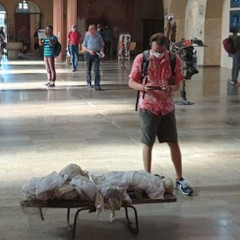
Tlotlo Sereisho, Rhodes Must Fall, a Mengelmoes: Tlotlo Sereisho chose an unexpected combination for the title of his painting. The part "Rhodes Must Fall" fits well within an exhibition about collective memory, as it refers to a historical event. But "a mengelmoes" (an Afrikaans word meaning hodgepodge) is rather uneasy. Through this word, the artist first of all names the surreal montage character of his work (balancing a monument on an egg), but he also introduces a linguistic mixture of English and Afrikaans. The consequence of his artistic strategy reveals itself in his own comment. He explains that he is using / appropriating the historical event to symbolically condense his daily experience of "still pending ... apartheid" and at the same time to agitate in the society ("exhortation") (Tlotlo Sereisho in his comment). To be consistent, he thus has to mix a broad range of different artistic strategies, more so than his colleagues discussed here in this chapter. From representation to creation: mengelmoes.

Gonca Sağlam, Polittalk: In her commentary on Polittalk, Gonca Sağlam speaks about "resistant rebellion against anti-democratic, autocratic to dictatorial governments”. But, what might this rebellion be in her work? If we take her suggestion (in her own comment) of "subversive strategies in an ironic and even cynical manner" seriously, it means putting our backsides on the faces of those in power. This ‘performative turn’ is an interesting artistic strategy chosen by the artist that is quite unique in the exhibition. It focuses on the co-creation of the viewer, at least in their imagination, offering a space in which the viewers can create their own collective memory.

Daniel Adofo, Shackles of a Freeman: In this painting, the depicted (historical) slave and the depicting (contemporary) artist merge – an exciting example of the highly complex ways in which the relationship of the individual to the collective memory can be shaped. This does not happen in the painting itself, but in the tension between the artwork and the commentary. In this way, the artist transforms the historical experience of slavery and shapes it into a narrative denoting something else, something new. He uses the easily recognisable collective memory to create a self-portrait, collapsing both the public and private spheres into one image.

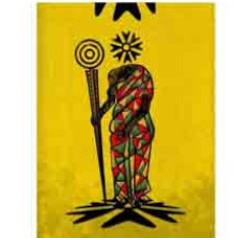
Nyameba Prince Anim, Yaa Asantewaa: Interesting to note is the contrast between the photorealism in the previous example and the quite opposite, ornamental-abstract solution here. The pattern in Nyameba Prince Anim’s design does not tell a story as the title suggests (the story of Yaa Asantewaa), although it refers to it. Guns and swords are symbolic of the ideas of rebellion against oppression and of longed-for freedom. But these symbols are braided in and interwoven into a decorative pattern, just as concrete historical events are woven into the collective memories, into what we call ‘grand narratives’. These narratives are created / constructed, as mentioned in the introduction to this section. They detach themselves from the single occasion, seeking their roots in the memories of the collectives themselves.
Continue with the last part, the exploration of theoretical concepts about collective memory: Link

In the following, we have selected new artworks for the category of memory, but – for purposes of comparability – mainly artworks that are related to memories of historical, political events as well as daily life. In this way, the different forms of memories become clearer: memories not only refer to specific events encountered directly as a participant. Rather, collective memory also articulates what we call experiences (rather than events). These experiences are either based on perceptions, interpretations, reflections of events or they are ‘grand narratives’ (narrations, tales, myths). The works in the exhibition can thus be placed in this chart on a sliding scale from factual to fictional.
Factual events
Dieudonné Assiga, L’unité: In his painting, Dieudonné Assiga from Douala, Cameroon, shows us his interpretation of a historical event in his country. The conflicts between the Francophone and Anglophone zones in Cameroon had led to violent clashes in 2017. In a ‘National Dialogue’ in 2019, the parties involved tried to save the unity of the country through reconciliation negotiations. In his painting Dieudonné Assiga has recreated, in a symbolic way, the political gathering based on this historical event.
David Ochieng, Soko Adventures: In contrast, David Ochieng's animation tells of an everyday experience of a market in Nairobi. The artist is from Nairobi, and he obviously shows a chase in the digital animation. Perhaps a trader chasing a thief? When we hear the word market, it immediately conjures an image in our minds of mobile stalls, piles of goods, people crowded together, colourful movement. These images are obviously deeply imprinted on our minds, and thus a typical example of (visual) collective memory, which refers to concrete, social experiences in everyday life.
Perceptions, interpretations and reflections
Tlotlo Sereisho, Rhodes Must Fall, a Mengelmoes: Tlotlo Sereisho, on the other hand, refers in his painting to the historical movement to topple the Rhodes Monument(s) in South Africa in 2015. In this respect, his work resembles that of Dieudonné Assiga which commemorates a political event in Cameroon. And again, it is not the concrete event, in this case the toppling of the monument, that is shown, but a complex montage of an egg, a pedestal and a wrapped monument (which could also be unwrapped again) against an unreal, flickering background. In this way, Tlotlo Sereisho detaches himself from the event (which, however, remains present) and articulates his perception and interpretation of the situation in South Africa. He asks about the "prevalent practices around commemoration and nation building" (Tlotlo Sereisho in his comment) and understands his painting as "an exhortation to continue the (still pending) overcoming of apartheid".
Gonca Sağlam, Polittalk: The work by Gonca Sağlam from the German section of the exhibition shows a similar appellative character. In her work Polittalk she depicts the faces that are currently engraved in the global collective memory of our time. We see Putin, Assad, Kim Jong-un, Erdogan, Trump. The circle speaks of conspiratorial meetings. This takes on a special relevance since the invasion of the Russian army under Putin into the Ukraine. Such talks, such meetings, such agreements do indeed exist, with massive repercussions for humanity. It is about power. But this specific meeting did not and will not take place. The theme is no longer a concrete experience, but an interpretation of world events as a narrative of the banality of power, secured in understandings between politicians of questionable reputation.
‘Grand narratives’: slavery, resistance, freedom
Already the previous section on ‘interpretations’ made clear that facts, events, incidents in history are always interpreted against specific narrations. In this exhibition we can even find examples that mainly address those narratives. This means that the respective memories are shaped as such.
The last two examples that show this in a complex way are from Ghana. They still reference a historical tradition (historical reports and artefacts), but from there something of their own develops, a general narrative, the first one through a penetration of the private (Daniel Adofo), the other one (Nyameba Prince Anim), with regard to society as a whole, through an extreme form of abstraction. Here, the focus is on the major themes of humanity: enslavement and freedom.
Daniel Adofo, Shackles of a Freeman: The slave castles stood and still stand on the coast of Ghana, shaping the perception of Ghana’s history, for Ghanaians and for visitors. Daniel Adofo from Winneba, Ghana, starts with his experience in his work Shackles of a Freeman. But in the commentary, the artist then fuses the collective memory with his own reflections regarding society but also with his self-perception (against the narrative). First, he is using the history of slavery as a mirror for the current situation of many African countries. But then and above all - and this is central - he mirrors his own experience in the historical experience of slavery. He sees his own life journey as an artist in the tension between freedom and enslavement. This entanglement determines his current mood and self-appraisal.
Nyameba Prince Anim, Yaa Asantewaa: In his digital prints on fabrics, Nyameba Prince Anim, also from Winneba, refers to heroes who contributed to the development of Ghana. In Yaa Asantewaa he thematises the story of the queen mother Yaa Asantewaa who led a rebellion against the British colonisers in the late 19th century: “a strong and courageous woman who stood up and fought for the peace and freedom of Ghana” (Nyameba Prince Anim in his comment). For his pattern design he used “gun and sword … as representational portrait of Yaa Asantewaa” (Nyameba Prince Anim in his comment).
But the guns and swords are not easy to distinguish. They almost disappear in the abstract pattern, which initially speaks of ornamental, abstract decoration. Nevertheless, under this decorative appearance there lies a highly complex meaning. The decorative surface collapses. In these contradictions and fractures, a story comes to the fore that is perhaps also contradictory and fractured in itself.
Continue with part 3, the exploration of different types of strategies applied by the artists: Link