
Look beneath the surface
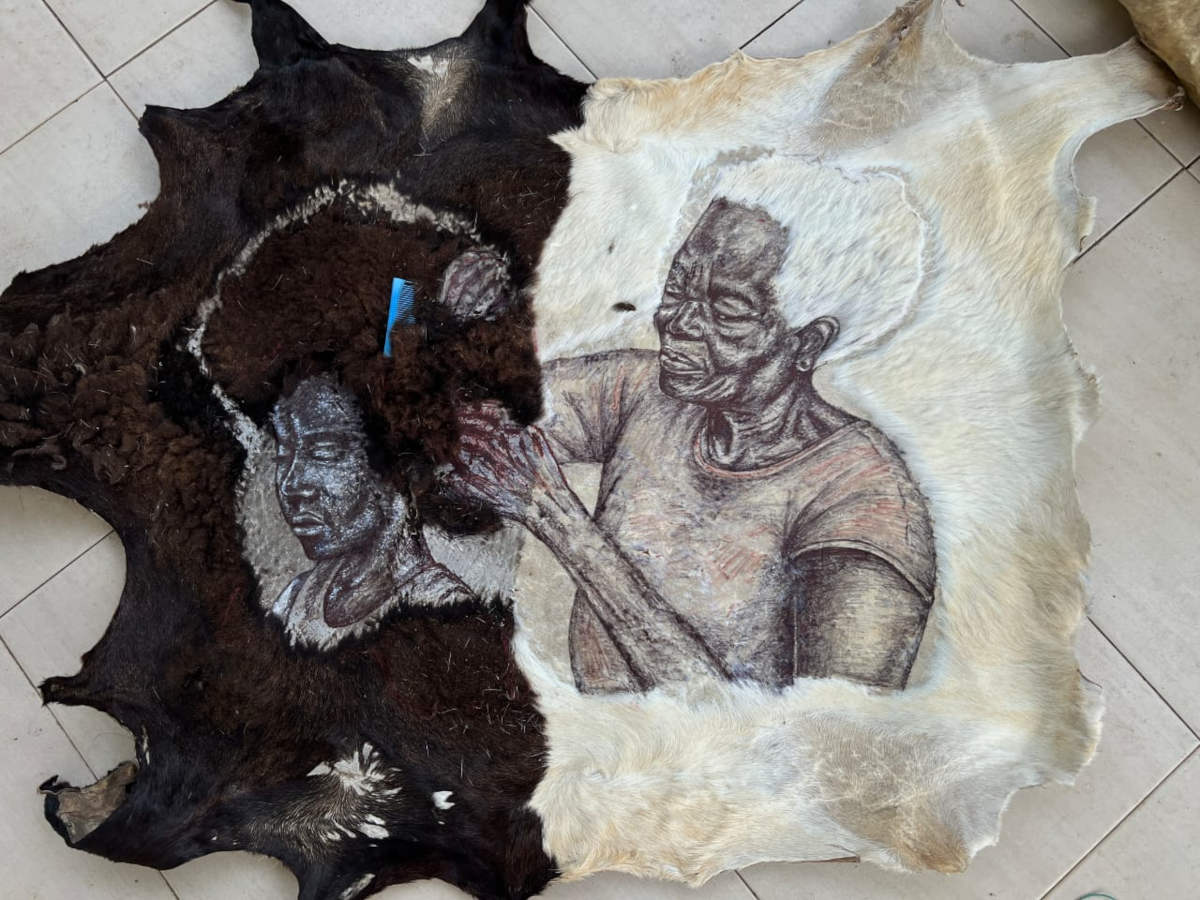
At first glance, Beneath the Hide draws attention through its unusual surface. Instead of a smooth canvas, the artist works directly onto natural animal hide, leaving some of the animal’s fur intact while removing it from other areas. From this simple but carefully controlled process, an image emerges. The work presents an older woman attending to the hair of a young girl, creating a quiet moment between two generations. Yet beneath this familiar scene lies a larger reflection on identity, culture, storytelling, memory and the things we inherit from those who came before us.
The choice of animal hide is central to the work. The artist does not treat the hide simply as a surface on which to place an image. Its natural texture, colour and fur remain visible and become part of the artwork itself. Some areas of the hide are shaved and scraped, exposing the surface underneath, while the remaining fur forms the organic shapes of the figures. The result is an artwork that appears to grow out of the material rather than being placed on top of it. The viewer can see where the fur has been preserved and where the hide has been revealed, making the process of removing and uncovering an important part of the visual experience.
This process also gives meaning to the title, Beneath the Hide. On a literal level, the artist is working beneath the animal’s fur, removing parts of what covers the hide to reveal what lies underneath. At another level, the title asks us to look beneath the surface of identity. What do we carry from the people and cultures before us? What have we allowed to become unfamiliar? What have we covered, changed or forgotten, and what might we discover if we take the time to look again?
The composition of the older woman and the younger girl adds an important dimension of storytelling and intergenerational learning to the work. The figures come together in an intimate moment of hair braiding, creating a scene where knowledge can be shared through conversation, observation and experience. In many African communities, older people, particularly elders, are regarded as bearers of wisdom and experience, and younger generations learn from them through everyday interactions, through stories, advice, demonstrations and shared activities. The act of braiding therefore becomes more than caring for the girl’s hair; it creates a space where knowledge passes from one generation to another. As the older woman works, the younger girl has the opportunity to watch, listen and learn. This reflects the Akan proverb “Nea onnim no sua a, ohu”, which conveys the idea that one who does not know can learn. The proverb also connects strongly with the tradition of storytelling, where knowledge, values, history and cultural understanding are passed on through the spoken word. Storytelling in this sense is not limited to a person sitting down to tell a formal story; it happens naturally through everyday activities and relationships. The artwork captures this kind of informal learning, where an elder becomes a teacher and a familiar activity becomes an opportunity for the younger generation to receive knowledge. It reminds us that learning does not take place only in classrooms or through books. It can also happen through listening to elders, observing their actions, asking questions, sharing experiences and participating in cultural practices.
The relationship between the subject and the material is particularly striking. The artist is depicting human hair while working with animal fur. Both are natural forms that have texture and direction, and both require the artist to pay close attention to the qualities of the material. The fur is not hidden or treated as a problem to be removed completely. Instead, what remains becomes an essential part of the image. This reflects one of the central ideas of the work: that something which may seem ordinary, old or unfamiliar can still have value.
The artist’s concern with ancestral inheritance is therefore expressed not only through the figures but also through the way the work is made. The hide carries something from its natural state, while the artist alters it without completely erasing what was already there. This becomes a way of thinking about identity itself. Our identities are shaped by what we inherit, what we experience, what changes over time and what we choose to retain.
The work also raises questions about how ideas of value can change across generations. The artist reflects on a time when what was indigenous, familiar and natural was considered sufficient, and contrasts this with the gradual tendency to question or overlook aspects of one’s own culture. This does not necessarily man that everything from the past must be accepted without question. Instead, the work encourages a more conscious examination of what has been inherited and why certain things may have come to seem less valuable.
In this way, Beneath the Hide invites the viewer to reconsider things often overlooked because they are part of everyday life. A simple act such as caring for a child’s hair can hold memories, skills, relationships and cultural knowledge. Likewise, a piece of animal hide can be seen as more than a discarded material. Through the artist’s process, it becomes a surface for exploring questions of identity and belonging.
Ultimately, Beneath the Hide invites us to look again. It asks us to move beyond the surface and consider what may be hidden beneath our changing ideas about ourselves and our culture. The artist’s use of natural hide, the preservation of the fur and the act of shaving and revealing the surface all reinforce this message. What remains after the removal is not empty; it contains possibilities for discovery. The work therefore encourages us to recognise value in what we have inherited, to stay curious about what may have been forgotten, and to understand that sometimes returning to what is familiar can help us see ourselves more clearly.
30th September, 2026