
A face can reveal who we are
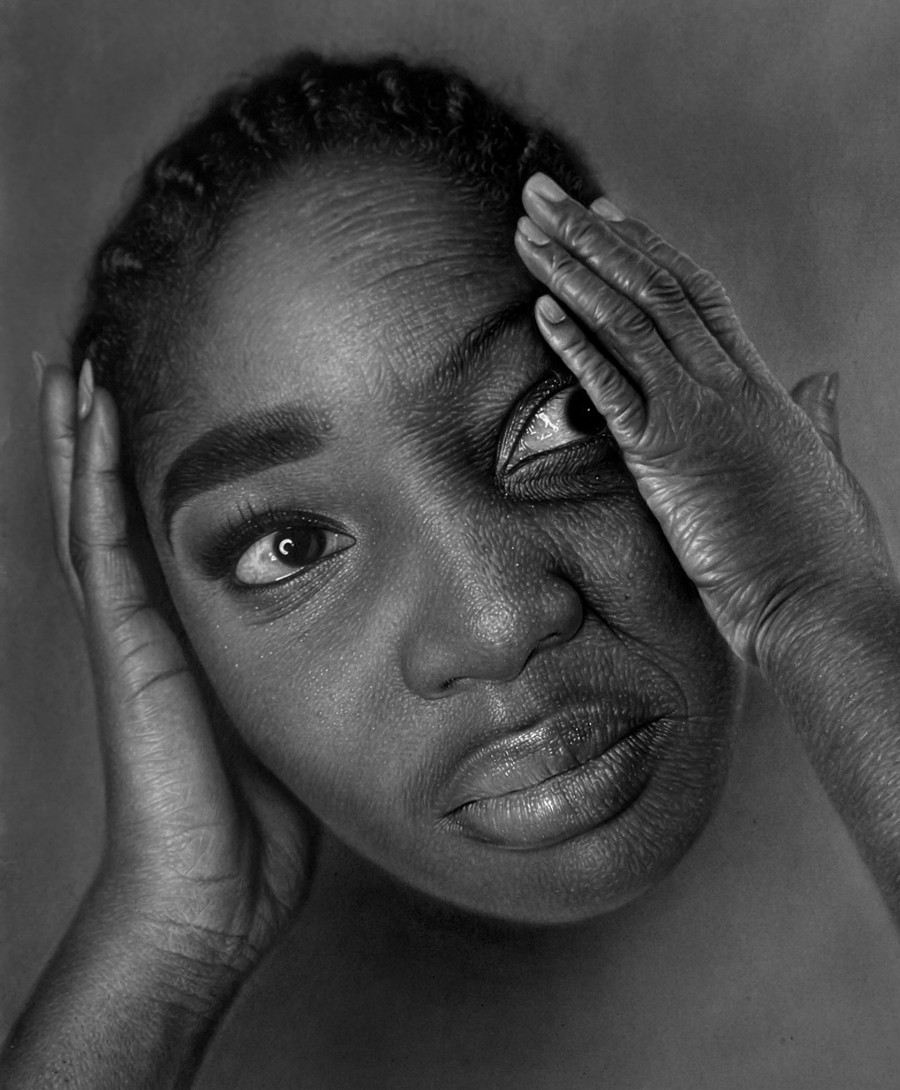
Stanley Adoma, Melanin Suppressed, Charcoal on White Paper. Photo Credit: Artist
A face can reveal who we are, but it can also become something we try to change when we feel that our natural appearance is not enough. This tension runs through Melanin Suppressed, a series of hyper-realistic charcoal artworks that explores the pressure to alter one’s complexion in response to accepted ideas of beauty. In the work, the face appears to hold two different versions of itself. One side is remarkably smooth, even and polished, while the other reveals the natural texture of the skin through visible pores, lines and folds. The contrast is subtle, but it encourages us to look more closely. Why does one side appear more perfected than the other? And why do we often associate smoothness and perfection with beauty?
The work is created in charcoal on white paper, and the materials closely connect to its meaning. The artist uses the white paper to represent Western beauty standards and black charcoal to represent Black people. As the artist repeatedly layers charcoal onto the white surface, the image gradually emerges through a laborious process of accumulation. Each layer adds depth, texture and presence to the figure. What begins as a stark white surface is gradually occupied by Blackness. The process matters because the artist is not simply drawing a Black figure onto paper; the artist uses the act of drawing to reclaim space and affirm an identity that dominant beauty ideals have made feel less desirable.
The two sides of the face bring this struggle into view. The smoother side suggests the polished appearance beauty culture often presents as desirable, while the textured side keeps the skin's natural qualities visible. The work does not suggest that makeup, grooming or changing one’s appearance is wrong. Instead, it highlights the pressure that can arise when people feel their natural appearance must be corrected before it can be considered beautiful.
The idea of a mask adds another layer to this conversation. Masks often hide a person’s identity, but they can also let someone take on another identity. Behind the mask, the person remains the same, while the outside appearance tells a different story. Something similar happens when a person begins to change their complexion to resemble an appearance society values more highly. The change may begin on the surface, but it affects how the person sees themselves. The desire is no longer simply to look different; it becomes a desire to become different.
This process of becoming is shaped by what people learn about beauty as they grow. Ideas about attractive skin, desirable features and acceptable appearances come from many places, including family, friends, media and popular culture. Balogun-Mwangi et al. (2023), for example, found that beauty ideals influence how Black African women view their bodies and skin. In Ghana, these ideas are also connected to skin-lightening practices. Lartey et al. (2017) found that skin-lightening products were widely used among people in selected urban communities in Accra, while Owusu-Agyei et al. (2020) found associations between lighter skin and ideas of beauty, attractiveness, self-esteem and wealth. These outcomes help explain why changing one’s complexion can become more than a personal beauty choice. It connects to the belief that a different appearance brings greater acceptance or value.
The hands around the face add to this sense of concealment and presentation. They partly cover and frame the face, directing attention to what is being shown and what is being hidden. Their presence makes the face feel as though it is being held between two possibilities: the natural appearance that already exists and the appearance that one feels pressured to present.
The labour involved in building the image is also significant. Layer after layer of black charcoal covers the white paper until the figure becomes fully present. The black charcoal that initially appears against the white surface eventually occupies it with confidence. This movement from a blank white ground to a strong Black presence echoes the artist’s intention to reclaim space. What has been associated with suppression is therefore also given room to assert itself.
Melanin Suppressed brings together questions of beauty, appearance and identity through the image of a single face. It asks us to consider what people change when they have been taught that their natural appearance is not enough. The work reminds us that social expectations shape becoming; it also suggests that becoming does not have to mean moving away from oneself. The face, with all its natural texture and individuality, remains a reminder that identity does not need to be hidden or lit up to have value.
7th October, 2026
REFERENCES
- Balogun-Mwangi, O., Robinson-Wood, T. L., DeTore, N. R., Edwards George, J. B., Rodgers, R. F., & Sanchez, W. (2023). Body image and Black African women: A comparative study of Kenya and Nigeria. Body Image, 45, 331-342.
- Lartey, M., Krampa, F. D., Abdul-Rahman, M., Quarcoo, N. L., Yamson, P., Hagan, P. G., Tettey, Y., Gyasi, R., & Adjei, A. A. (2027). Use of skin-lightening products among selected urban communities in Accra, Ghana. International Journal of Dermatology, 56(1), 32-39.
- Owusu-Agyei, M., Agyei, M., & Ogunleye, T.A (2020). Skin-lightening practices among shoppers in selected markets in Kumasi, Ghana: A cross-sectional survey. JAAD International, 1(2), 104-110.