
an archive
a platform to connect artists and to research ecologies and germinate new ways of knowing
Emerging from the intersection between Exploring Visual Cultures (EVC), the New Futures Arts Collaborative by IoFC USA and Collective Webs, the Lab becomes a space for a living archive and collective engagement. A Space, where artistic practices become pathways for building relationships, sharing knowledge, and co-creating possible horizons. Bringing together artists, researchers, and communities across cultures, generations, and geographies, we aim to explore art-making as an ongoing process of intersection, research, experimentation and community building.
Grounded in the interconnection between socio-political-ecological crises and the urge for imagining otherwise, EVC Lab aims to inhabit an open rhizome of possibilities for reflecting and engaging on collective ways of living, relating, and creating. Within this wider network, EVC, New Futures Arts Collaborative and Collective Webs comes together to cultivate a space of learning and archiving across fields, cultures, landscapes and memories. The Lab embraces what emerges through encounters, allowing artistic practice to simultaneously become inquiry, method and reflection in a continuous movement.
Here, exhibitions, workshops, residencies, artistic experiments, publications, reflections, and emerging models of sharing knowledge come together to exchange and grow. By documenting and archiving the creative processes within and beyond the network, the Lab invites us to revisit, connect, and expand these experiences, allowing ideas and practices to circulate, transform, and give rise to new encounters. An archive for what is becoming.
New Futures Residency 2026
Pina Scantamburlo
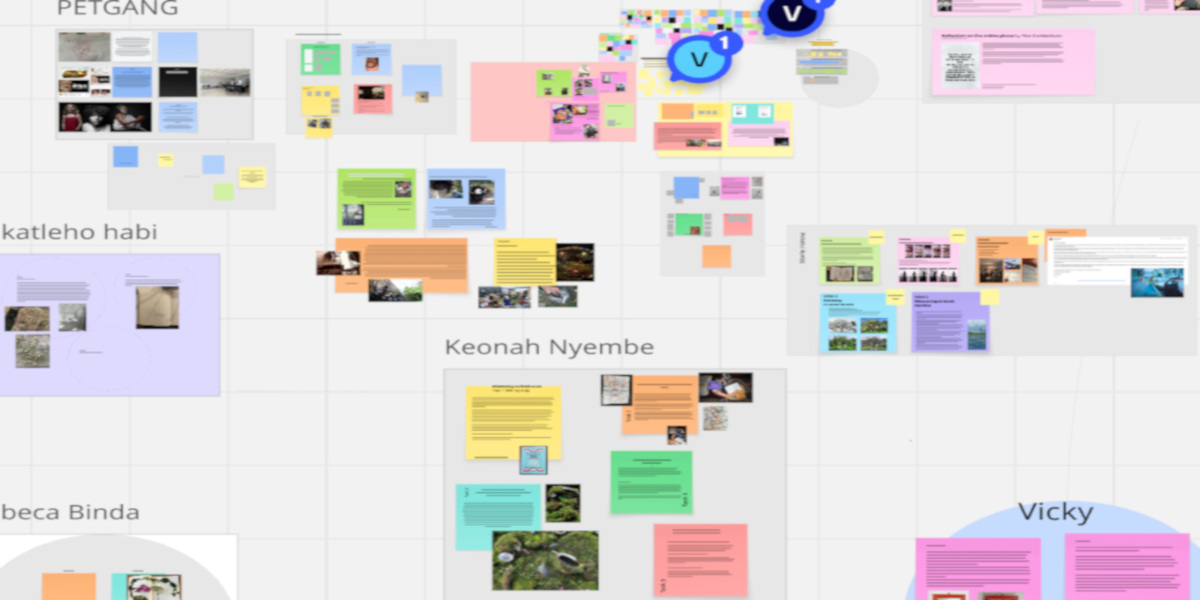
The New Futures Residency 2026 (link), brought together 16 artists from around the globe to collaboratively explore the topic of decomposition and composition. In preparation for the in-person phase of research and experimentation in Cape Town, five online meetings were held in advance to establish the theoretical ground for the residency.
To think of decomposing is to think of letting go and allowing things to end, in the broadest sense. To think of decomposing is also to think of the possibility of regenerating, and bringing new life forms to what we attach fixed meanings. These themes are not only restricted to the natural ecosystems that surround us, but rather our own lifecycles and experiences, places and people we’ve met, objects and things we own, what we love and what we fear, our own perceptions of reality and our environment.
The online phase introduced the program’s general themes of “de()composing, between extraction and regeneration”, asking us to engage in some instructions and reflect on our work, stepping away from our practice and understanding what guides us in our personal processes. To think of decomposing, in this sense, could mean to decompose our own artwork and practices, or rather to decompose the narratives and systems that inspire us, consciously or not.
As an artist who comes from research and activism, it was natural for me to put every sphere of my life under the lenses of decomposition. From lifecycles to the clothes that I own, everything will pass through decomposition and some time, and the ability to let this process be what it is and watch it turn into something new is a powerful one that we, as artists, expect to be able to share with the public.
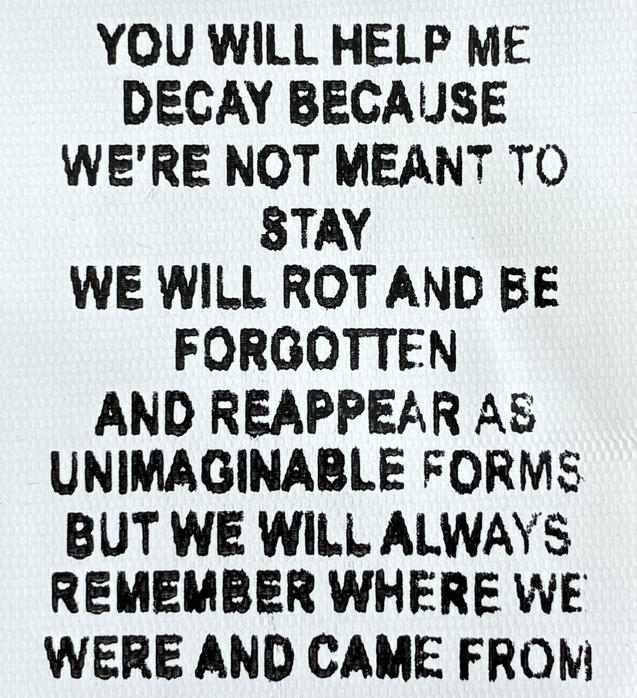
Acetate textile care label, the poem was the result of a reflection on the program's online phase.