By Avi Sooful
This is a reflection on a philosophy that carries both the weight of history and the promise of creative futures: Sankofa. Rooted in the Akan concept often symbolised by the mythical bird that looks backwards while moving forward, this philosophy teaches us a simple but profound truth: the importance of returning to the past to retrieve knowledge necessary for shaping the present and the future. Sankofa conveys the idea that progress is not possible without reflection on history. Within the context of the creative arts and cultural practices, the philosophy of Sankofa becomes a powerful framework for understanding how artists, cultural practitioners, and communities engage with heritage through processes of both learning and unlearning. It encourages a critical engagement with inherited knowledge systems while simultaneously challenging imposed narratives that have shaped artistic production and cultural expression over time.
Learning, within the philosophy of Sankofa, involves reconnecting with cultural memory and recovering knowledge that may have been forgotten.
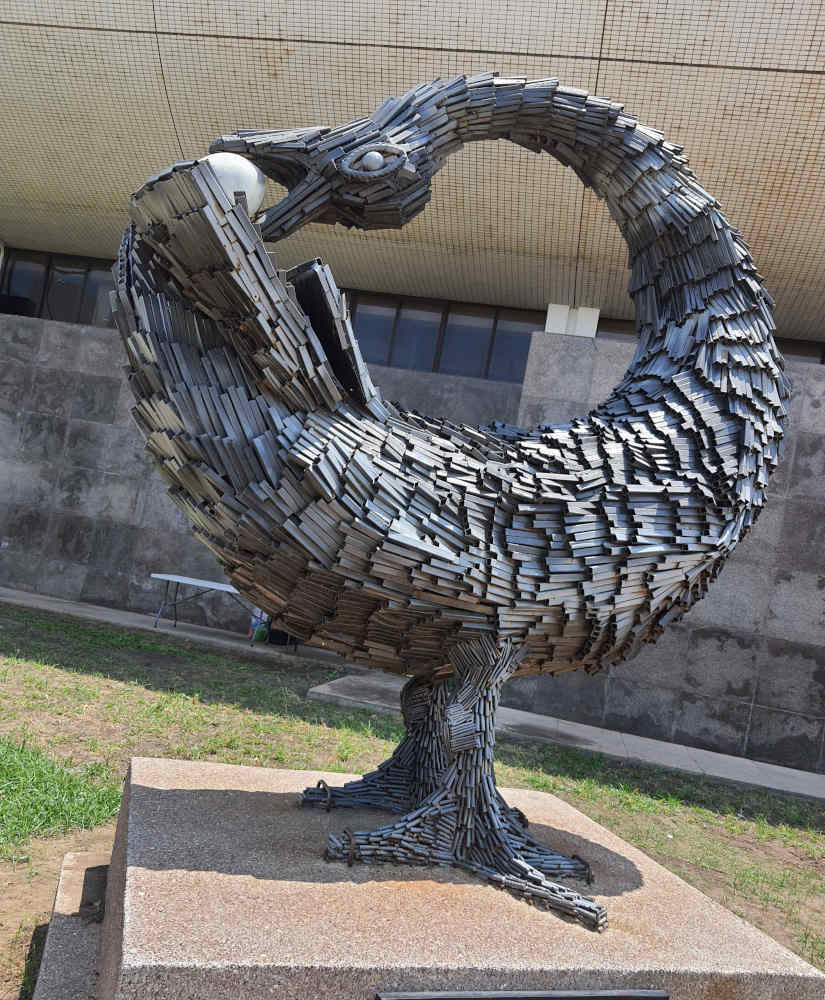
Sankofa bird. National Theatre, Accra/Ghana. Photo: A. Sooful (2023)
The use of a bird symbol in depicting the philosophy of Sankofa is equally powerful. Often, the Akan people used elements from nature to communicate complex ideas. In this context, the bird symbolises awareness and perspective.
In many African traditions, birds are seen as creatures that move between earth and sky, and in this way, they have a broader “view” of things. This makes them a natural symbol of wisdom and insight—qualities central to Sankofa. The backwards-looking posture is the key message, facing forward (moving ahead) and at the same time looking backwards (reflecting on the past). This unusual posture visually captures the philosophy: You can progress, but only if you remain mindful of where you’ve been.
The egg represents 3 things of value
- Knowledge
- Heritage
- Lessons from the past
It is for these reasons that a bird’s movement and behaviour made it an intuitive and memorable way to visualise this concept—even without words. This interpretation is in keeping with the African philosophy of man, a relationship of triangulation between man, cosmos and the environment.
But I want to move beyond the metaphor. I want us to think about Sankofa not merely as remembrance, but as a dynamic process of learning and unlearning within the creative arts and cultural practices. For us to introduce the concept or philosophy beyond Ghanaian borders, we refer to it as Sankofa-ism, making it a word of action that includes the ideals of Sankofa.
For artists and cultural practitioners, the past is never simply behind us. It lives in our gestures, our sounds, our languages, our fabrics, our rituals, and our stories. Yet the histories we inherit are often layered with disruption—colonialism, displacement, silencing, and misrepresentation. In such contexts, learning alone is not enough. We must also unlearn. Learning reconnects us to cultural memory, whilst unlearning frees us from imposed narratives. Together, they create the conditions for Sankofaism.
In the creative arts, Sankofa-ism invites us to revisit the archives of our communities—not only the formal archives in libraries and museums, but the living archives in elders’ memories, oral traditions, community ceremonies, and everyday cultural expressions. When a choreographer draws from ancestral movement vocabularies, when a musician reinterprets traditional rhythms through contemporary forms (e.g., the late South African musician, Miriam Makeba- Pata Pata), or when a visual artist reclaims indigenous symbols, they are practising Sankofa. They are reaching back—not to replicate the past, but to reimagine it for the present.
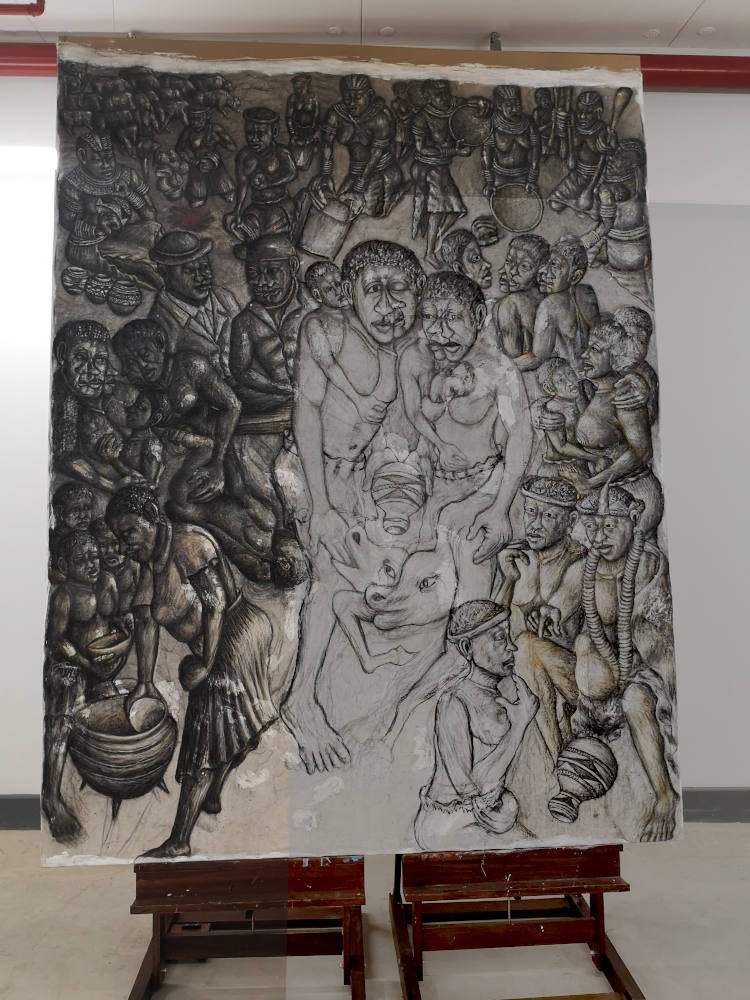
Helen Sebidi. Untitled – Gallery 2.1. University of Pretoria. Photo: A. Sooful (2019)
Similarly, South African artist Helen Sebidi explores history and memory through charcoal drawings, ceramics and paintings. By revisiting South Africa’s political past through experimental visual storytelling, Sebidi demonstrates how artists can learn from history while critically interrogating it. Her work demonstrates how unlearning colonial imagery can open space for alternative visions.
In Sebidi’s making, she relies on the ancestral voice to inspire her as she works in isolation, locked away from people. This is not uncommon in African practices to be guided by the wisdom of the ancestors. Sebidi perceives township and rural living as two separate lifestyles created by apartheid. She believes that the lack of traditional knowledge taught in the rural communities rendered these urbanised young people ‘empty’ and unable to cope with the pressure exerted by society.
The artwork Untitled (2019) represents the breakdown in traditional family values in homes, and the anguish faced by contemporary black families that live in semi-urban developments. Sebidi includes in her work specific symbols that remind us of traditional values and modern living. A calabash is an essential and versatile object in African culture. In ritual or domestic practices, it serves as a spoon or storage vessel, or it can be turned into a musical instrument when dried. More importantly, it is a symbol of sharing (community) and a metaphor for knowledge and wisdom and, therefore, occupies a central place in Sebidi’s work. The calves indicate the community’s relationships with their animals. A cow is an integral part of rural life.
However, this act of returning requires courage. Because to retrieve what was lost, we must also confront what was taught. Many of us were trained in institutions that privileged Western aesthetics while marginalising others. These hierarchies shaped how we create, curate, and aesthetically appreciate art. Sankofa - ism challenges us to question what we learn.
What knowledge have we overlooked? What creative languages were interrupted? And perhaps most importantly: what must we unlearn to truly see ourselves?
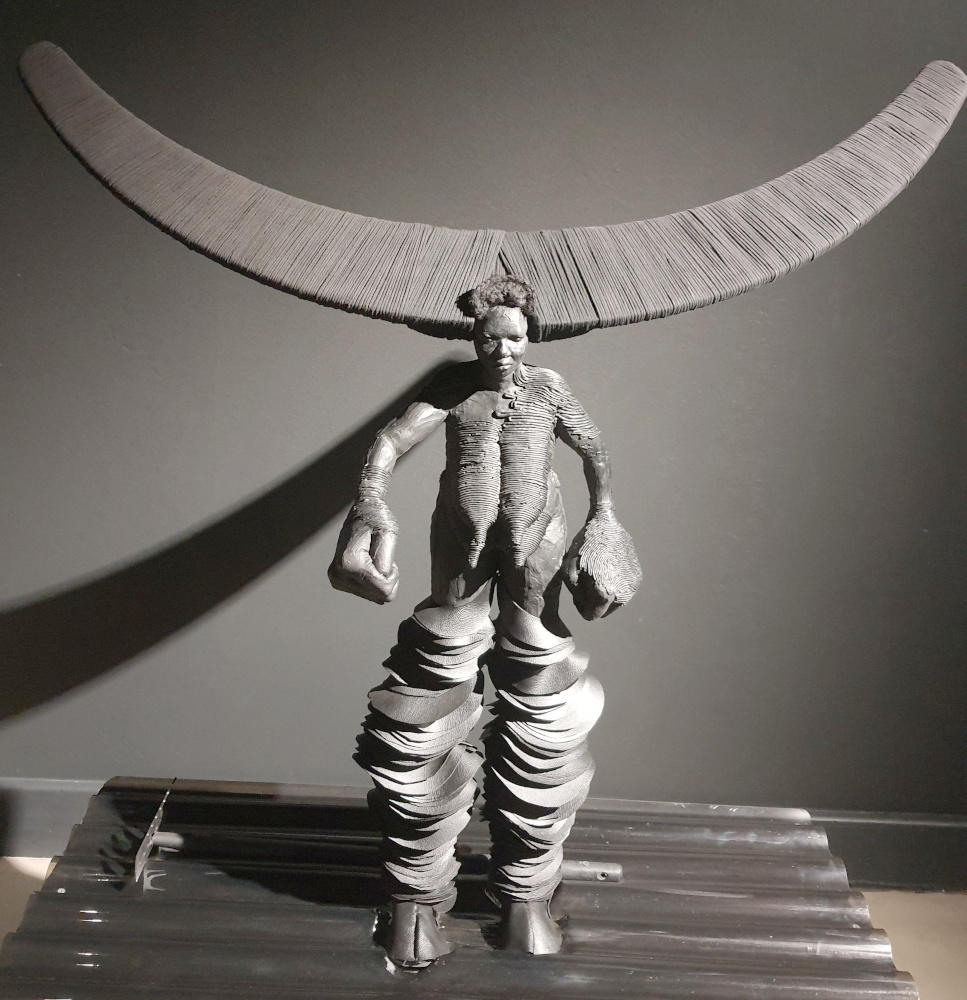
Cow Mash. They come from the field. Javette-UP Art Centre, Pretoria. Photo: A.Sooful (2026)
In her show at the Javett-Up Art Centre that opened a week ago, Cow approaches her artmaking through cow metaphors and associations as a way of thinking through ancestry, labour, histories and collective memory. Her works are about an imagined space, a metaphorical garden of knowledge, care and abundance.
Again, in her works, as in Sebidi, the symbols of calabash are used within a contemporary site of shopping trolleys. It speaks to the commodities of indigenous knowledge that evolve and migrate with generational knowledge.
In this case, unlearning does not mean rejecting everything we have been taught. Rather, it means examining inherited frameworks with critical awareness. It means recognising when artistic standards have been shaped by historical power rather than cultural relevance. For the creative arts, this is a liberating act. When we unlearn restrictive categories, new possibilities emerge. In her works, objects are not as isolated artefacts, but living expressions connected to communities and knowledge. Sankofa, therefore, becomes a methodology for creativity.
It encourages artists to move fluidly between memory and innovation. In the creative arts, this process of learning from the past does not imply simply reproducing traditional forms. Instead, artists reinterpret cultural knowledge to address contemporary realities. It affirms that tradition is not static; it is a reservoir of knowledge that can be activated in new ways. The goal is not nostalgia. The goal is continuity with transformation. In this sense, Sankofa-ism also speaks to cultural healing.
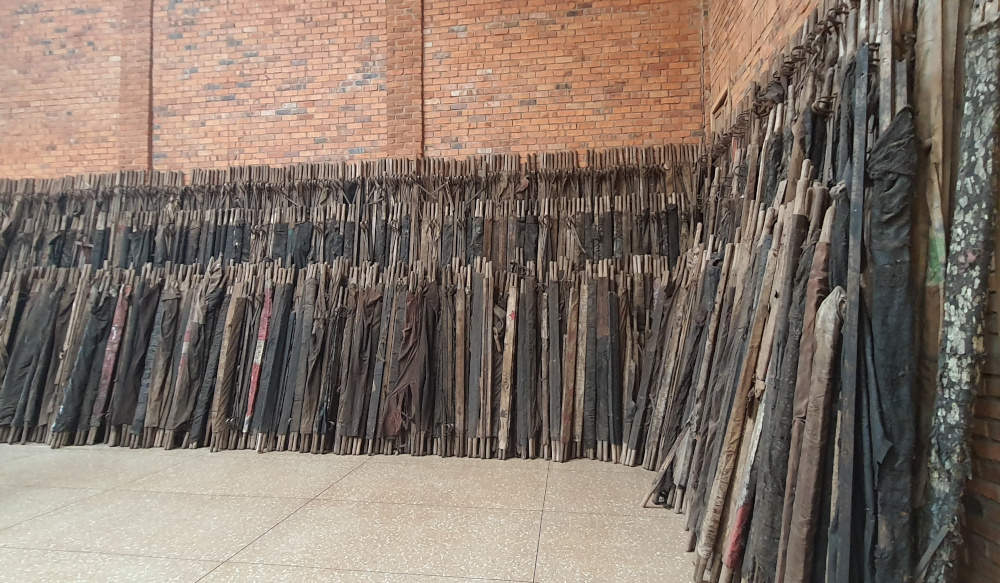
Ibrahim Mahama, Stretchers at Red Clay, Tamale/Ghana. Photo: A. Sooful (2023)
Let's look at the Ghanaian artist Ibrahim Mahama’s work. He is known for his large-scale, site-specific installations. He sees his materials as vessels of memory; often, he uses objects from Ghana’s past to reflect on the history of people’s experiences under colonial rule and how we learn from these as we bring these experiences in the form of objects that hold narratives and memories in the form of human patina trapped within them. These objects examine the impact of Ghana’s material history from past to present and what it may hold in the future. His monumental works force you to confront what you are looking at and experiencing, and the shock and sensory effect allow you to embrace a history of suffering and loss. Toolboxes- reflect hardship, journeys of migration, skills of. The medical stretchers that stand as sentinels against the wall at Red Clay, Tamale recall the Anglo-Ashanti Wars of the 18-1900s against the British. These objects house trauma but also the spirit of the people who fought for independence.
At the Venice Biennale in Italy, he draped buildings with coal sacks from Ghana that were stitched together to form ‘wall facades” in his show, ‘Out of Bounds”. The textiles themselves hold sweat, coal, blood, and pieces of dried fish that become an archive of Ghanaian history and its people.
The objects that are used become archival information about the histories of Ghana into staged monumental installations of contemporary artistic practice. Art becomes both archive and future. Exhibitions increasingly include oral histories, performance, and community participation to highlight the living nature of cultural heritage. This shift reflects a broader movement toward recognising indigenous knowledge systems and cultural authority. More importantly, when looked at in the context of Sankofa-ism, these archives of memories are not the work of individual artists alone; it requires collective participation, and we move from merely conserving heritage to co-creating knowledge with communities. Elders become scholars. Ritual becomes pedagogy. Cultural practice becomes research, and within this process, creativity flourishes.
For younger generations of artists, Sankofa-ism offers a powerful orientation. It tells them that innovation does not require abandoning heritage. Instead, it invites them to experiment with it, reinterpret it, and speak through it in ways that address contemporary realities—migration, climate change, identity, technology, and social justice. In this was the past becomes a foundation, not a limitation.
So, the question before us today is not whether we should look back. The question is how we look back.
- Do we return to the past as passive observers or as active interpreters?
- Do we repeat tradition, or do we converse with it?
- Do we inherit culture, or do we participate in shaping its future?
Sankofa-ism reminds us that the journey forward is strongest when it is rooted in awareness of where we come from. As artists and cultural practitioners, we hold a unique responsibility. Our work shapes collective memory. It influences how communities see themselves and how future generations understand their heritage. When we engage in both learning and unlearning, we create space for more authentic cultural expression. We allow creativity to become a dialogue across time.
How do we appreciate the beauty of something like a library of memories and know that we as Africans are lacking on library shelves? How do we perceive and acknowledge knowledge investments in new ways?
Another notable example is the Ghanaian sculptor El Anatsui, whose large-scale installations such as 'Tsiatsia- searching for connection ' shown at Zeitz MOCCA, Cape Town, 2019 are constructed from thousands of discarded aluminium seals stitched together with copper wire.
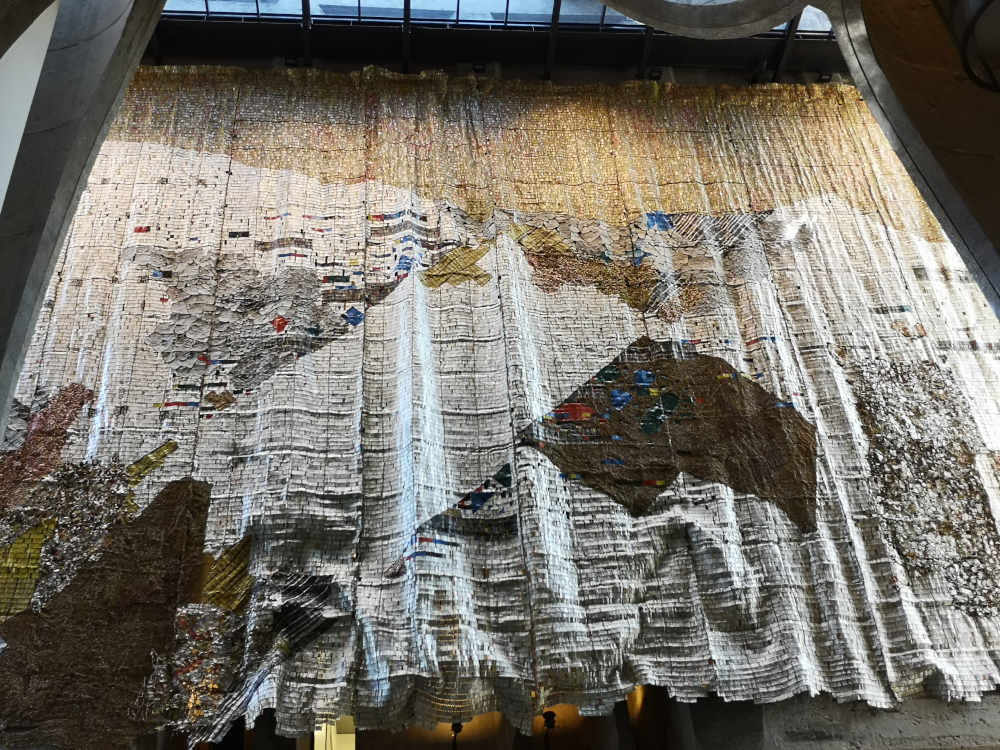
El Anatsui. Tsiatsia - Searching for Connection. Zeitz MOCCA, Cape Town - Photo: A. Sooful (2019)
These shimmering tapestries visually resemble traditional West African kente cloth, yet they are made from recycled materials associated with global trade and colonial histories of alcohol exchange. Through this work, Anatsui like Mahama, draws from traditional textile aesthetics while simultaneously commenting on globalization, consumption, and historical exchange between Africa and Europe. His work exemplifies Sankofa-ism by transforming historical references into contemporary artistic language.
In the creative arts, learning from the past does not necessarily imply replication of traditional forms. Rather, it involves understanding the cultural meanings, values, and aesthetics embedded within those traditions. Through these practices, artists engage in what can be described as a creative dialogue between past and present.
While learning reconnects individuals with cultural heritage, unlearning requires a critical examination of the frameworks through which knowledge has been transmitted and valued. Sankofa-ism encourages the development of more inclusive approaches to creativity and cultural scholarship. The interplay between learning and unlearning allows Sankofa-ism to function as a dynamic methodology for artistic innovation. Rather than viewing tradition as static or fixed in the past, Sankofa-ism understands cultural heritage as a reservoir of knowledge that can be activated and transformed in response to contemporary realities. Artists become mediators between generations, translating ancestral knowledge into new forms that resonate with modern audiences. In this sense, cultural continuity does not require strict preservation but rather creative adaptation.
Furthermore, Sankofa-ism contributes to broader processes of cultural restoration and healing. Communities that have experienced cultural erasure or marginalization often seek ways to reclaim their identities and histories. Creative arts play a crucial role in this process by making cultural memory visible and accessible. Artistic expression becomes a space where communities can reflect on their histories, celebrate resilience, and imagine alternative futures.
For emerging generations of artists, Sankofa-ism offers a meaningful framework for navigating identity and creativity in a rapidly changing world. Globalisation, technological innovation, and migration have transformed cultural landscapes, often creating tensions between tradition and modernity. Sankofa-ism provides a way to negotiate these tensions by affirming that innovation does not require abandoning cultural roots. Instead, artists can draw from heritage as a source of inspiration while addressing contemporary social, political, and environmental issues.
Ultimately, Sankofa-ism emphasises that the relationship between past and present is not linear but cyclical. Cultural knowledge flows across generations, constantly being reinterpreted and reimagined. Learning reconnects individuals with the wisdom embedded in tradition, while unlearning frees them from limitations imposed by historical power structures. Together, these processes allow artists and cultural practitioners to create work that honours heritage while contributing to the evolution of culture.
In conclusion, Sankofa-ism offers a compelling philosophical framework for understanding creativity within cultural contexts. By encouraging both the recovery of forgotten knowledge and the critical examination of inherited systems, it enables artists and communities to engage with culture in transformative ways. Within the creative arts and cultural practices, Sankofa-ism reminds us that meaningful progress often begins by looking back, retrieving the knowledge, stories, and practices that shape who we are, and using them to imagine new possibilities for the future.
I invite us to embrace the philosophy of Sankofa not only as a symbol, but as a practice. Let us return to the knowledge that nourishes us. Let us question the narratives that confined us. Let us listen deeply to the cultural wisdom that surrounds us.
And from that place—between memory and imagination—let us create art that honours the past while courageously shaping the future. Sometimes, the most radical act of innovation is simply this: to remember differently.
This text is based on Avi Sooful’s key note at the conference "SANKOFAISM: Unearthing, Unlearning/Learning, and Uplifting Sustainable Creative Arts and Cultural Practices and Methods" in Winneba, Ghana in 2026. It responds to the contribution by Patrique deGraft-Yankson: Decolonisation as Sankofa (link).