
By Dr Nyamamero Navei
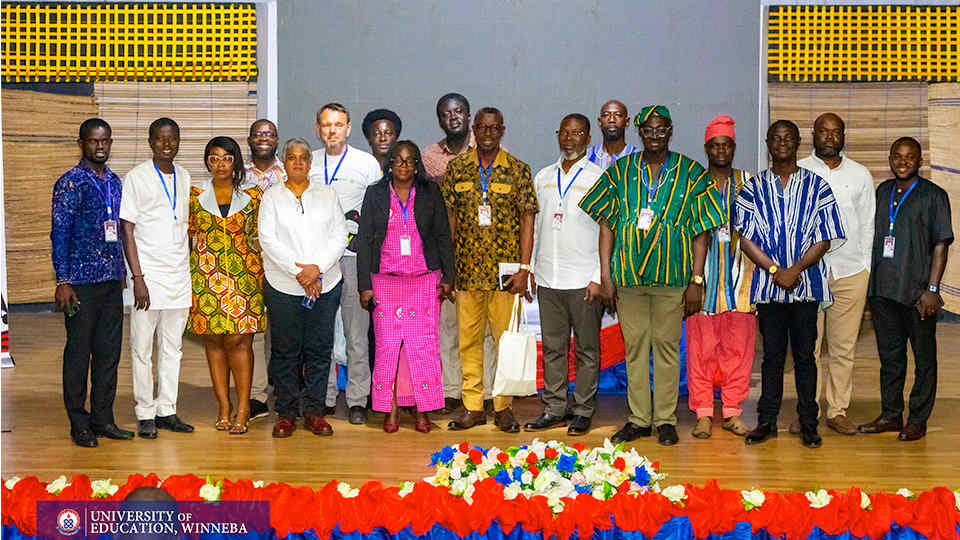
Photo: Division of Public Relations and Communication, UEW
About the Conference
The Centre for Research in Culture and Creative Arts (CeRCCA), School of Creative Arts, University of Education, Winneba (UEW), Ghana, in collaboration with Exploring Visual Cultures (EVC), successfully convened the Creative Arts and Culture International Research Conference (CACIRC) 2026 from 31 March to 2 April 2026. Held at the Central Campus of the University (UEW), the conference was organised under the theme “SANKOFAISM: Unearthing, Unlearning/Learning, and Uplifting Sustainable Creative Arts and Cultural Practices and Methods.” Acceptance of abstracts was strictly based on the following sub-themes:
- Preserving Indigenous Arts and Cultural Heritage
- Creative Arts in Social Change
- Innovations in Creative Industries
- Cultural Policy and Creative Economy
- Intersectionality in Arts and Culture
- Creative Arts and Technology
- Creative Arts Education and Policy Making
- Cultural Production and Entrepreneurship
- Indigenous Knowledge Systems and Cultural Preservation
- Arts, Culture, and Sustainable Futures
- Human Capital Development and Growth of the Culture and Creative Arts Sector
- Tangible and Intangible Cultural Heritage, Museum, and Art Gallery Issues
- Art History and Visual Material Culture
- Music, Sound, and Culture
- Technical, Vocational Education and Training (TVET) Issues
- Film Narratives in a Digital Era
- Cinematic Identities and Cultural Representation
- 21st-Century Communication and Digital Landscape in Cultural Contexts
- Language, Cultural Preservation, and Transformation
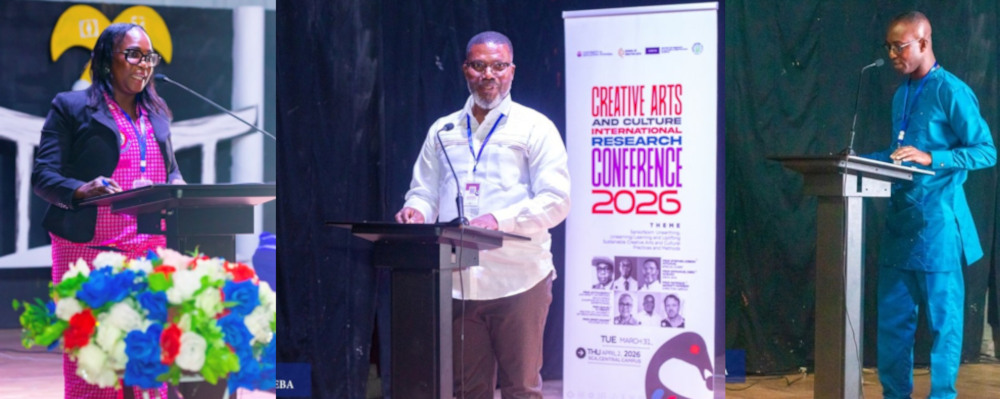
Pro-Vice Chancellor of UEW, Professor Esther Yeboah Danso-Wiredu / Director of CeRCCA, Professor Patrique deGraft-Yankson / Dean of the School of Creative Arts, Professor Emmanuel Obed Acquah. (Photos: Division of Public Relations and Communication, UEW)
Conference Opening
The three day conference was formally opened on the 31 March 2026, with a series of addresses that set an intellectual and collegial tone. Distinguished scholars, esteemed researchers, creative practitioners, invited guests, students, and members of the broader public were warmly welcomed by the Dean of the School of Creative Arts and the Director of CeRCCA.
In his opening remarks, the Dean of the School of Creative Arts, Professor Emmanuel Obed Acquah, underscored the conference’s core invitation: to reflect critically on the past, reassess the present, and strategically shape the future of creative arts and cultural practices. He articulated Sankofaism not as a passive retrieval of heritage but as an active process of interrogation, challenging inherited systems, relearning what is essential and uplifting practices that sustain communities in meaningful ways.
The Pro-Vice Chancellor of UEW, Professor Esther Yeboah Danso-Wiredu, chaired the conference on behalf of the Vice Chancellor. With profound pleasure and institutional pride, she welcomed participants warmly, characterising the gathering as an intellectual and creative homecoming. Reflecting on the theme, she distinguished Sankofa from Sankofaism: while Sankofa reminds us to look back, Sankofaism calls us to act, demanding a philosophy, a movement, and a methodology for contemporary complexities. She unfolded three interrelated imperatives: unearthing obscured cultural wisdom; unlearning and learning through critical examination of inherited hierarchies; and uplifting knowledge into communities, industries, and policies. Commending the UEW sustained partnership with Exploring Visual Cultures (EVC) since 2019, she noted that this collaboration embodies Sankofaism itself, drawing from diverse traditions to shape a collective future. She declared the conference officially open, urging all participants to engage deeply, question critically, and collaborate meaningfully.
The Director of CeRCCA, Professor Patrique deGraft-Yankson, provided a brief overview of the conference and further enriched the Sankofa philosophical framing. He emphasised that Sankofaism is neither an act of nostalgia nor an uncritical rejection of colonial legacies, nor a wholesale invocation of every traditional practice. Rather, it is a deliberate and discerning retrieval of past wisdom to inform future possibilities. This reflective engagement, he argued, positions creative arts scholarship to address contemporary challenges with depth, sensitivity, and innovation. He reiterated the significance of UEW’s collaboration with EVC, which has produced inspiring art exhibitions, numerous publications, teacher training courses, and conferences such as CACIRC 2026.
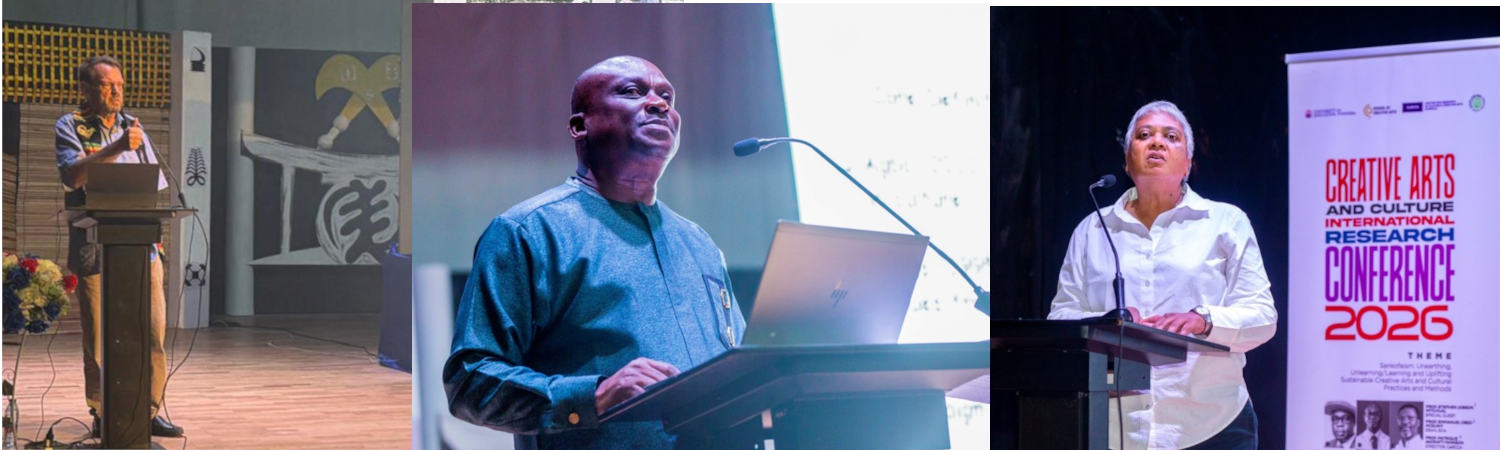
Keynote speackers: Ernst Wagner, Samuel Manasseh Yirenkyi, Avitha Sooful (Photos: Division of Public Relations and Communication, UEW)
Keynote Addresses
Three keynote addresses were delivered during the three-day conference, one for each day:
- Day 1 (31 March 2026): Professor Avitha Sooful (University of Pretoria, South Africa), Chair of Exploring Visual Cultures (EVC).
- Day 2 (1 April 2026): Professor Ernst Wagner (Germany), Co-founder and Secretary of EVC.
- Day 3 (2 April 2026): Professor Samuel Manasseh Yirenkyi (Ghana), University of Media, Arts and Communication (UMAC).
Professor Avitha Sooful delivered the opening keynote, offering a profound meditation on Sankofaism as a dynamic process of learning and unlearning. Invoking the Akan Sankofa bird, which looks backward while moving forward, carrying an egg representing knowledge, heritage, and past lessons, she argued that progress is impossible without critical reflection on history. For artists and cultural practitioners, the past lives in gestures, sounds, fabrics, and rituals, yet these inheritances are often layered with colonial disruption, silencing, and misrepresentation. Thus, learning alone is insufficient; we must also unlearn imposed narratives to create conditions for authentic Sankofaist practice. Drawing on South African artists Helen Sebidi (whose work reclaims ancestral wisdom and critiques broken family structures) and Cow Mash (who places calabashes in shopping trolleys to symbolise migrating indigenous knowledge), alongside Ghanaian examples Ibrahim Mahama (whose coal sacks and stretchers archive colonial trauma) and El Anatsui (whose shimmering tapestries transform discarded trade materials into kente-like forms), Professor Sooful demonstrated how artists converse with tradition rather than merely repeating it. She concluded with urgent questions that resonated throughout the conference: Do we return to the past as passive observers or as active interpreters? Do we inherit culture, or do we participate in shaping its future? Her address reminded participants that sometimes the most radical act of innovation is simply to remember differently. (Link to her contribution.)
Professor Ernst Wagner brought a German perspective on Sankofaism, drawing on artistic and real-life evidential scenarios (Link). The Ghanaian perspective was vividly addressed by Professor Samuel Manasseh Yirenkyi, punctuated with photographic and artistic evidence, while calling upon policymakers and political leadership in Ghana to attend to the creative arts and culture through a Sankofaist lens for the betterment of the country.
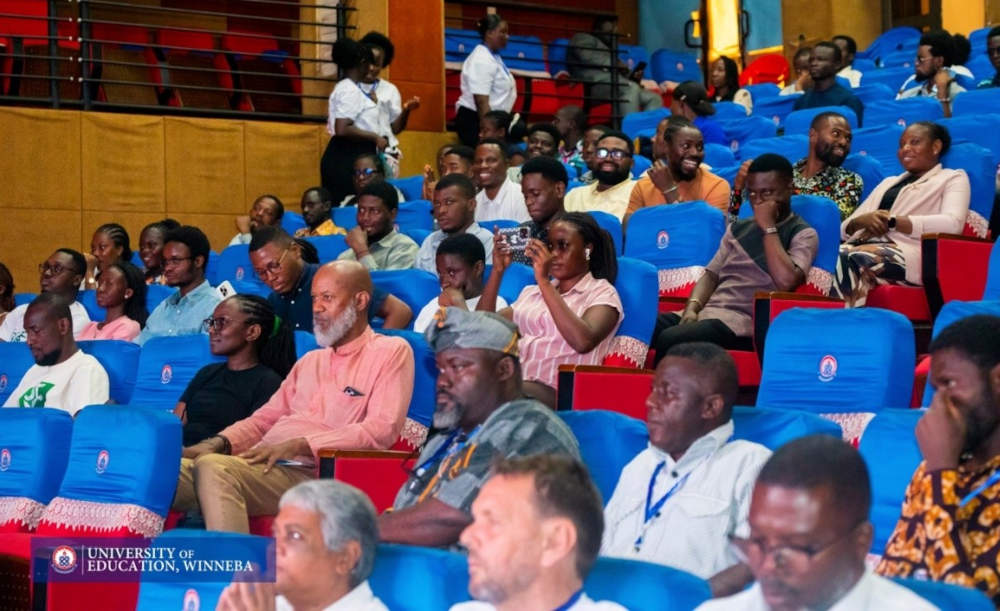
A glance at the audience (Photo: Division of Public Relations and Communication, UEW)
Conference Presentations
A total of 88 abstracts were received from 131 authors across the globe (see Table 1 for abstract details). Overall attendance was 280 participants, including scholars, activists, cultural experts, industry leaders, practising artists, postgraduate students, and art enthusiasts. The atmosphere was intentionally designed to be encouraging for all researchers, from early-career presenters to established academics. Virtual participation via Zoom was also facilitated, extending the conference’s reach to an international audience. The organisers extend their profound gratitude to all contributors, particularly the EVC network members who travelled from South Africa, Germany, and Kenya, and to the Local Organising Committee for their dedication. The conference underscored the transformative potential of the creative arts in addressing global challenges and left participants inspired to drive cultural innovation grounded in the wisdom of Sankofaism.
Abstract Statistics
|
Total Number of Abstracts |
88 |
|
Total Number of Authors |
131 |
|
Abstracts with Single Authorship |
51 |
|
Abstracts with Multiple Authorship |
37 |
Geographical Distribution of Authors
|
Country |
Number of Authors |
|
1. Ghana |
104 |
|
2. Nigeria |
17 |
|
3. Kenya |
4 |
|
4. Germany |
3 |
|
5. South Africa |
1 |
|
6. China |
1 |
|
7. USA |
1 |
The programme featured presentations across four parallel sessions, alongside a concurrent art exhibition and a 2D/3D animation workshop. (Download the book of abstracts: Link)
Conference Outcomes
The conference successfully achieved its primary aim of providing a timely and rigorous platform for academic engagement. The diverse scholarly contributions, spanning 88 presentations, facilitated a rich exchange between presenters, seasoned scholars, and experts. A central outcome was the collective validation of Sankofaism not merely as a historical or philosophical concept but as a dynamic, practical methodology for decolonising creative pedagogies, re-evaluating indigenous knowledge systems, and fostering sustainable innovation within contemporary cultural industries. The dialogue generated a clear consensus on the need to retrieve pre-colonial artistic epistemologies to inform and uplift current practices in fields ranging from textile design and musicology to digital film and heritage management.
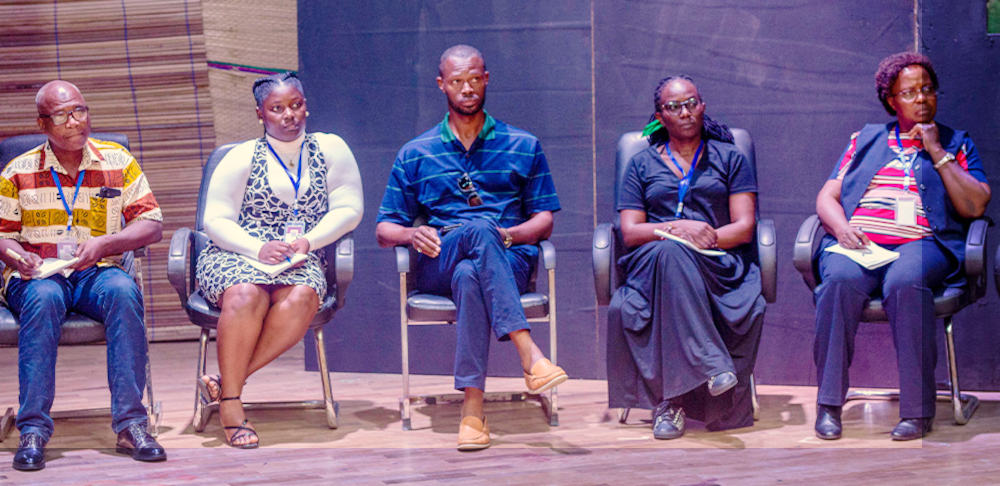
Panel Discussion (Photo: Division of Public Relations and Communication, UEW)
The Sankofaism Dialogue
As the formal proceedings drew to a close, a reflective Sankofaism Dialogue was deliberately programmed. The session was designed not as an exhaustive deliberation but as a collective intellectual pause, offering participants an opportunity to synthesise key insights emerging from the three-day engagement. Guided by the conference theme (SANKOFAISM: Unearthing, Unlearning/Learning, and Uplifting Sustainable Creative Arts and Cultural Practices and Methods), the dialogue invited critical reflection on origins, reconsiderations, and future trajectories. Reflections gathered during this session were intended to contribute to the Conference Communiqué and to help shape the future directions of this scholarly and creative platform.
The discussion unfolded across three thematic strands, which underpinned the conference theme. Under Unearthing, participants identified essential aspects of history, indigenous knowledge systems, and cultural memory that demand re-centring in contemporary art and design practice. Under Unlearning and Learning, delegates interrogated inherited assumptions, pedagogies, and frameworks within their fields that require critical rethinking or transformation. Under Uplifting, the conversation turned towards positioning the creative arts to address contemporary societal challenges more effectively, particularly in the context of technological change and global transformation. The dialogue concluded with a final round of very brief reflections, in which each participant distilled their key takeaway from CACIRC 2026 into a single sentence, capturing the collective spirit of intellectual renewal and collaborative purpose.
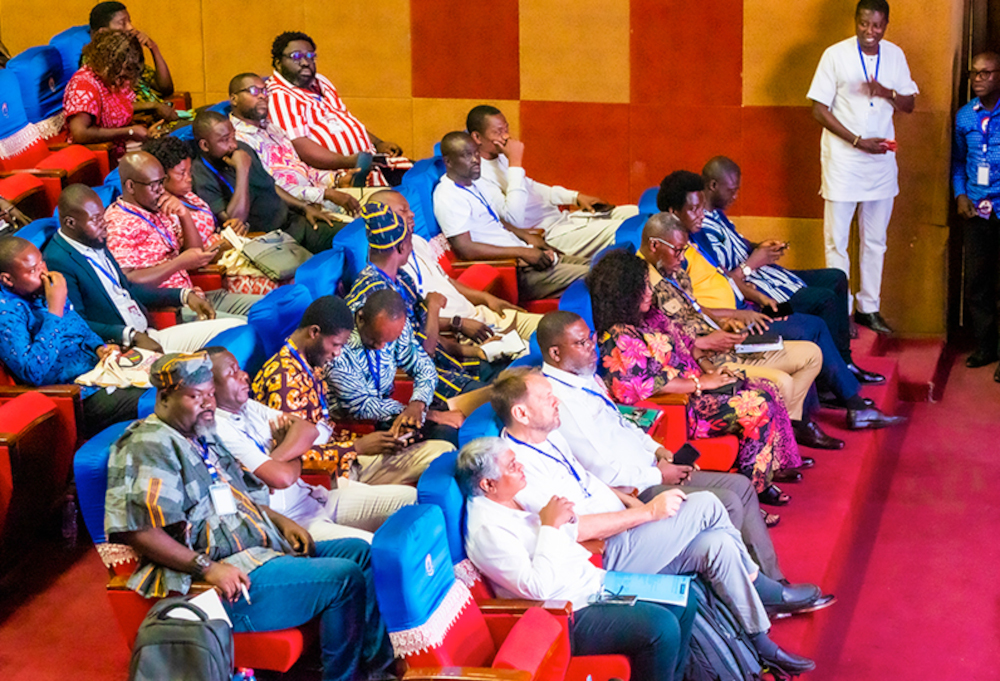
A glance at the audience (Photo: Division of Public Relations and Communication, UEW)
Conclusion
The Creative Arts and Culture International Research Conference (CACIRC) 2026 stands as a resounding success, firmly establishing itself as a pivotal forum for decolonial discourse and creative innovation in West Africa and beyond. A significant achievement was the deepened collaboration with Exploring Visual Cultures (EVC), whose international partnership enriched the conference’s intellectual scope and provided invaluable global linkages. The participation of scholars from Germany, South Africa, Kenya, Nigeria, and Ghana among other countries, marked a substantial step forward from CeRCCA’s previous conferences, transforming CACIRC 2026 into a genuinely international event. This global engagement not only elevated the quality of academic exchange but also positioned the University of Education, Winneba, and its EVC partner, as a central hub for research with reference to sustainable creative arts and cultural practices. CACIRC 2026 has reaffirmed the transformative power of Sankofaism as both a philosophical anchor and a practical methodology for unearthing forgotten wisdom, unlearning restrictive frameworks, and uplifting sustainable creative practices. The robust international participation, the depth of scholarly exchange, and the palpable sense of community among artists, academics, and cultural practitioners have demonstrated that the creative arts are not peripheral but central to social transformation, economic growth, and cultural continuity in Ghana, across Africa, and beyond. The conference has laid a strong foundation for future collaborations and has generated a collective resolve to ensure that the knowledge produced here translates into tangible impact in classrooms, communities, and cultural policies. As we look forward, CACIRC stands poised to grow into a premier global platform for decolonial creative scholarship, guided always by the Sankofa bird’s enduring lesson: that to move forward wisely, we must first remember well.
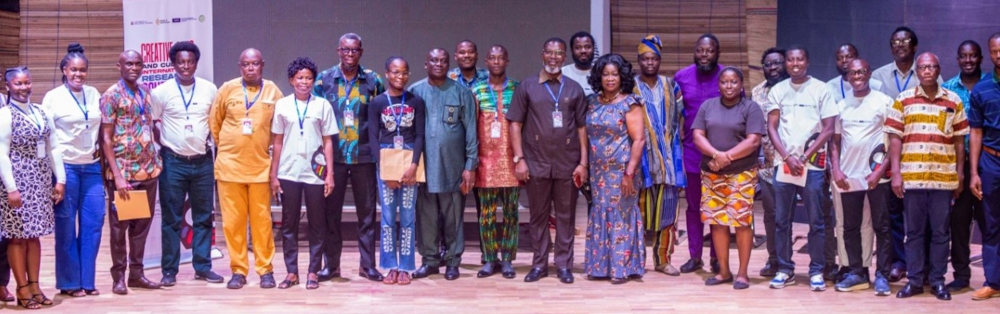
A Group Photograph of Dignitaries and Participants at CACIRC 2026 Closing Ceremony (Photo: Division of Public Relations and Communication, UEW)