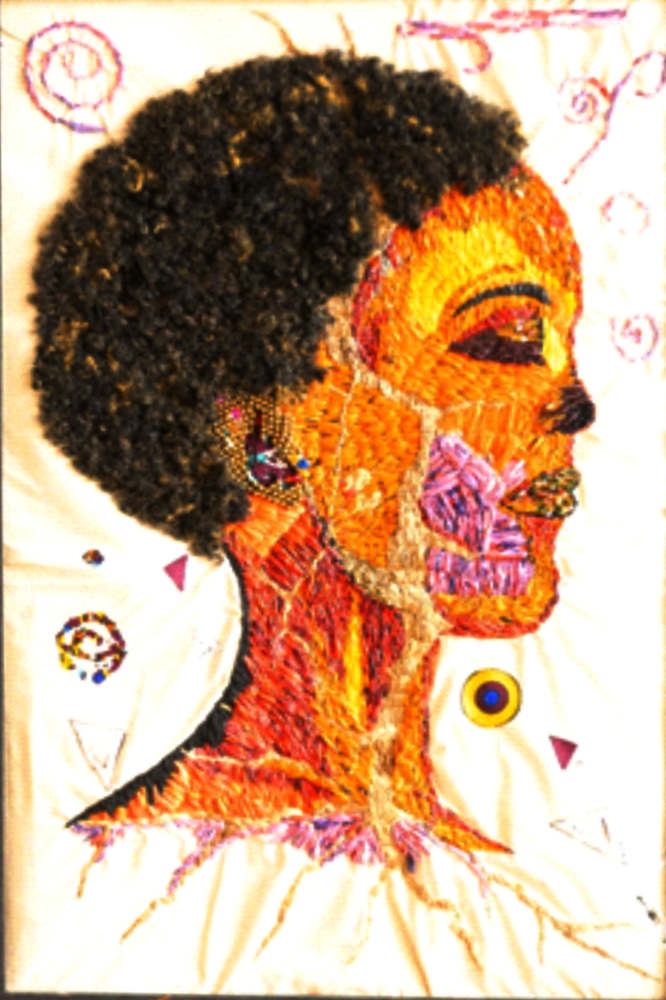
ESTHER ASSABAE. Untitled. 2026
This work was born from my reflections on how disruption shapes not only objects and societies, but also people. In creating this embroidery, I wanted to show that what seems fractured or broken can still hold strength, meaning, and beauty. My choice of materials, dry plantain stems, beads, plastic, and human hair, was deeply intentional, each one speaking to the dialogue between chaos and legacy. The dry plantain stems from the cracks across the face. For me, they embody fragility, yet also survival. A plant that once sustained life, now dried and brittle, it becomes a metaphor for how even loss carries memory and resilience. Beads are placed on the nose, mouth, and eyes. They are small, luminous markers of breath, speech, and sight, the very features that make us human. They remind me that identity and culture endure even when disrupted. Plastic is used to shape the face and neck. This material, often seen as destructive and polluting, here becomes structure and flesh. It challenges me to consider how even the most disruptive substances in our world might be reimagined into something of value. Human hair, stitched into the hairline, is perhaps the most personal element. It carries ancestry, lineage, and the intimate connection between body and legacy.
The face I embroidered is cracked but not destroyed. The fissures do not erase the figure; instead, they transform it. I wanted to show how people and communities, like fabrics, can fray under pressure but are redefined through acts of repair. In the end, this piece is my statement that legacy is not the absence of disruption but the beauty we create from it, threads of chaos stitched into permanence.