
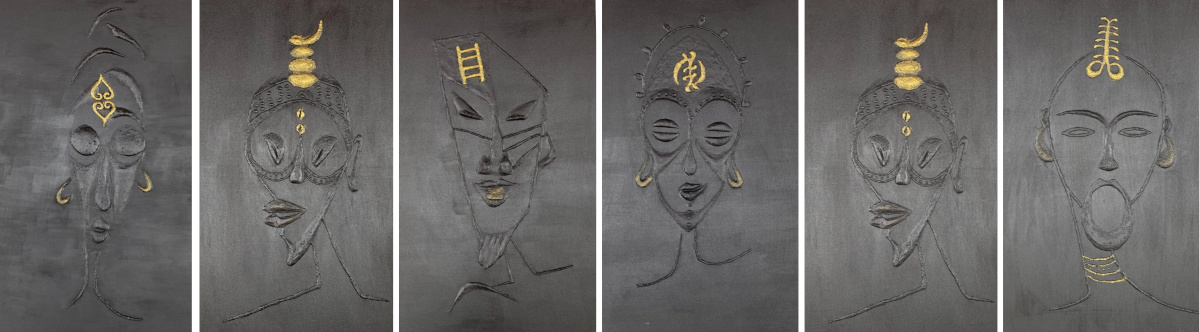
Mixed media (sand and acrylic on canvas), 36 × 24 × 1 inches each (series of 5)
Nyimpadua II is a practice-led visual inquiry comprising five interconnected works—Konde, Daadze Asa, Mesere Nyame, Obi nka n’asem, and Kaya—grounded in Indigenous Knowledge Systems and cultural preservation. Situated within Ghana’s contemporary condition of intersecting cultural, ecological, and spiritual crises, the series engages broader global conditions of polycrisis, exploring how indigenous epistemologies offer strategies of resilience, continuity, and resistance.
Rooted in a family history marked by recurrent childhood mortality, locally referred to as Awombawu, the project draws on Akan situational naming traditions developed as spiritual interventions against death. Within Akan cosmology, naming functions as a metaphysical and protective act, encoding grief, resistance, and ancestral resilience while sustaining collective memory across generations.
The compositions are anchored by central raised mask forms derived from African ritual aesthetics, functioning as both spiritual vessels and symbolic archives of ancestral presence. Through relief rendering, each work establishes a dialogue between Adinkra symbols and situational names: Owu Atwer with Konde, Asaase Ye Dur with Daadze Asa, Gye Nyame with Mesere Nyame, Eya with Obi nka n’asem, and Akoben with Kaya. Each pairing represents one piece within the series, collectively evoking themes of mortality, endurance, reverence, vigilance, and historical trauma while preserving fragments of Akan cultural memory.
The black surface represents the essence of human existence—a shared interior space that transcends racial, religious, and political differences. It reflects the universal shadow of grief and the pain of losing a loved one, uniting humanity through emotional and spiritual depth. From this darkness, golden Adinkra symbols emerge as luminous markers of wisdom and continuity.
Materially, the embossed mask incorporates sand as a meditation on mortality and return, reflecting the cyclical nature of life. Its tactile surface draws viewers into close proximity, extending the work beyond visual perception and creating an inclusive sensory experience for visually impaired audiences. Guided by Sankofaism, the work retrieves ancestral knowledge as a strategy for cultural survival, spiritual reclamation, and collective transformation.

Agnes Mensah Onumah is a Ghanaian contemporary artist and educator whose practice explores the intersections of memory, spirituality, and ecology. Drawing on African traditions, particularly Akan iconography, she examines how cultural identity endures amidst disruption and exploitation. Working through painting and mixed media, Onumah engages themes of mining, social displacement, and resource extraction, while affirming resilience, survival, and renewal.
Her recent works (Tribute to the West, Stripped Sacred, and Nyimpadua I) interweave ecofeminist thought with indigenous spirituality, transforming personal and communal histories into layered visual narratives. These pieces confront the tension between sacred traditions and extractive economies, offering both critique and pathways toward reimagined futures.
As both artist and educator, Onumah positions her practice as testimony and pedagogy, using art to spark dialogue, preserve cultural memory, and envision transformation. She has exhibited in Ghana, Poland, South Africa, and Brazil, with a practice resonant far beyond national borders.