
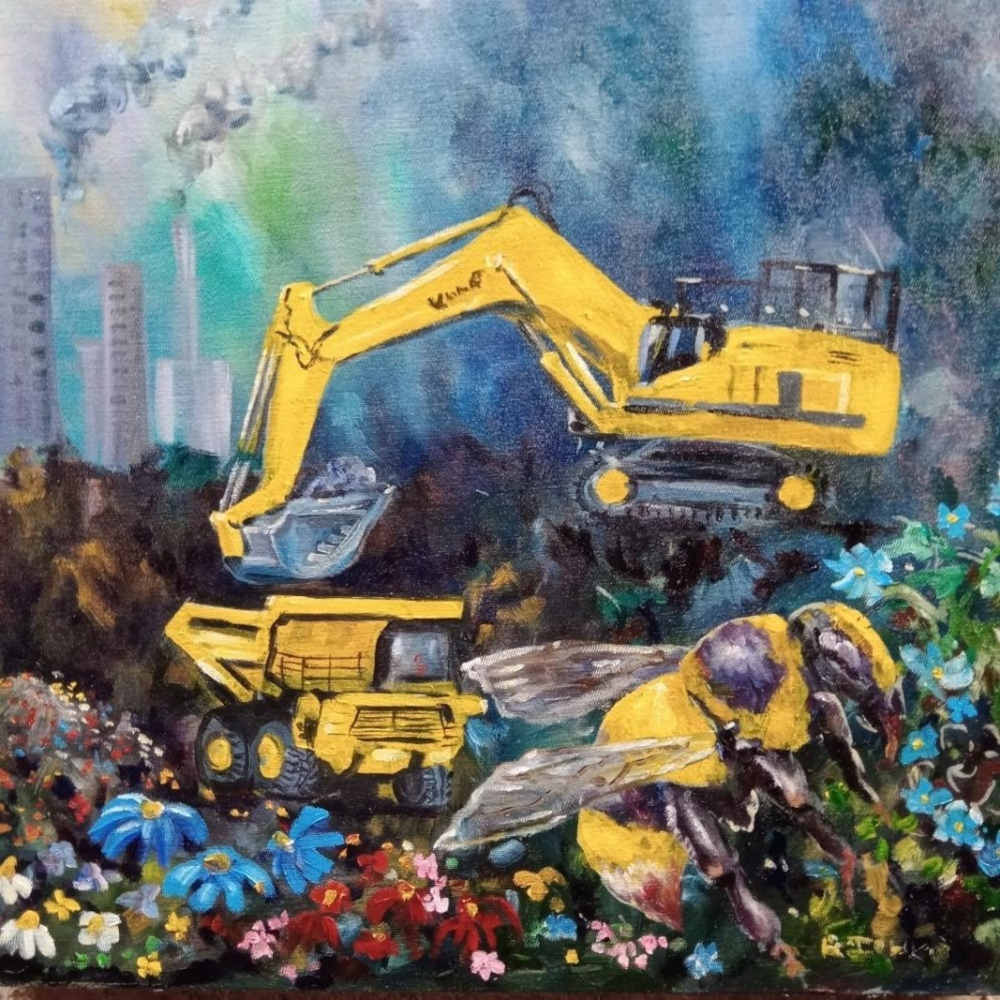
Oil on Canvas, 50 cm × 50 cm
The painting “Displacement” portrays a honey bee in the foreground foraging nectar among blooming flowers, while the middle ground reveals earth-moving machinery and the background an industrial complex releasing smoke into the atmosphere, symbolizing the encroachment of extractive industries on natural habitats. Through this contrast, the artist critiques the link between consumerism, industrial pollution, and climate change, highlighting how such activities threaten pollinators like bees—organisms that sustain ecosystems and support a significant portion of crop production and food security across Africa.
By juxtaposing the fragile act of pollination with large-scale industrial development, the work reflects growing environmental concerns in many African landscapes where resource extraction and rapid industrialization disrupt ecological balance. This visual narrative emphasizes that the decline of pollinators—responsible for supporting many crops and wild plants—poses a direct risk to biodiversity, agricultural productivity, and the stability of the food chain.
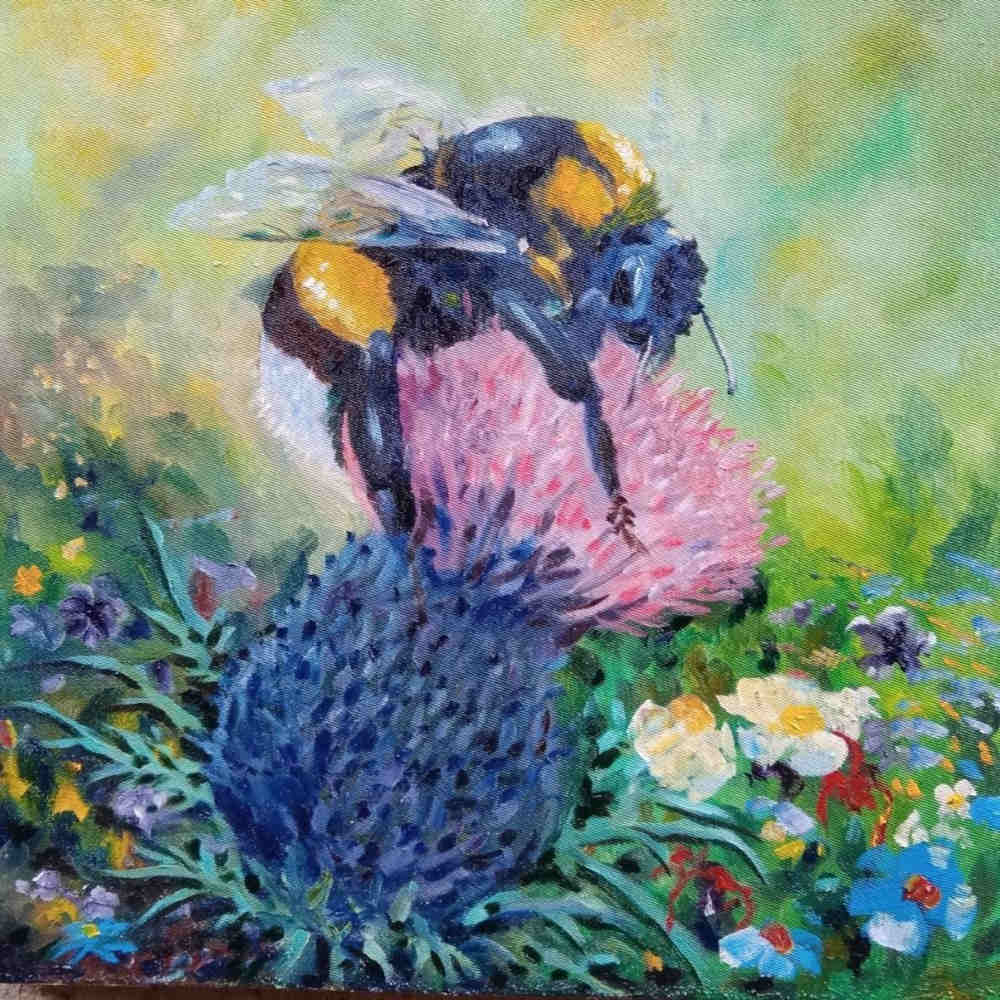
Rupante Tobiko. bumble bee dance. 2026. Oil on Canvas. 50 cm × 50 cm
This painting presents a close observation of a bumblebee as a symbol of the delicate beauty and balance found in nature. Through careful composition, vibrant colour, and expressive brushwork, the artist draws attention to the intricate form of the bee and the natural environment it inhabits. The work celebrates the quiet elegance of the natural world, encouraging viewers to appreciate the small yet vital creatures that contribute to the richness and diversity of ecosystems.
Beyond its aesthetic qualities, the painting highlights the ecological importance of pollinators, particularly solitary bees, which play a crucial role in plant reproduction and global food production. Their populations are increasingly threatened by the effects of climate change, habitat loss, and environmental degradation. By foregrounding the bumblebee, the artist underscores the urgent need for conservation, reminding viewers that the survival of pollinators is closely tied to the stability of the entire food chain and the sustainability of natural ecosystems.

My work is grounded in landscape as experience — in the shifting light on rolling plains, the silent dialogues between sky and earth, and the enduring rhythms of natural life. I am drawn to the beauty of Kenya’s ecosystems, but I am equally compelled by their fragility. With each brushstroke I am not merely to depict but to deeply feel the world around me, to reflect both its splendour and its vulnerability. It is from this place of witnessing that my work often becomes a meditation on conservation, belonging, and the shared human condition.
My media include oil paint and watercolour, which allow me to explore colour, form, and atmosphere with both precision and sensitivity. In recent years, I have also devoted significant study to smoke painting — an experimental medium that was the focus of my master’s thesis. Through hundreds of tests with smoke as pigment, I have discovered how this ancient, elemental process can evoke memory, impermanence, and presence in ways traditional media cannot, giving voice to histories both personal and collective.
I find meaning in the landscapes that surround us and in the human stories they hold. Whether rendered in oils, watercolour, or the delicate traces of smoke, my work is an invitation to pause, to reflect, and to imagine a more attentive and compassionate way of seeing the world.
Through the expressive brushstrokes in the painting below, I aim to highlight the beauty of nature with bold colours and enriched composition. The work celebrates not only the aesthetic wonder of the natural world but also the vital role of pollinators in our ecosystems, which support global food systems and biodiversity. Pollinators such as bees, butterflies, birds, and bats are essential for the reproduction of most flowering plants, and approximately 75–87 % of the world’s food crops depend on animal pollination, underscoring its critical link to food security and ecosystem health.
Unfortunately, these crucial ecosystem services are increasingly threatened. Human-driven climate change is one of the most significant drivers of pollinator decline worldwide, affecting their habitats, reproductive cycles, and plant–pollinator synchrony. Rising temperatures, altered weather patterns, and habitat disruption can lead to mismatches between when plants bloom and when pollinators are active, reducing pollination success and plant reproduction.
This decline reflects a broader loss of biodiversity linked to human activities. Extensive land use change, resource exploitation, pollution, and climate change have collectively pushed many species toward extinction, with an estimated one million species— including many insects threatened globally.
At the same time, unsustainable consumerism has driven the construction of mega-scale machines and systems that extract Earth’s resources, often with little regard for ecological limits. This resource exploitation contributes to habitat loss, species displacement, and disruption of ecological networks—ultimately weakening the balance that maintains ecosystem function.
The loss of pollinators and other organisms does not occur in isolation; it disrupts the equilibrium of ecosystems, which rely on complex interactions among species to sustain nutrient cycling, food webs, and resilience to environmental stressors. If key species disappear, these networks can collapse, leading to declines in ecosystem services that humans depend on—such as food production, climate regulation, and clean water.
In the long run, continued degradation of natural systems driven by climate change and resource exploitation will significantly impact human life, from increased food insecurity to weakened ecosystem resilience in the face of environmental change.