
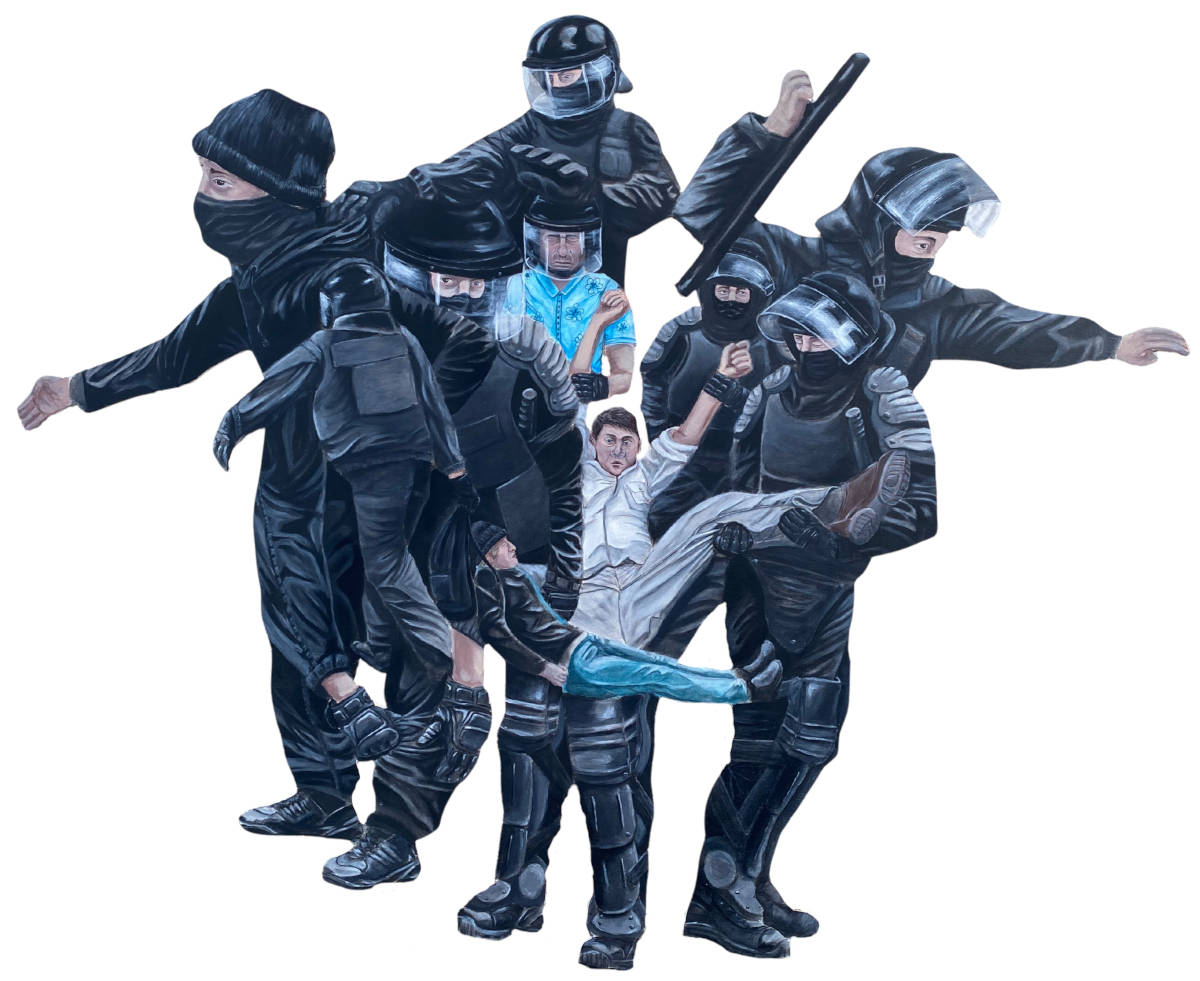
Acrylics on wood cut out. 120cm x 100cm
At demonstrations, individuals often find themselves standing face to face, defining one another as adversaries in response to a charged situation. In these moments, the focus can unintentionally shift away from the issue being protested toward a direct, physical confrontation between opposing sides. The original cause risks fading into the background as the encounter becomes embodied, reduced to gestures, resistance, and proximity.
Empathy and recognition of shared humanity falter when mediated through uniforms, symbols, or protest signs. Strangers become quickly categorized, and firm conclusions are drawn about their beliefs, intentions, and identities. What emerges is less a dialogue about the underlying problem and more a visible struggle between groups whose differences appear irreconcilable.
In the painting, the bodies of the figures are interwoven, forming a dense and inextricable knot. Limbs overlap and merge in a way that makes it increasingly difficult to distinguish where one body ends and another begins. The boundaries between the supposed opposing sides begin to blur, dissolving the clarity of division that initially defined the confrontation.
From a distance, this entanglement reveals a different reading: rather than two clearly separated factions, what becomes visible is a shared physical and emotional condition. The figures are bound within the same tension, suggesting how conflict, intensified by social and political pressures, can obscure underlying interdependence.
The work reflects on how contemporary divisions, shaped by fear, instability, and competing narratives, often mask deeper commonalities. What appears as opposition may in fact be a shared entanglement within the same uncertain conditions.
Nikolas Pfanzelt (b. 1999, Kempten, Germany) is an artist and art educator based in Weingarten. From 2020 to 2025, he studied Art Education at the University of Education Weingarten, completing his Bachelor’s degree with a thesis titled: „The Role of Irritation in Aesthetic Perception“. Since 2025, he has continued his studies in the Master’s program in Art Education. Alongside his studies, he is actively involved in the Department of Art at the University of Education Weingarten as a student and research assistant.
Pfanzelt’s artistic practice explores the tension between the individual and the collective dimensions of human existence. Through painting and sculptural work, he investigates socially constructed images of identity and belonging. By deliberately employing irritation as an aesthetic strategy, his work challenges viewers to question internalized norms, expectations, and perceptions of what it means to be human.