
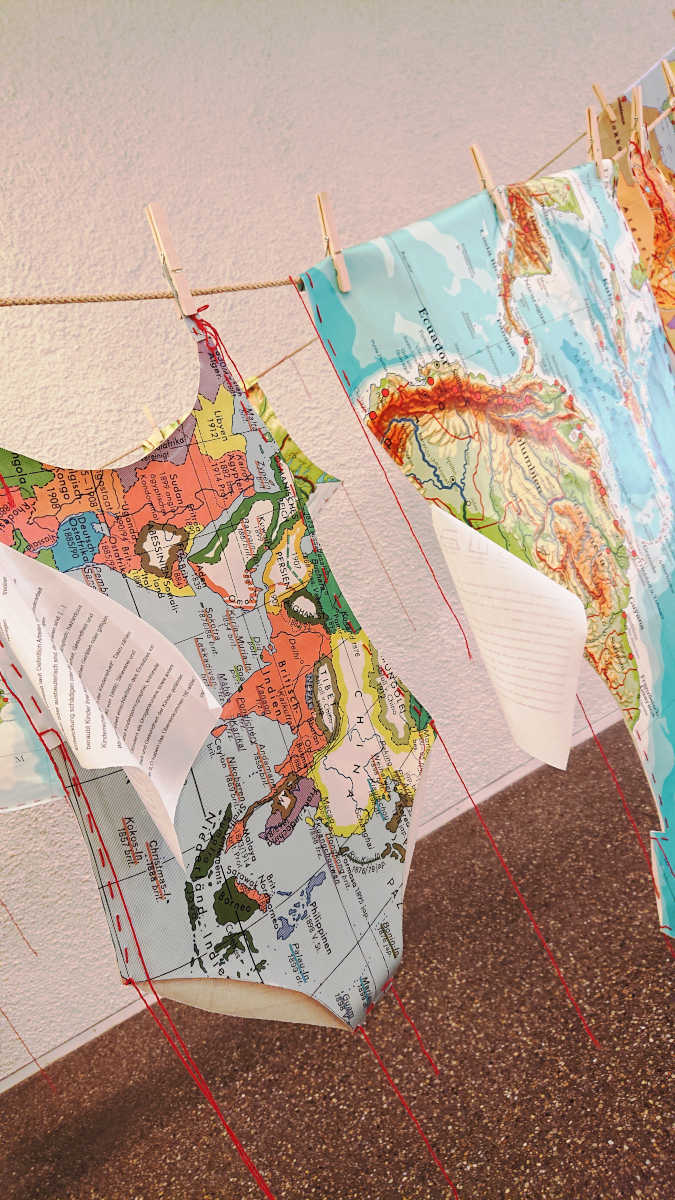
Installation: model, string, clothes pegs, laundry basket, maps
World Hand Hygiene Day, World Crossword Day, World Laughter Day, World Tumbling Day, World Emoji Day, World Soap Bubble Day, World Egg Day, World Donkey Day—there are countless “world days,” some of which seem rather bizarre. One day that does not exist, yet might be highly desirable, is the fictional “World Washing Day.” “World Washing Day,” originally titled Weltwaschtag, is the name of the artwork presented here.
When numerous old maps from geography lessons were discarded at a school in Augsburg, the idea arose to recycle this material for an artistic project. The maps were transformed into symbolic garments hanging on a line like freshly washed laundry, while the red wooden rods from the maps were reused as poles for the clothesline. In response to the growing number of such sometimes curious observances, the work imagines a new, fictional day: one dedicated to “washing” the world.
The metaphor of washing operates on several levels. In its most immediate sense, washing removes dirt and restores hygiene and order. At the same time, in many cultural and religious traditions, washing can symbolize purification, renewal, or the removal of guilt. Yet the notion of “washing things clean” is also viewed critically today, as terms such as greenwashing or money laundering reveal how acts of cleaning can conceal underlying problems. Within this tension, “World Washing Day” reflects the human desire for renewal while acknowledging that complex global challenges cannot simply be washed away. The garments contain laundry labels similar to those found in everyday clothing. These labels name and briefly explain key problems facing our world.
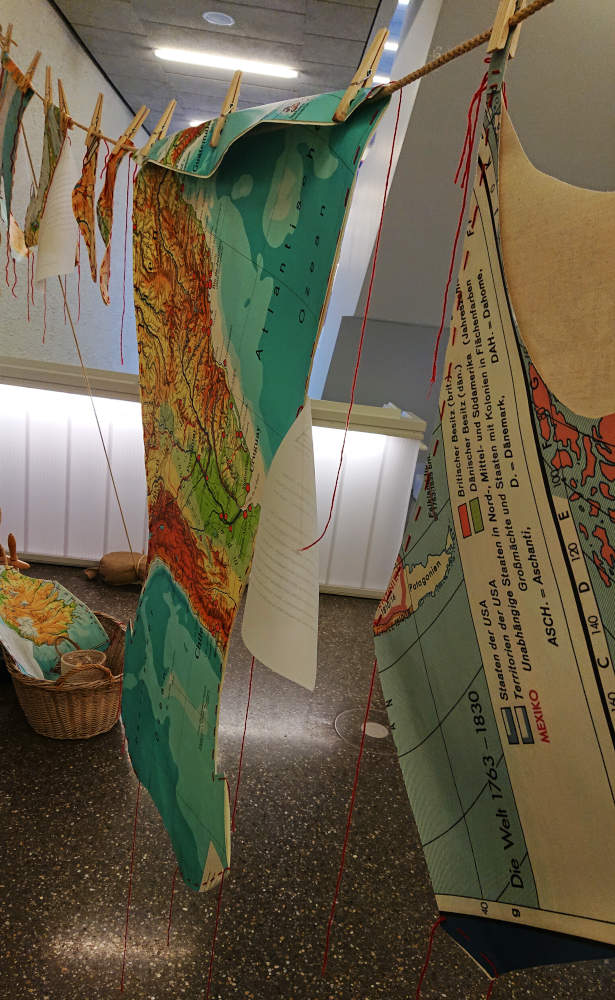
Fourteen labels address issues including water scarcity, child labor, hunger, refugees, the climate crisis, drug trafficking, war, species extinction, dictatorship, slash-and-burn agriculture, the waste of raw materials, environmental disasters, the exploitation of rare earths, and microplastics. Each term is accompanied by a short informational text printed on white fabric and sewn into the garments’ side seams. Typical care symbols along the upper edge mark them as washing instructions.
Visitors can walk through the installation, lift the labels, and read the texts—becoming actively involved in the work. The installation follows the idea that artistic practice can engage with social realities. By drawing attention to environmental damage and social injustice in our world, it seeks to encourages reflection about responsibility in a shared world

Lena Frischmann was born in Augsburg in 2003 and is now studying secondary modern school education at the University of Augsburg. She is expected to complete this degree program in fall 2026. After that, she plans to pursue a master’s degree in art pedagogy and subsequently become a high school art teacher. Lena particularly enjoys working with textiles and also likes using paper and reflectors in her artwork.