
Toyin Ojih Odutola’s metro station of stories
Hectic bustling at a subway station. People wait impatiently, letting their gaze wander, and then everything usually happens very quickly. The train pulls in. New perspectives open up, revealed through the windows of the carriage, before disappearing again behind pillars. The brief moment in which these lines of sight open up, in which one becomes part of a scene, a conversation, or even a direct encounter, creates something special - and yet is almost impossible to grasp.
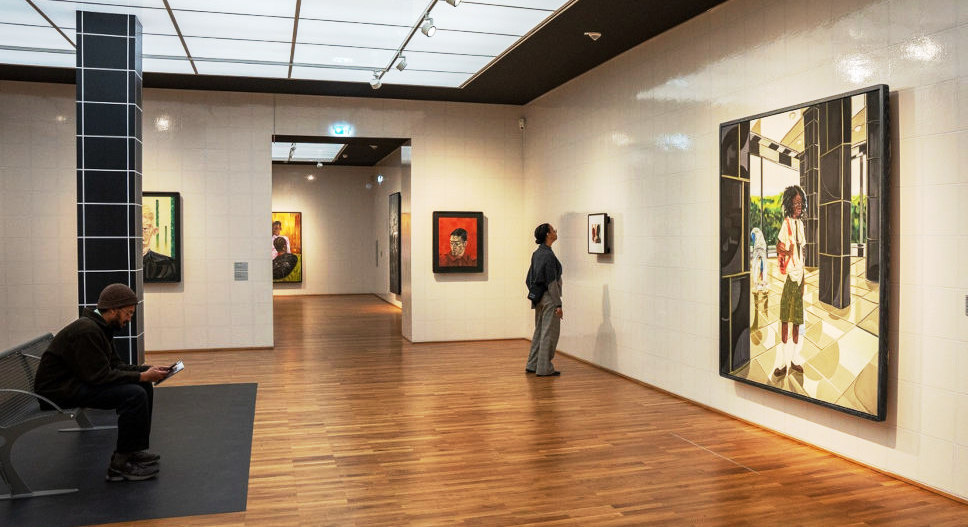
Nigerian artist Toyin Ojih Odutola worked with this metaphor of the train station as a hub of migration and stories when setting up her exhibition “U22 – Adijatu Street” at the Hamburger Bahnhof in Berlin. The Museum of Modern Art showed 25 works on paper and canvas, which the curatorial team described as “narrative portraits” (back cover of the exhibition catalogue, published by Silvana Editoriale Milano).
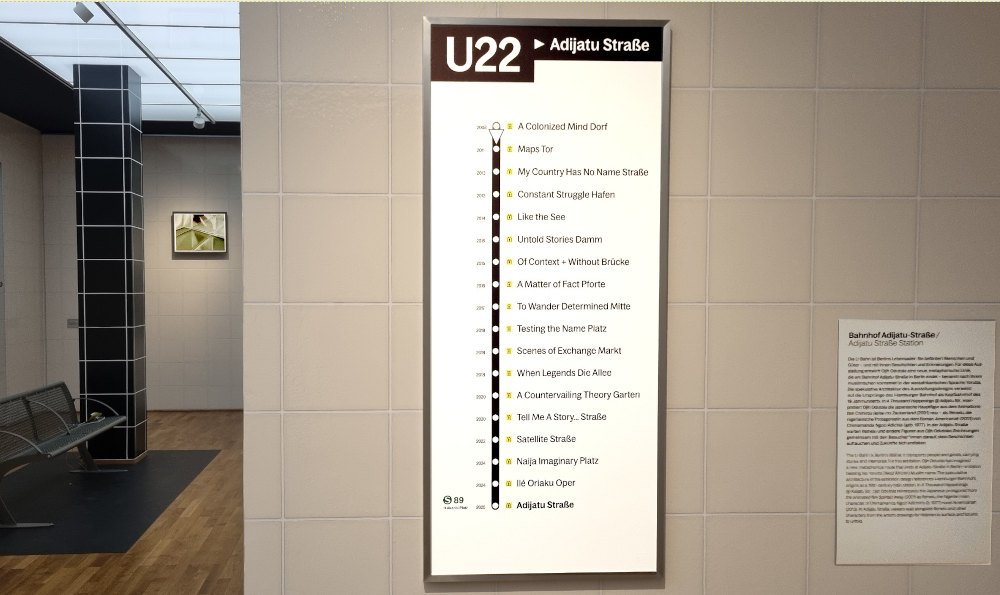
Exhibition view (Photo © Ernst Wagner)
While the figures depicted in the portraits occupy the foreground of the pictorial space in a relatively classical manner, the different backgrounds evoke changing contexts. Spread across the four rooms in the east wing of the former railway station, the exhibition creates a network of stops where visitors can make contact with the protagonists in the portraits (complete with loudspeaker announcements, artificial subway tiles, and uncomfortable benches – as familiar from the Berlin subway).
"It is not about the portrait itself. The pictorial space rather becomes a stage or event—something very dynamic that responds simultaneously to the circumstances of the time and our environment," the artist describes in an interview with curator and co-director of the museum Sam Bardaouil (p. 49).
Toyin Ojih Odutola was born in Ile-Ife, Nigeria, in 1985 and migrated to the southern United States as a young girl. This move was the first of many lifelines depicted on a world map at the end of the exhibition and set in correlation with the flight routes to her exhibition venues (except Venice, where she was part of the Nigerian Pavilion in 2019 and 2024). A juxtaposition of personal journey and artistic endeavours, in which Ojih Odutola examines the social and political dynamics of these various places, asking questions such as: What history do I carry within me? Who is my counterpart? And will we meet again?
"Because I constantly grapple with the different perspectives within my family, with its diverse social affiliations and beliefs, I perceive time as flexible and intuitively comprehensible", says the artist, describing her complex images that connect individual destinies with speculative futures (p. 43).
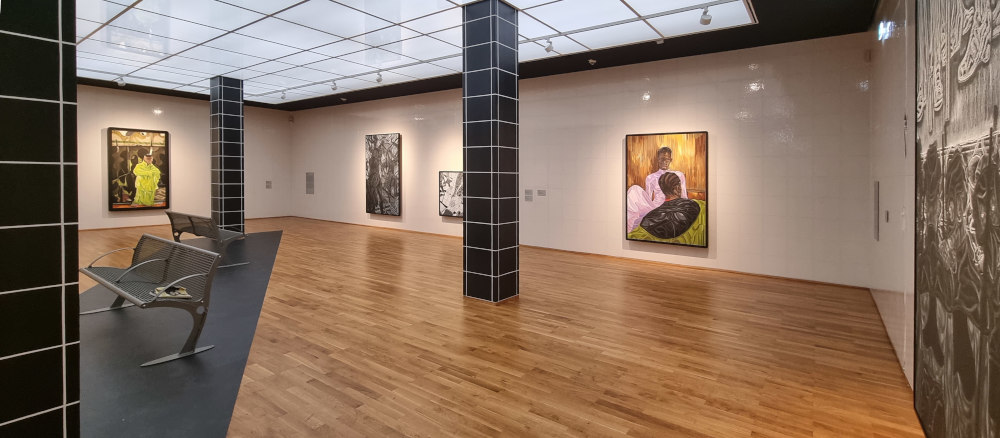
Exhibition view (Photo © Benjamin Merten)
The hanging on different levels challenged guests to engage with the individuals depicted: sensitive, somewhat disturbed, yet self-assured gazes that are rarely captured. An androgynous boy stands in oversized clothes at a vintage market in Lagos, looking after someone (“Balogun Market Vintage,” 2024-25). Are these his grandfather's clothes - or a reference to the dubious clothing donations from Europe? Another man lies naked in bed, his thoughts far away from his partner, who herself turns away from him. Both these stories are merely hinted at, but are difficult to reconstruct plausibly. Too often, the figures seem to fall out of Ojih Odutola's pictorial spaces. It seems as if the ground dissolves into a cubist fragmentation of context. There are low angles, double floors, harsh shadows. With these painterly devices, too, the artist deliberately encourages us to question the factual content of a scene.
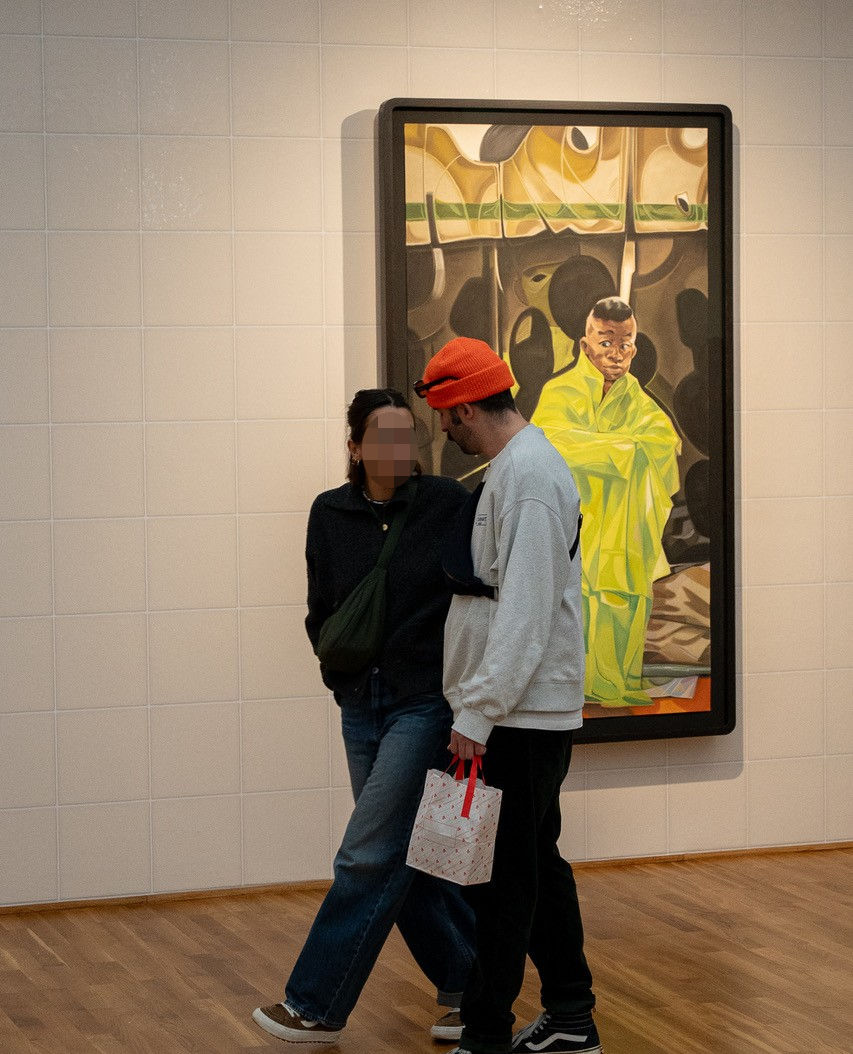
Exhibition view (Photo © Benjamin Merten)
Ojih Odutola is a talented illustrator, but she does not limit herself to quick sketches with charcoal and graphite. In her earlier works, she uses ink pens to trace over body parts and faces of her protagonists. The skin is then no longer realistic - and certainly not pale, delicate, and “pure,” as in European art history. Applied with a fine ballpoint pen, the complexion is more reminiscent of tendons, hair, or muscles - and thus becomes substance. Ojih Odutola herself favours comparisons with topographical maps or landscapes, which complement the surface and highlight the psychological quality of the process. “Coloring the skin was a method of localizing a feeling,” she explains (p. 48). Skin is then not only the surface of a human being, but also raises questions about identity, texture, and cohesion. Particularly in the context of Black figurative painting, these portraits are thus more than representative attributions to a certain cultural identity (see also Leigh Raiford, Professor of African American and African Diaspora Studies at the University of California, Berkeley, and Anna-Maria Kellen Fellow at the American Academy, Berlin, in her essay on p. 32).
At the end of the show, in the educational space designed by the artist, two videos are shown that also deal with migration and history. On the screen to the left, a television report from the 1970s shows the visit of Nigerian soldiers during the strict training of the German army (while taking part in an exchange program). The other screen features an interview with a Vietnamese couple living in the former GDR who, after German reunification, suddenly find themselves confronted with an unclear residence status. These are two of numerous examples in which international encounters cannot be read as a linear migration story, but rather as an anchor point for cultural connections and pluralistic societies. Or in other words: As a metro station of stories.
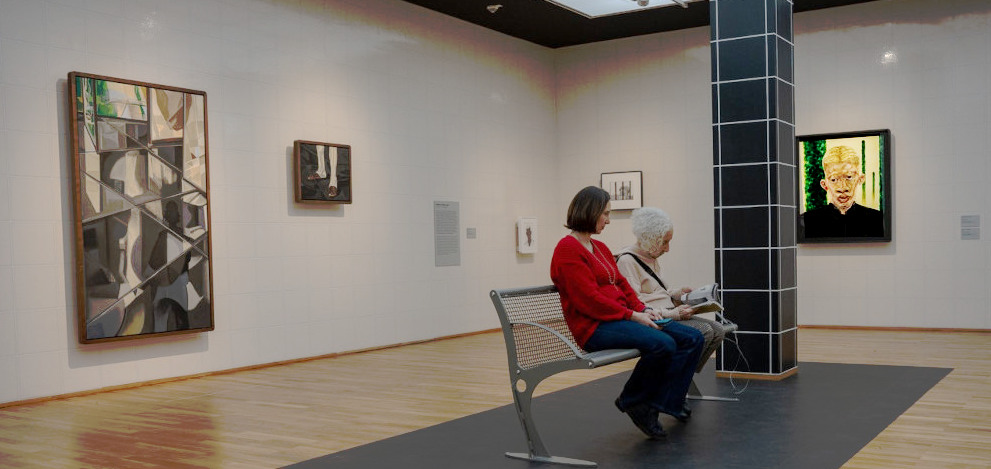
Exhibition view (Photo © Benjamin Merten)
The exhibition was curated by Sam Bardaouil and Till Fellrath, as well as assistant curator Emily Finkelstein for the Hamburger Bahnhof - Nationalgalerie Gegenwart, and was on show from June 13, 2025 until January 4, 2026.
References
Sam Bardaouil