
DECOLONISATION BEGINS IN THE SOIL
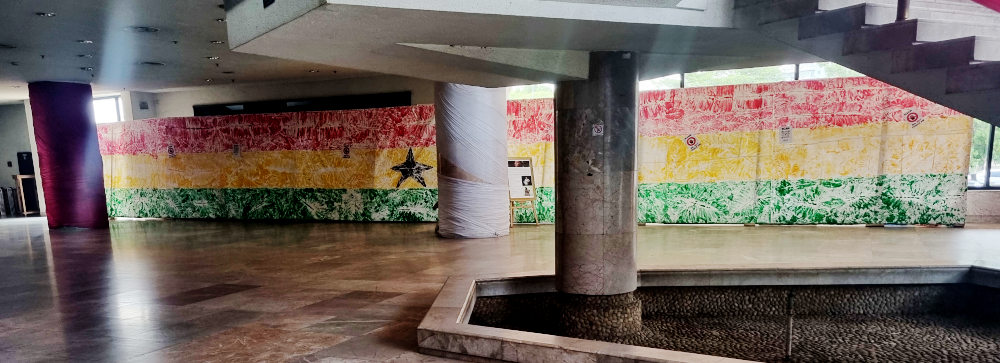
Image: Sharon Dede Padi. Not titled. 2025. 54.33 m². Copyright: Padiki
In a world characterised by long-standing Western-centric narratives and a rigid hierarchy of artistic materials, contemporary artists in Ghana continue to thrive and make strides on the international art landscape. Challenging the hegemony of the art world, these practitioners move beyond mere representation to dismantle the structures of aesthetic valuation. One such artist is Padiki (known in formal circles as Sharon Dede Padi), an architect, project manager, and scholar whose recent Guinness World Record (GWR) for the largest leaf-print artwork has captured global attention. While this achievement is a personal milestone, its deeper significance lies in how it exemplifies a resilient Ghanaian tradition of revaluing indigenous materials. This essay demonstrates how Padiki’s work independently mirrors and amplifies ongoing decolonial efforts. I do this by examining her practice against the backdrop of colonial art education and the contested platform of the GWR.
The Colonial Legacy of Art Education in Ghana
To fully appreciate the intervention Padiki’s work represents, one must first understand the colonial framework it implicitly challenges. The influence of colonial art education on modern African movements embedded specific hierarchies that favoured European aesthetic forms. Woets (2014) documents how the "Hand and Eye" curriculum at Achimota School (est. 1927) prioritised mechanical drawing and still-life composition while excluding the critical modules of art history and appreciation. This legacy often restricted Ghanaian students to replication rather than ideation. Historically, the curriculum privileged imported oils and canvases over indigenous practices, a move, critics like Olu Oguibe argue, was deliberate, serving to preserve a "colonial dependency" by suggesting that a high aesthetic sensibility belonged exclusively to Western culture (Woets, 2014). Against this century of institutionalised preference, Padiki’s choice of local leaves as her primary medium is a profound political reclamation.
Padiki’s Practice: A Revaluation of Indigenous Materiality
Padiki’s record-breaking 54.33-square-meter print, depicting the Ghanaian flag, was created using natural leaves sourced across the country. The leaves include cocoyam, plantain, cocoa, and shea.
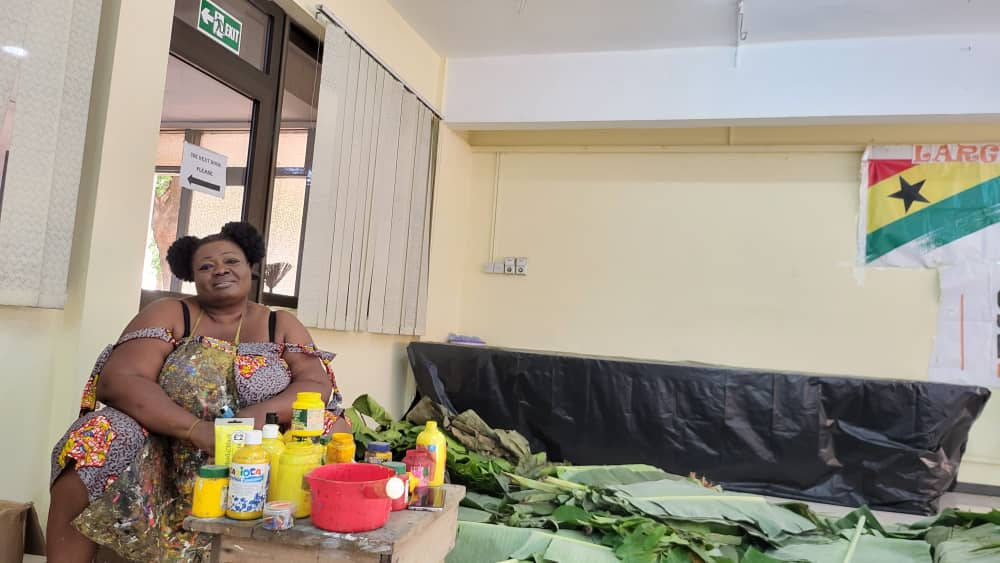
Figure 2: Padiki displays the materials (acrylic paints and locally sourced natural leaves) for her record-breaking artwork. Copyright: Padiki
Historically, direct printing was relegated to the "craft" tradition, distinct from the "fine art" of the academy. However, as scholars like Pöllänen (2011) and Shiner (2012) contend, this boundary has essentially disappeared in contemporary practice, as craft has evolved into a holistic, culturally engaged methodology.
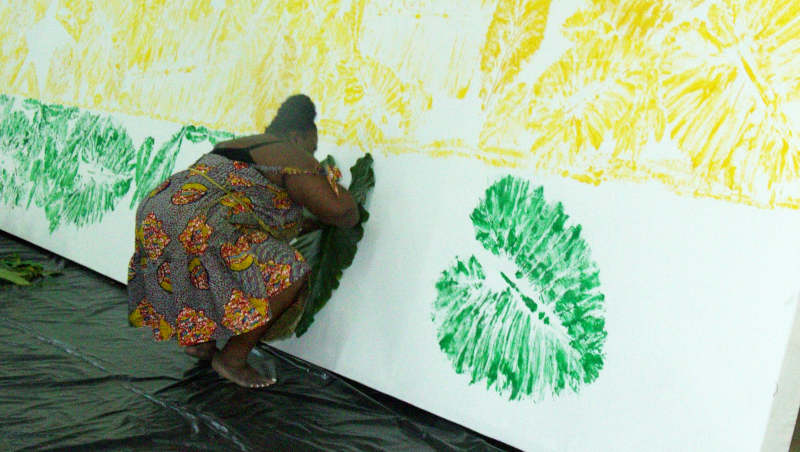
Figure 3: Padiki prints with cocoyam leaves with the direct printing technique. Copyright: Padiki
Padiki’s project extends this theoretical collapse into tangible practice. The leaves she chose are not arbitrary; they are biological archives of Ghana’s food systems, medicine, and biodiversity. As noted by Hon. Abla Dzifa Gomashie, the work preserves "indigenous knowledge" at a time when many traditional medicinal leaves are disappearing from public consciousness (Bediako, 2026).
A Parallel Lineage of Material Reclamation
Padiki holds a BSc in Architecture from the Kwame Nkrumah University of Science and Technology (KNUST) and a master’s degree in construction and project management from London Southbank University and is currently pursuing a PhD in Museum and Heritage Studies at the University of Ghana. While Padiki completed her architectural training at the Kwame Nkrumah University of Science and Technology (KNUST) before the formal introduction of the Emancipatory Art Teaching Project (EATP) led by the scholar, kąrî’kachä seid’ou, her work represents a significant parallel evolution. The EATP and the broader "BlaxTARLines" movement later radicalised the KNUST Art Department by encouraging a "heteronomy of materials" and site-specific installations (Bodjawah et al., 2021).
Padiki’s practice, though developed through the technical lens of architecture and independent artistic exploration, arrives at a similar decolonial destination. She extends the lineage of masters like El Anatsui, who transformed manufactured waste into new orders of surplus visuality, and Ibrahim Mahama, a beneficiary of EATP, whose monumental installations of jute sacks interrogate the global history of global commodity exchange and labour. Whilst Mahama utilises the industrial "skin" of trade to wrap architectural monuments, Padiki returns to the living flora of the Ghanaian landscape to print a national icon.
Both artists share an obsession with the "material memory" of Ghana, but take different approaches. Mahama expresses this through the weathered fibres of commerce, and Padiki through the organic textures of the soil. Altogether, Padiki proves that the impulse to reclaim indigenous and found materials is both a widespread intellectual shift in Ghana and an independent practitioner's endeavour.
The Guinness World Record: Strategic Engagement or Spectacle?
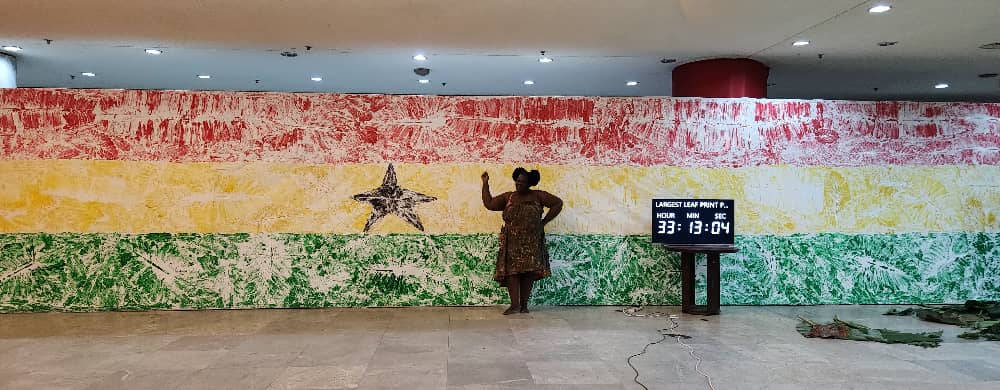
Figure 4: Padiki displays the Guinness World Record largest leaf-print artwork. Copyright: Padiki
The central tension in Padiki’s achievement lies in the institution that validated it. The GWR, founded in London in 1955, has a history of "exoticising" achievements from the Global South, often reducing culture to a commodified spectacle. Seeking validation from a Western institution that thrives on the logic of measurement and classification is inherently ironic.
However, Padiki’s approach is best understood as strategic institutional engagement. She achieved this milestone by creating a new category for monumental "leaf printing" as method. In the process, she forced a Western platform to recognise a technique rooted in Ghanaian material practice that had no prior place in its archives. She has effectively "reappropriated" the platform, using the global megaphone of the GWR to redirect attention toward Ghanaian cultural preservation, environmental advocacy, and the scholarly documentation of indigenous botany.
Visual Ecology and Environmental Advocacy
A vital dimension of Padiki’s work is its response to the ecological crisis. She frames the record as a megaphone for the "silent calls" of plants being destroyed by galamsey (illegal mining) and deforestation. In this context, decolonisation and ecological preservation are intertwined. Colonial extraction economies devastated Ghana’s biodiversity. Padiki symbolically restores value to the very flora threatened by extractive capitalism by creating her monumental work from leaves. Her work establishes a "Visual Ecology" where the leaf is both the medium and the message of sovereignty over the land.
Funtunfunefu-Denkyemfunefu: A Unified Framework
Padiki grounds her multidisciplinary career in the Akan Adinkra symbol Funtunfunefu-Denkyemfunefu (the Siamese crocodiles). This symbol represents unity in diversity, a worldview in which separate identities cooperate toward a shared goal. Her life as an architect, project manager, poet, and PhD scholar embodies this philosophy. This integration mirrors pre-colonial African modes of knowledge, where the distinction between "builder," "historian," and "maker" was fluid. Her career serves as a "shared stomach," where different academic and professional "heads" nourish a singular mission of Ghanaian cultural empowerment.
Conclusion: A Material Blueprint
Sharon Dede Padi is more than a record holder; she provides a blueprint for what a decolonised artistic practice can look like. While her training preceded specific modern academic movements at KNUST, her work stands as a typical example of the organic, widespread movement toward reclaiming the Ghanaian identity. Padiki shows that decolonisation begins in the soil, not as a slogan, but as a material practice of reclaiming the leaves, plants, and stories of one’s environment. As she continues her doctoral research, she joins the ranks of those ensuring that African art history is written, painted, and printed by those who live it.
References
- Bediako, K. (2026). Guinness World Record Holder Sharon Dede Padi Presents Historic Leaf-Print Artwork to Tourism Culture and Creative Arts Minister. Ghana Broadcasting Cooperation. https://www.gbcghanaonline.com/news/guinness-world-record-holder-sharon-dede-padi-presents-historic-leaf-print-artwork-to-tourism-culture-and-creative-arts-minister/2026/
- Bodjawah, E., Boafo, K., Castro, K., Buma, G. A., Ohene-ayeh, K., Amenuke, D., Adashie, M., Mahama, I., Mcternan, B., Akoi-jackson, B., Owusu-ankomah, K., Kujie, S., Riskin, R., Naa, T., & Thompson, K. (2021). Transforming Art from Commodity to Gift. African Arts, 54(2), 22–35. https://www.researchgate.net/publication/351320425_Transforming_Art_from_Commodity_to_Gift_kari’kacha_seid’ou’s_Silent_Revolution_in_the_Kumasi_College_of_Art/link/60bc8e9d92851cb13d7edd60/download
- Pöllänen, S. H. (2011). Beyond craft and art: A pedagogical model for craft as self-expression. International Journal of Education Through Art, 7(2), 111–125. https://doi.org/10.1386/eta.7.2.111_1
- Shiner, L. (2012). “Blurred boundaries”? Rethinking the concept of craft and its relation to art and design. Philosophy Compass, 7(4), 230–244. https://doi.org/10.1111/j.1747-9991.2012.00479.x
- Woets, R. (2014). The recreation of modern and African art at Achimota School in the Gold Coast (1927-52). Journal of African History, 55(3), 445–465. https://doi.org/10.1017/S0021853714000590