Sankofa: The Strokes Return Home - Curatorial Statement
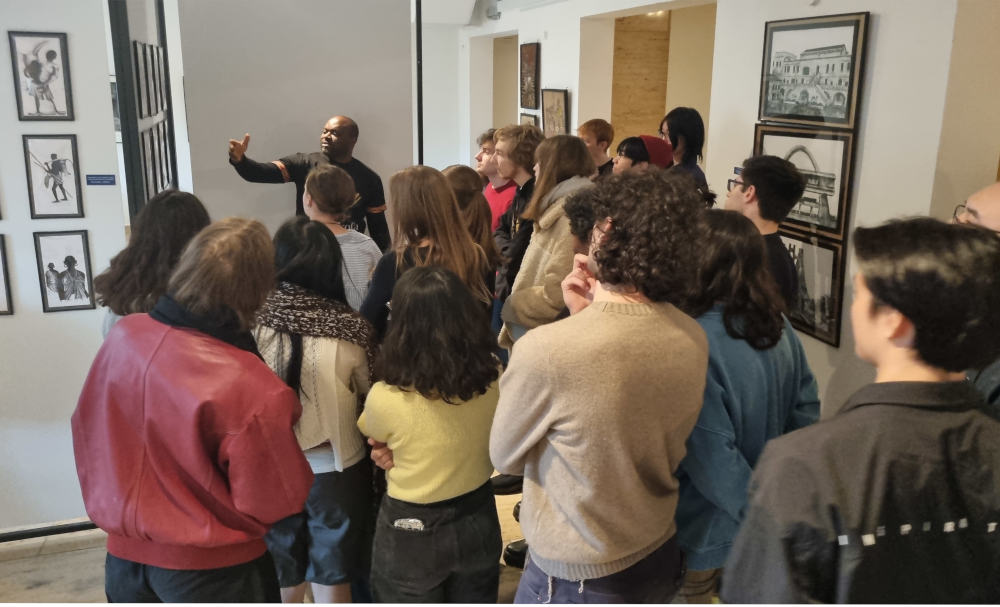
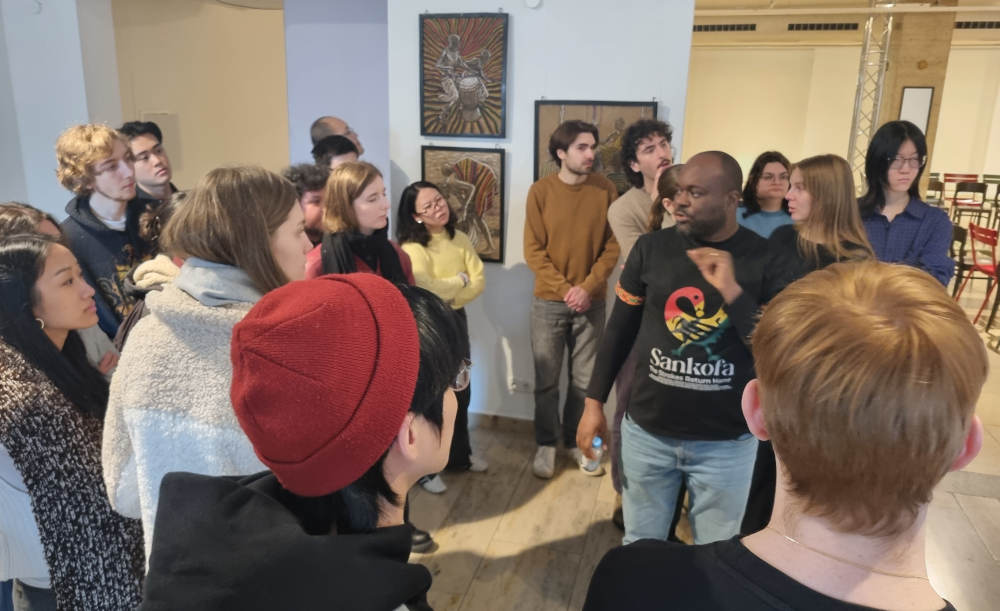
The Strokes Return Home presents a collective declaration of artistic and intellectual sovereignty. This exhibition is the culmination of a radical pedagogical experiment in the Department of Art Education at the University of Education, Winneba. It is also a deliberate, decolonised intervention in the Independent Studies in Drawing (ISD) course for level 300 students in the 2025 academic year.
Here, we witness a fundamental reorientation. The conventional, Westernised classroom, with its emphasis on the neutral ground of the "unmarked canvas," still life, landscape, and figure study, has been reimagined. In its place, a collaborative studio of critical inquiry has emerged, where drawing is not a universal skill to be mastered but a culturally situated language to be reclaimed. The students have shifted from passive recipients of a foreign canon to active investigators of their own visual heritage.
The guiding principle is Sankofa: the profound Akan wisdom that teaches us to return to and retrieve what is vital from our past to navigate the present and build the future. In this context, every mark, every stroke by these seventeen artists, is an act of return. A return to indigenous symbols, ancestral memory, materials steeped in local meaning, and narratives silenced by colonial history. The drawn stroke becomes a deliberate, physical manifestation of this retrieval, a line that connects past to present and memory to material.
The works on view demonstrate a powerful achievement: material and aesthetic sovereignty. The artists have defined their own terms of engagement. Calabash, maize sacks, plantain leaves, Oware game boards, sewing threads, and stone slabs are not mere supports; they are co-narrators, carrying histories of sustenance, play, governance, and resilience. Techniques such as pyrography, stitching, stippling, and charcoal patterning are chosen not for academic pedigree but for their conceptual resonance and their capacity to hold cultural memory.
Anastasia Eshun carefully inscribes Adinkra philosophy onto paper, while Francisca Osei Boateng etches the trauma of enslavement onto the playful surface of Oware. Meanwhile, Selassie Nkrumah uses hyperrealism to block out the colonial gaze and highlight the dignity of African features. From Clara Asare’s rhythmic carvings on calabashes to Victus Apedo’s sewn Kente "drawings," each work shows that our local materials and techniques are not only suitable for "high art" but are its fundamental, philosophical basis.
This exhibition goes beyond showcasing student works; it symbolises a shift in perspective. It honours the bravery to question, the discipline to research, and the creative drive to integrate ideas. These students have not just brought back their artwork; they have forged a new path for future generations, envisioning a future where Ghanaian art education is firmly grounded in its own cultural wisdom. They call on us to observe, understand, and remember.
Curator: Ebenezer Kow Abraham, Department of Art Education, University of Education, Winneba
Access to the virtual exhibition.
Download the catalogue.