
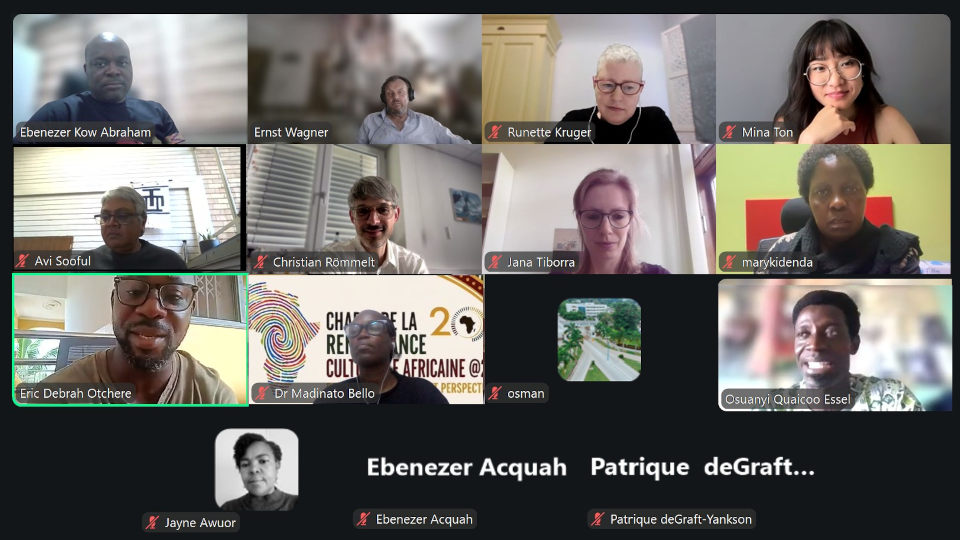
Present: Avi Sooful (Chair), Ebenezer Kow Abraham (Secretary), Ernst Wagner, Runette Kruger, Mina Ton, Christian Rommelt, Jana Tibora, Mary Clare Kidenda, Eric Debrah Okyere (University of Cape Coast, Ghana), Madinatu Bello (University of Cape Coast, Ghana), Osuanyi Quarcoo Essel, Patrique deGraft Yankson, Ebenezer Acquah
Apologies: Bernadette Van Haute, Meike Lettau. Canyürek Özlem
Welcome and New Member Introductions
The Chair officially welcomed the panel members and extended a special welcome to two new participants from the University of Cape Coast (UCC), Ghana, courtesy of Ernst Wagner.
- Dr Madinatu Bello introduced herself from the Department of Theatre Arts and Film Studies at UCC. Her specialisation spans Arts Management and Cultural Sustainability. She highlighted her extensive history with German-funded projects, including her PhD under the SDG Graduate School project (coordinated by Meike Lettau), the "Co-creating Avenues for Sustainable Development" project, and the recent "Reframing Colonial Legacy" initiative in Friedrichshafen, where she met Ernst Wagner.
- Prof. Eric Debrah Okyere introduced himself as an Associate Professor of Music Education in the Department of Music and Dance at UCC. He previously served as the director of the DAAD-funded SDG Graduate School project mentioned by Dr Bello and has collaborated on several overlapping sustainable development projects.
The Chair expressed high enthusiasm for their joining, noting that they would be excellent additions to the EVC family and future contributors to newsletters, research projects, and informational frameworks.
Agenda Items & Project Updates
3.1 Feedback on the Zeppelin Universität Conference- Germany
Ernst Wagner suggested a postponement of feedback due to the inability of the organisers, Meike Lettau and Özlem, to attend. The formal discussion and feedback regarding the conference at Zeppelin Universität in Friedrichshafen, Germany, was postponed to the next meeting.
3.2 EVC / New Futures Residency Programme (South Africa)
Avi Sooful provided an update on the upcoming residency in the Western Cape Province (Hout Bay), South Africa, organised in collaboration with Brendon Bell-Roberts and Suzette (Art Africa) and funded by New Futures/Changing Lives (USA).
- Selection Process: Out of 64 applicants worldwide (including Brazil, Mexico, Sudan, Ecuador, South Africa, Lesotho, Germany, and Pakistan), a shortlist of 15 individuals was selected via interviews and portfolio reviews.
- Adjustments: The selected candidate from Kenya had to withdraw due to starting a new job. To maintain the cohort size of 15, an applicant from Brazil has been admitted.
- Timeline & Structure:
- July: Online preparatory lectures will be held every Tuesday from 3:00 PM – 5:00 PM. Dr David Hooker will deliver the first lecture, followed by a 2-hour lecture by Ernst and Avi on 7th July.
- August: Participants arrive in South Africa for physical activities and sightseeing. Avi will coordinate onsite during the first week (until 10th August), after which Ernst will take over.
- September: The residency will culminate in a formal exhibition. Research outcomes will be uploaded to the EVC website.
- Feedback & Future Planning: Runette praised the initiative. Christian requested that notifications and timelines for selecting university candidates be distributed earlier to give students adequate time to prepare. Avi acknowledged the tight turnaround and noted that young members Lukas (Germany) and Isadora (Brazil) are now closely involved with New Futures, which will streamline communication across Germany and the rest of the world. The panel expressed a desire to host next year's residency in Kenya.
3.3 EVC Head Office Registration in Ghana
Ebenezer Kow Abraham, Osuanyi and Patrique provided an update on the establishment of the EVC Head Office as a registered NGO in Ghana.
- Constitution: The EVC Constitution is finalised and ready for the registration process.
- Registration Status: Physical contact has been established with the registry, and forms have been collected. Due to the technical nature of the digitised registration system, Ebenezer-, Patrique-, and Winneba-based EVC members are working together to complete the paperwork.
- International Directors: To circumvent cumbersome legal bottlenecks for international partners, local members will handle the primary structural filings but ensure the international spirit of the partnership is represented. Osuanyi noted that under the Companies Act, a minimum number of directors must be registered, and once the system processes the paperwork, approval is anticipated within two weeks. Complete registration is targeted before the next meeting.
3.4 Website and Newsletter Transitions
- Website Governance: Christian reported that the legal responsibility for content on the EVC webpage has been successfully aligned with the University of Education, Weingarten, resolving previous issues regarding Ernst representing the site as a private individual. The editors-in-charge remain Mina Ton and Ernst Wagner, with faculty oversight split between Christian and a colleague from the English department.
- Team Expansion: To handle programming and content aggregation, Ernst proposed bringing Ebenezer Kow Abraham on board to help centralise updates. Runette volunteered her assistance to support this web and editorial team.
- Newsletter Restructuring: Mina noted that keeping up with the rapid growth of the EVC network has become challenging as a solo compiler. Over the last few editions, Mina, Ernst, and Avi have successfully trialled shorter, thematic newsletters (e.g., highlighting educational resources or specific open calls) to prompt readers to visit the main website. Avi directed that a sub-committee meeting be scheduled between Mina, Christian, Ebenezer Kow Abraham, Runette, and Ernst to formalise workload sharing.
Collaborative Research & Country Projects
4.1 Weingarten and Imbali Cooperation
Christian and Mina reported on the didactic materials project designed for secondary school pupils that explores artistic positions on migration. Mina is currently leading the first editing phase. A book designer has been secured, and the project will yield two versions (English and German). The platform will feature deeply contextualised data to support school teachers.
4.2 Decolonising Art Education Mapping Project
Jana reported on the joint mapping project focusing on post-coloniality and decolonisation in art education alongside Ernst, Ebenezer Kow Abraham, Patrique, Ansgar, and Navei.
- The project has built a dedicated website and features 25 authors and 25 project participants across Ghana, Kenya, Germany, and Austria.
- While the submission deadline has passed, the team is awaiting a few remaining text submissions. Uploads will commence over the next two weeks, initiating a broader collaborative negotiation and evaluation of varied cultural understandings of decolonisation.
4.3 Upcoming Artist/Art Educator in Residence (Weingarten)
Christian announced that the Art and English departments are preparing a second iteration of their 3-week Artist/Art Educator-in-Residence program for next year. It will include a 1-week hands-on workshop alongside German art education students. Christian will circulate a brief layout to the panel. Avi requested that recommendations include candidate CVs to streamline evaluation.
4.4 Journal Publication Status ("Image & Text")
Avi shared a summary report from Kyle Rath regarding the special section publication emerging from the conference in Kenya, focused on Artificial Intelligence:
- Completed/Near Completion (In Layout or Final Editorial): Kruger, Rath, Adendorf and Kühn, Jorrison and Bauermann, Jakob, Lebakeng and Smith et al.
- Editorial/Exhibition Reviews: Completed by Jenny and Ardrie will be uploaded directly at the end.
- Revision Stage: Abraham et al. and Onana et al. are wrapping up revisions.
- Withdrawn/Rejected: Matere, Wimmer and Damir were rejected after several revision loops.
- Summary: A robust collection of 9 articles alongside 2 non-peer-reviewed texts is selected for publication.
4.5 Gender, Textiles, and Institutional Partnerships
- Osuanyi's Project: Osuanyi highlighted his ongoing focus on advancing female artists working within traditional fashion and textiles into mainstream contemporary art spheres, building on concepts originating from the Kassel colloquium and the Sankofa conference in Ghana.
- Madinatu's Special Issue: Madinatu shared that she is currently co-editing a special issue for the Journal of Cultural Management and Cultural Policy alongside Kim Marie Spence (Queen's University Belfast). The issue examines cultural management perspectives across the Global South, bridging connections between northern and southern diversity sectors.
- Synergy & Networking: Avi suggested that Osuanyi, Madinatu, and Mary Clare pool their research. Mary Clare noted that Kenyatta University is exceptionally strong in textiles and eagerly welcomes opportunities for collaboration. Furthermore, Mary Clare shared that she has begun a postgraduate Trainer-of-Trainers pedagogical program at the Open University of Kenya to facilitate the country's transition to competency-based education, and that she registered the African Cultures and Heritage Foundation last week.
- Action Item: Osuanyi will draft and circulate an informational blurb summarising his project focus. Runette will use this brief to initiate exploratory connections with Cow Mash (Link) and Prof Pfunzo Sidogi (TUT).
New Proposals: Provenance Research Initiative
Osuanyi introduced a conceptual proposal to expand EVC's focus toward Provenance Research and the biographies of indigenous objects. The initiative aims to research, document, and publish histories of who created certain historical objects, where they originated, and how their dimensions have been understood over time.
He proposed a structured 3-Tier Data Access Model:
|
Tier |
Target Audience |
Content Focus |
|
Tier 1 |
General Public |
High-level overview, accessible histories, and general visual records. |
|
Tier 2 |
Academic Researchers |
In-depth stylistic analysis, contextual background, and profound historical documentation. |
|
Tier 3 |
Institutional Management |
Back-end curation of administrative data for museum personnel and content updaters. |
Panel Feedback: Avi praised the idea, citing provenance as a crucial baseline for the ongoing global restitution discourse. Ernst pointed out that this framework aligns perfectly with the foundational scope of Runette's object-biography initiatives and encouraged Runette and Osuanyi to coordinate efforts.
Adjournment
The Chair thanked all participants for their active contributions, project development, and the ongoing maintenance of the EVC web framework.
The meeting concluded with anticipation for the upcoming De()composing: Between Extraction and Regeneration residency programme in Hout Bay.