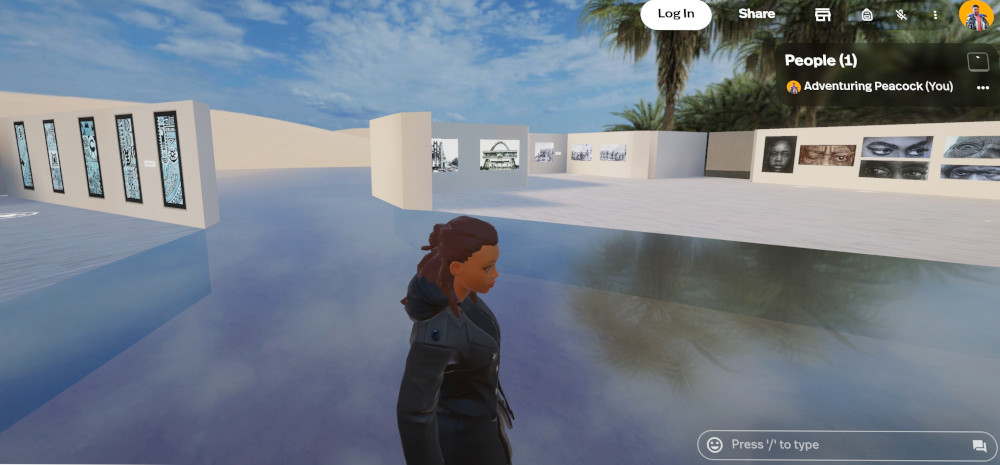
Click on the image to enter the exhibition
A curatorial reflection
When the Forum der Zukunft of the Deutsches Museum in Munich was opened to visitors for the exhibition Sankofa: The Strokes Return Home, the aim was not only to show students' drawings. The bigger picture was an invitation to a dialogue about what art education could look like when we dare to retreat and reclaim what colonialism has displaced.
The response was humbling. Many visitors came; they observed, asked questions and left notes behind. Karin Guggeis of the Museum Fünf Kontinente called the exhibition “very inspiring” and asked for more. Stefan Eisenhofer was impressed by the “smart combination of topics”, materials, techniques and styles. One visitor left a note that still lingers on my desk: Thank you for showing that ‘looking back’ means ‘moving forward’. Similarly, another simply wrote: ‘It made me feel your home, your love, your history. It made me glad.’
These responses confirmed what we at the Department of Art Education at the University of Education, Winneba, suspected: that the works of our students were not just good student work. They were a blatant display of artistic ingenuity, worthy of speaking across borders, cultures, and history. The works bridge the gap between the classroom and the gallery, as well as the past and the present.
The title of the exhibition, Sankofa, is an Akan symbol depicting a bird that reaches backwards to retrieve an egg while its feet face forward. It signifies the Akan proverb: ‘Se wo were fi na wosan kofa a, yenkyiri’ translated as: it is not a taboo to go back and get something you have forgotten. It is paradoxical, yet the wisdom is clear: the future we desire to build requires the wisdom of the past that we are willing to retrieve.
Our students retrieved many things. Among others, Anastasia Eshun retrieved Adinkra symbols from clothes and transformed them into meditative drawings. Francesca Osei Boateng retrieved the playful Oware board and scorched the painful memory of the countless slaves we lost through the slave trade. Clara Jennifer Asare retrieved the calabash from domestic use and carved everyday life activities on its surface. Selassie Nyamekye Nkrumah retrieved hyperrealism from its European associations and used it to blindfold the colonial gaze. He aimed to expose the striking beauty of the African features his subjects had. Victus Apedo retrieved the kente patterns, a rich Ghanaian textile and stitched them into his drawings. For him, the sewing needle was his pencil, and the stitches were his marks.
Despite the variety of techniques, styles, and themes, what was common among them was what I term material sovereignty. This is the freedom to move away from conventional materials and explore local ones. They displayed a conviction that local materials are not just useful as support for their drawings but co-narrators that deepened the meaning of their art. The calabash, maize sacks, plantain leaves, oware boards, stone slabs and sewing thread they used were not raw materials awaiting transformation by European technology. The students found in them agents carrying histories of sustenance, play, governance, and resilience. The students did not just define their own terms of engagement; they entered a relationship with past generations to advance their drawings.
This endeavour has critical implications for art education: drawing should not be taught as a universal skill detached from culture and history. It must be taught as a situated language, with its dynamics depending on who speaks, where, and the tone. The conventional classroom with its “unmarked canvas” inherited from our colonial masters teaches one version of drawing. This exhibition has shown that there are others.
The exhibition has closed in Munich, but the story has not ended. It will be shown in Austria and Ghana in the coming months. It is envisaged that it will demand new arrangements, conversations and new questions with the same guiding principle: Sankofa. The virtual version of the exhibition removes transboundary barriers and makes it accessible to everyone. Again, the exhibition catalogue, beautifully designed by one of the students, Patrick Baffour Assan, documents the exhibition for posterity.
I am grateful to the nineteen students who heeded my curatorial instructions and entrusted me with their works for their journey to Europe. I extend my profound gratitude to the XR HUB Bavaria, especially Silke Schmidt and Johanna Deffner, for enabling the journey from Winneba to Munich with such care and creativity. I am also very thankful to Exploring Visual Cultures and, especially, Ernst Wagner, whose vision of cross-border dialogue made this collaboration possible.
I doff my hat to you, the viewer, for entering this space. The strokes have returned home. Now, they wait for you to meet them.
10th March 2026, Ebenezer Kow Abraham, Curator/Lecturer, Department of Art Education, University of Education, Winneba, Ghana