
THE HERITAGE WE CARRY IN OUR POCKETS
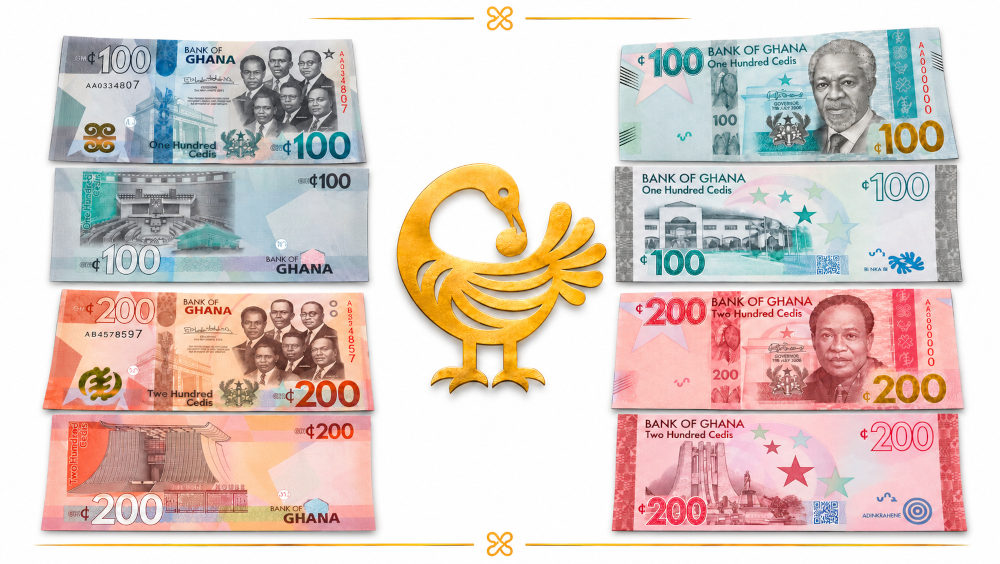
I have been tempted on several occasions to comment on Ghana’s newly unveiled banknotes, but I have held back. Much of the commentary I have encountered follows the familiar divisions of our partisan politics. Those sympathetic to the government readily defend the notes, while those opposed to it readily find reasons to criticise them. Somewhere between the defence and the criticism, the opportunity to discuss the currency thoughtfully as a cultural and educational object seems to be slipping away.
Yet the urge to contribute has refused to leave me, basically for two reasons. First, beyond its monetary functions and economic significance, a banknote is a product of art and design. Its images, typography, colours and composition communicate ideas about the nation and the people it represents. Naturally, being an artist and art educator, I cannot easily look away from these choices. Second, the designation of the new notes as the Heritage Series speaks directly to my growing research interest in Ghanaian and African visual cultures. Once heritage enters the conversation, my interest extends beyond how the notes look to what they invite us to remember, understand and pass on.
The Heritage Series was unveiled on 12 November 2026 and is scheduled to enter circulation on 1 December, alongside the existing notes. In his welcome remarks, Asiama (2026) described the launch theme as “The Cedi, Our Future: Secure, Designed to Last” (p. 2). The series connects its practical concerns about security and durability with representations of national personalities, historic sites, monuments and Adinkra symbols. It is this relationship between currency and heritage that I wish to examine.
Historical background
The political sensitivities surrounding Ghana’s banknotes have roots in the independence struggle. The United Gold Coast Convention (UGCC), established on 4 August, 1947, brought together the leaders who became known as the Big Six following their detention in 1948. They were Kwame Nkrumah, J. B. Danquah, Ako Adjei, Edward Akufo-Addo, Emmanuel Obetsebi-Lamptey and William Ofori Atta. Differences over leadership, strategy and the pace of self-government led Nkrumah to establish the Convention People’s Party (CPP) in June 1949. With substantial popular support, Nkrumah and his CPP led Ghana to independence on 6 March 1957 (National Development Planning Commission, 2017).
These differences, besides helping shape the Nkrumahist and Danquah-Busia-Dombo political traditions, also fuelled a debate over how credit for Ghana’s independence should be shared, a debate that continues to this day. In the fourth republican Ghana, the Danquah-Busia-Dombo is ideologically associated with the New Patriotic Party (NPP). In fact, NPP is in so many ways a direct offspring of the Danquah-Busia-Dombo. The National Democratic Congress (NDC), on the other hand, is a political party that emerged from the political developments associated with Jerry Rawlings’s interventions in 1979 and 1981. Over time, however, the NDC has aligned with some Nkrumahist political ideas. This may reflect the presence of former CPP members within its ranks, particularly as the CPP, although still part of Ghana’s political landscape, has become less prominent. It may also reflect the NDC’s rivalry with the NPP. Whatever the explanation, the NDC should not be understood simply as a continuation of the CPP (Carbone, 2003).
Currency has periodically become part of this contest over national memory. Nkrumah’s portrait appeared on the Cedi introduced in 1965 but was removed from the new Cedi issued in 1967, following his overthrow (Bank of Ghana, n.d.). Years later, the Big Six imagery accompanied the 2007 redenomination under President Kufuor’s NPP administration, while a GH₵2 note featuring Nkrumah alone was introduced in 2010 under President Mills’s NDC administration (Fuller, 2015). Changes between Founder’s Day, which honours Nkrumah’s central role in Ghana’s independence, and Founders’ Day, which recognises the broader contributions of nationalist leaders, including the Big Six, have similarly reflected competing approaches to national recognition (Ghana News Agency, 2025).
This history helps explain why banknote imagery so readily attracts political interpretation and why the removal of the Big Six from the current series suggests political undertones. Officially, however, the Bank of Ghana’s stated reasons for introducing the series include improved security, durability, convenience and the celebration of Ghanaian heritage (Asiama, 2026). For me, this history reinforces the need to approach our currency as a shared national possession, with imagery that encourages understanding and belonging across our political differences.
Currency as a carrier of cultural knowledge
A useful starting point is to clarify what we mean by heritage. The banknote itself is a tangible object. Something we can see, touch, collect and preserve. The knowledge, philosophies, oral traditions and cultural practices expressed through its imagery may belong to the intangible dimensions of heritage. UNESCO’s (2003) convention recognises the relationship between living cultural knowledge and its associated objects, and identifies education and transmission as important aspects of safeguarding. I therefore understand the banknote as a material carrier of cultural meanings. We may preserve the printed object and still lose the knowledge its images were intended to communicate.
Although my first interest concerns design, I do not intend here to assess the notes’ artistic execution in detail or enter the ongoing disputes about the accuracy of particular portraits. My concern is with the understanding of heritage that informs the choice of images and the relationships established between them.
I would therefore begin with two questions. Must a national currency always carry portraits of identifiable individuals? And is placing someone’s portrait on a banknote the only, or even the most effective, way to honour that person and sustain their memory?
To the first question, the art educator in me offers a straightforward answer. A currency can certainly be designed without portraits of named individuals. Norway’s current banknotes, its eighth series, use maritime imagery to express the sea’s significance to Norwegian life (Norges Bank, n.d.). Switzerland’s current banknotes, its ninth series, similarly moved away from individual personalities, using hands, landscapes, activities and other motifs to express different facets of the country (Swiss National Bank, n.d.). These examples demonstrate that the environments, knowledge and activities through which a people live can provide a compelling account of national identity. Given the political meanings that become attached to many of our historical personalities, I believe Ghana could have explored this possibility more fully. My question concerns the scope of national representation. Could our currency tell a broader story of who we are while giving us fewer reasons to retreat into our political corners?
Indeed, the name of our currency already offers an instructive starting point. The Bank of Ghana (n.d.) explains that “Cedi” derives from “sedie” (in Akan language), meaning cowrie, a shell historically used as money. The name carries a memory of earlier systems of exchange and the relationships through which people established and negotiated value. Before we even decide whose face should appear on a note, the currency’s name has already connected us to a material expression of our history. From where I stand as an artist, art educator and researcher in visual culture, the Heritage Series offered an opportunity to give indigenous knowledge a more prominent place in national representation. I see our traditional symbols and icons as visual expressions of ideas about authority, responsibility, interdependence, spirituality and communal life. Their value extends beyond their capacity to beautify a surface, as understanding them requires attention to the knowledge and experiences through which their meanings have developed.
This raises another concern I have about combining portraits with Adinkra symbols. A carefully considered relationship between a personality and a symbol could strengthen the meaning of both. However, when several elements compete for attention without a clear visual and conceptual hierarchy, they risk creating visual noise. The viewer encounters an abundance of imagery but may struggle to understand how the elements relate to one another or what they collectively communicate.My worry is that the symbol becomes background ornament while the portrait commands almost the entire public conversation. Meanwhile, arguments about the portrait’s likeness or political significance can overshadow the contribution of the person represented. Both may receive considerable attention without receiving much understanding. Including a symbol on a banknote is one thing; enabling people to learn from it is another.
Adinkra deserves recognition, but Ghana’s visual heritage extends beyond any single symbolic tradition. We could also give prominence to symbols, emblems and visual expressions associated with Ga, Ewe and other Ghanaian communities. Such a project would require careful research and consultation with those who hold and interpret the knowledge involved. We should neither assume that every community organises its visual expressions in the same way nor treat every culturally significant symbol as freely available for public reproduction. This emphasis on community involvement is consistent with UNESCO’s (2003) approach to safeguarding living heritage.
The opportunity would be to develop a coherent account of Ghana’s cultural diversity across the denominations. Each note could introduce a body of knowledge, supported by accessible explanations in public education materials, classrooms, exhibitions and digital resources. The conversation could then extend to what a symbol means, where it comes from, who uses it and what it teaches about collective life.
Imagine how beautiful and educative it would have been to hear custodians of our cultural heritage, at the launch, offer insightful interpretations of carefully chosen symbols and explain the philosophies and values embedded in them. Thereafter, each encounter with the currency could remind people of the richness of our indigenous knowledge systems and the responsibilities those symbols call upon us to uphold. To me, this would offer greater educational value than reproducing familiar portraits of personalities, some of whom already occupy prominent places in our history books, quite apart from the political associations their images may evoke. For me, this would give the series’ heritage emphasis greater educational and epistemic substance. It would encourage us to recognise the communities behind these visual traditions as producers and custodians of knowledge, whose contributions deserve understanding and acknowledgement.
Honouring the people behind the portraits
On the second question, whether banknotes are necessary for honouring our historical figures, my answer is an emphatic no. I do not dispute that portraits on currency can confer recognition and keep a face publicly visible. But visibility does not necessarily produce understanding, just as familiarity does not necessarily produce reverence. We may handle a portrait every day and know very little about the life, work or values of the person whose image passes through our hands.
The arguments I have encountered about the earlier Big Six imagery and the present series encourage me to reflect on the limits of this form of commemoration. Once the conversation becomes partisan, the people being honoured can become instruments in disputes that reduce their lives and contributions to political allegiance. The recognition intended to preserve their memory may expose them to dismissive judgements that have little to do with a serious examination of their place in history. Banknotes also change as institutions respond to security needs, durability and changing conditions of use (Asiama, 2026). Should the disappearance of a portrait from circulation make the person’s place in national memory less secure? And if future generations conduct more of their transactions digitally, how much should our remembrance of national figures depend on the banknotes they may handle less frequently?
The art educator in me sees these questions as an invitation to invest more seriously in art, museums, archives and education. Such investments can create sustained opportunities to encounter a person’s work, examine their contribution and understand the circumstances in which they lived. Madame Tussauds in London offers a familiar example of how sculptural representation can give audiences a sense of encountering well-known personalities. Its history grew from Marie Tussaud’s wax modelling and exhibitions into an enduring visitor attraction (Madame Tussauds London, n.d.). Although entertainment is central to its appeal, I see in this artistic practice possibilities for connecting public curiosity with learning.
Other institutions make the educational purpose more explicit. South Africa’s Nelson Mandela Museum is mandated to preserve and communicate Mandela’s life, legacy and values (Department of Sport, Arts and Culture, n.d.). Gandhi Smriti in New Delhi preserves the setting and memories of Gandhi’s final months (Gandhi Smriti and Darshan Samiti, n.d.), while the Smithsonian’s National Portrait Gallery uses representations of individuals to explore American history and culture (Smithsonian Institution, n.d.). In these settings, the image introduces a larger story that visitors have the opportunity to explore.
We have an example at home in the Kwame Nkrumah Memorial Park, where commemoration is supported by a museum containing artefacts associated with Ghana’s independence (Andrew, 2025). Visitors can encounter aspects of history that a portrait on a banknote has very little space to explain.I would like us to extend this thinking. Imagine a carefully researched national portrait collection, supported by regional exhibitions, biographies, documentary films, oral histories and resources for schools. Imagine students learning about our educators, artists, scientists, market leaders, statesmen and community builders through their work, their words and the experiences that shaped their contributions.
Such a programme would provide meaningful opportunities for institutions such as the Kwame Nkrumah University of Science and Technology and the University of Education, Winneba, working with artists, designers, historians, researchers, educators and the communities concerned. It could bring research, artistic practice and public education into a shared national undertaking. Of course, a museum or monument does not guarantee remembrance simply by existing. It requires care, credible interpretation, public access and continuing educational activity. An impressive building with little engagement can become as silent as an unexplained symbol. For me, cultural preservation acquires meaning when people can engage with what is preserved and carry that understanding into their own lives.
A currency we can all call our own
My concern, ultimately, is with the responsibility that accompanies national representation. Our currency passes through the hands of people with different political loyalties, cultural backgrounds and religious convictions. It occupies a shared space in our daily lives, and the decisions about its imagery should reflect that breadth of belonging. We must remain free to question its design and the choices behind it. Thoughtful criticism is part of responsible citizenship. We should also be prepared to appreciate a sound decision without first asking which political party stands to benefit from our approval. Our loyalties should leave room for judgement.
In my opinion, the last thing we should willingly surrender to partisan ownership is our currency. We owe it to ourselves to make the cedi something every Ghanaian can confidently call “our own”. If we allow it to become, in the public imagination, the currency of “Party A” or “Party B”, we risk weakening a sense of common belonging that must outlive every government. Future generations may ask what we chose to place in their hands, what knowledge those choices carried and how carefully we protected the heritage entrusted to us. We should be able to offer them a more enduring and convincing account of our stewardship than a record of the political arguments we won.
References
- Andrew. (2025, April 16). Kwame Nkrumah Memorial Park. Visit Ghana. https://visitghana.com/kwame-nkrumah-memorial-park/
- Asiama, J. P. (2026, November 12). Welcome remarks at the launch of the Ghana Cedi Heritage Series [Speech]. Bank of Ghana. https://www.bog.gov.gh/wp-content/uploads/2026/11/Welcome-Remarks-by-Governor-Dr-Johnson-Pandit-Asiama-at-the-Launch-of-the-Ghana-Cedi-Heritage-Series-121126.pdf
- Bank of Ghana. (n.d.). Evolution of currency in Ghana. https://www.bog.gov.gh/bank-notes-coins/evolution-of-currency-in-ghana/
- Carbone, G. M. (2003). Developing multi-party politics: Stability and change in Ghana and Mozambique (Crisis States Programme Working Paper No. 36). Development Research Centre, London School of Economics and Political Science. https://www.files.ethz.ch/isn/57744/wp36.pdf
- Department of Sport, Arts and Culture. (n.d.). Nelson Mandela Museum. https://www.dsac.gov.za/nelson-mandela-museum
- Fuller, H. (2015). Father of the nation: Ghanaian nationalism, internationalism and the political iconography of Kwame Nkrumah, 1957–2010. African Studies Quarterly, 16(1), 33–70. https://asq.africa.ufl.edu/wp-content/uploads/sites/168/v16i1a2.Fuller.pdf
- Gandhi Smriti and Darshan Samiti. (n.d.). Gandhi Smriti. https://www.gandhismriti.gov.in/about-us/gandhi-smriti
- Ghana News Agency. (2025, September 21). Ghanaians mark Kwame Nkrumah’s birthday as Founder’s Day returns. https://gna.org.gh/2025/09/ghanaians-mark-kwame-nkrumahs-birthday-as-founders-day-returns/
- Madame Tussauds London. (n.d.). Our history. https://www.madametussauds.com/london/information/our-history/
- National Development Planning Commission. (2017). Long-term national development plan of Ghana 2018–2057 [Draft]. https://www.ndpc.gov.gh/media/Long-term_National_Development_Plan_2018-2057_tdqQ7xU.pdf
- Norges Bank. (n.d.). About the notes. https://www.norges-bank.no/en/topics/notes-and-coins/legal-tender-notes-coins/About-the-notes/
- Smithsonian Institution. (n.d.). National Portrait Gallery. https://www.si.edu/museums/portrait-gallery
- Swiss National Bank. (n.d.). The current banknote series. https://www.snb.ch/en/the-snb/mandates-goals/cash/series-9
- UNESCO. (2003). Convention for the safeguarding of the intangible cultural heritage. https://www.unesco.org/en/legal-affairs/convention-safeguarding-intangible-cultural-heritage