
A report by artist Pina Scantamburlo on the New Futures Art Collaborative 2026 program
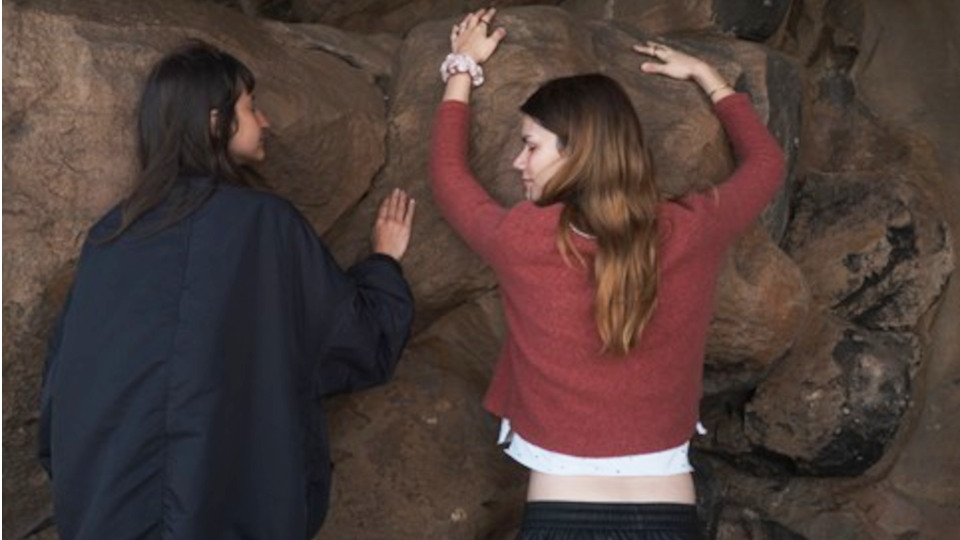
Juji and me, when we went to Elands Bay Cave and got to feel the rocks that lasted for thousands of years before our existence. Photo by Barbara Gabrielle
It was maybe two or three days before the opening for the De()composing exhibition that I’ve come to terms that the program was going to end, that we would all head back to our countries, to our routines, to our families and friends, to our lives as we know them. I had a view of the artists and crew working at the studio to assemble the exhibition: they were all rushing back and forth, running with materials and supplies, putting things together, hanging their artworks, no one was still but there I was, admiring this scene from afar (because I had already put my artworks all together), thinking of how much we’ve all had lived in that same environment — not just Hout Bay or Cape Town, but that particular studio — and how much that space was transformed, from the first day of the classes, until my last sight of the exhibition days. It was in that moment that I realized it was all going to end, and that the images and memories we’ve constructed throughout August 2026 would eventually fade away, the voices and laughs of the residents would slowly disappear, their faces would dissolve and merge with other people in my life, that this transformative experience would decompose into my being.
When I say this, I’m not trying to express any negative feeling to this realization. We all have to deal with the fact that things end, specially in this situation of an art residency where we knew the date we would fly back home. In fact, I say this as a reaction and reflection to the program itself: we’ve learned to decompose, what it is and how to do it. To decompose is not to let go, it is not a farewell. It was never attached to us in the first place, it didn’t belong to anyone. When we decompose we acknowledge the return, and we know it might return to us someday. Decomposing may come from us, as an act we were invited to do it intensively throughout the residency, but it is also a state of its own being, a force coming from outside of us, that has its own process and flow. We cannot control what is slowly transforming and becoming a new life form. The way we relate to our surroundings, to the people we’ve met and the places we’ve been, may dictate how we deal with their absence (another theme explored in the last year’s program) and, for me, learning how to decompose made this process easier, either through accepting the possibilities of new encounters, either through embracing the rebirths of new lives.
This understanding, of course, couldn’t be done alone, nor without the support of the New Futures team. The program structure and methodology, conceived by Isadora and Juji from WEBS Collective, with classes mentored by professors David Anderson Hooker, Avi Sooful and Ernst Wagner, and a group travel guided by professor Tauriq Jenkins, have set up the perfect environment for our full flourishing[1]. There were many moments during classes and the exchanging of personal experiences with the artists and the community of Hangberg, in Hout Bay, where we stayed, that were transformative, usually ending with all of us crying and hugging each other, culminating in the result of the exhibition.
These moments, however, didn’t go as easy and smooth at first, I confess. I struggled a lot during the first weeks while presenting myself and getting to know everybody. As a transgender woman, meeting people outside of my queer community (specifically, the queer community in Brazil, where I’m based) can be quite challenging, because I never know how the treatment is going to be like, and the perception of others over me can become overwhelming. Well, that happened, and I did need to put myself in a vulnerable position where I wouldn’t let others refer or treat me wrongly. That wasn’t easy but, thankfully, I wasn’t alone, and we all, as a group, were able to learn (and decompose) something from it. I won’t ever try to diminish the impact of this experience in me and my body. It was traumatic and exhaustive. But once you see the behavior and the treatment around you changing (and, hopefully, towards other trans people), the slightest feeling of causing some “impact” is rewarding in itself. I recognize its burden on me but I also choose to embrace it, because, otherwise, what could’ve been done about it?
I prefer starting my report sharing this moment of discomfort because what happened afterwards was much more beautiful, intimate and meaningful. When remembering the activities, lessons and exchanges we had during the residency, I think about two moments that have had the greatest impact on me. The first one was during an exercise proposed by professor Ernst Wagner, in which we would reflect on our artistic practices, remembering objects, encounters, passages or artworks that have caused a paradigm shift. This activity, as simple as it looks, was the most profound and intimate moment I had with the other artists during classes. Sure, we’ve got to know each other a lot better during our times living together, but it is always a very special moment to hear one artist talk about what inspires them, and not just about their work (which can happen a lot).
The dynamic of the exercise also contributed for our excitement and participation: in a triangular interaction, one artist had to interview a second one about their object/artwork they’ve chosen; after the interview’s done, the interview had to explain about the artist’s choice to a third person, who would then register their interpretation of the story on a blank canvas. In the end, the artist that was interviewed would complete the interpretation of the third person with their own intervention, and we would all have to explain to the class what were our choices and how we decided to complete the work.
Opening up about works, passages, artists that have inspired and intrigued me, seeing the possible interpretations of them and listening/seeing others’ choices was really inspiring. I first got into this art residency program with my textile and fashion research background and a few artworks that I didn’t feel that they represented me the best (I was still figuring out what I wanted to do!), so not only I was able to understand my colleagues better through this exercise, I also felt validated with my experiences and what I would eventually do for the final exhibition. If you’re curious about what was my paradigm shift, I’ve chosen the Truisms series by Jenny Holzer.
This happened just a few days before the second event, which was a more spiritual and “abstract" one, at least for me to elucidate. If Ernst’s exercise helped me “decompose" my art practice, this second moment completely shattered my preconceived perceptions of the time and space we collectively share and inhabit.
At the end of the second week, finishing our school routine and getting ready for the production weeks, we embarked on a group travel through the Western Cape that lasted four days, guided by professor Tauriq Jenkins. Going up north and then returning to Cape Town, we visited the cultural center !Kwha ttu, the West Coast Fossil Park, the Vasco da Gama monument on Shelley Point, the University of Cape Town, the Kirstenbosch National Botanical Garden and, my personal favorite, the Elands Bay Cave. All the sites we visited were unique and important for their history and symbolism, some which we deconstructed and reflected their meaning, and others we absorbed the weight of the landscapes and the memories that they hold (to reflect on Avi’s class). That was the case with the Elands Bay Cave and the encounter with the marks that our ancestors left us thousands of years ago.
It’s hard to describe, to even grasp a little of the absurdity of that moment. It was my first time seeing a cave painting. Actually, I don’t remember of other moments going into caves (not like this one, no), so it was an overall first time for me. We saw a testimony from three or four thousands years ago, a register that endured through time. We saw drawings, patterns, signs that we recognize today, the oldest lullaby to ever be told. The same way the paintings haven’t fade away from the rocks, I absorbed the memory of that moment into my being. I stretched time and saw it leaving me behind and starting over again.
Then, after witnessing what I attempted to describe, I went to talk to my dear friend Juji to share this ignite in my body with her, because I knew she was feeling it too. We just sensed a collective calling into our hands to embrace the rocks of the cave (the ones that were allowed to) and that’s what we did, illustrated by the photo on the top of the text.
The two moments I described were crucial to my knowledge, my experiences and my understanding of decomposing as a practice. Elands Bay was a midpoint between the beginning and ending of the residency, and it is now extremely symbolic to see how that site has completely shaken up my body, mind and soul. It’s interesting to reflect that, although my final artworks don’t relate or refer aesthetically to these encounters, it was impossible for me to do it differently after the travel and the classes.
And in the end, after two weeks focusing on our own works and reclaiming our individuality, we arrive at the day of the exhibition, the day after I realized it had already ended, that the images were fading in the back of my head but the change was never going to be dissolved. After almost one month together, collecting all of our learnings and breathing our spirits, to decompose didn’t seem like a difficult task to accomplish anymore. I’ve began this text with an homage to the end, to saying goodbye, and going back to that passage now, in my head, remembering our last days together, I feel complete. I know this wasn’t the end and that new routes are being opened, I know that the learnings are not fix and the discomforts are not here to stay. I know that everything will decompose and, someday, return to my hands into something new.
And as I was writing this, I’ve noticed my own process of decomposing, that we all do in a daily basis. Thoughts, ideas, feelings, images, places, people, tastes, visions, sounds, textures, smells, objects, encounters, passions, obsessions and deceptions, bitterness, materials, clothes, beginnings and endings. Even my writing process decomposed itself (as I was writing bit by bit every day). We are constantly saying goodbye to things and reencountering then again, I guess that’s part of decomposing.
To finish this report, I would like to express my immense gratitude to the New Futures Art Collaborative team: Isadora Canela, Juji, Victoria Mazzia, Allan-Charles Chipman, Rohit Valecha and David Anderson Hooker; to the EVC team: Avi Sooful and Ernst Wagner; to Brendon and Suzette Bell-Roberts and Alice Sartori from Art Africa Magazine; to professor Tauriq Jenkins; to Kenneth Shandu; to Rashid and Jessie; and, of course, to all the amazing artists and friends I’ve met during this period: Barbara Gabrielle, Eshal Khan, Gisela Perez, Isaac Mukonde, Katleho Habi, Keabetswe Seema, Keonah Nyembe, Mahmoud Elenani, Marcus Deusdedit, Marie Hahne, Mudashir Chandio, Mukutsawa Montahuano, Rudy Petgang, Rebeca Binda and Tetteh Narh Martin.
--------------------
[1] Concept presented by Dr. David Anderson Hooker. It is a state where us, the artists, could see beyond our own worldviews and myths, achieving a narrative transformation.